

Brian Schiff’s Blog
Injury Prevention, Sports Rehab & Performance Training Expert
 4
4
Well, it is just days before I embark on my 3rd half marathon. Just one short run to go. And no, I am not suffering from shin splints (lol). But as I approach the Columbus Half Marathon on 10/18, I am reminded about all the patients and clients I see who are in some way affected by shin splints.
Shin splints, more commonly referred to as medial tibial stress syndrome (MTSS) in medical circles, plague many runners, walkers and athletes. So, what is a shin splint? People often report pain and tenderness along the outer or innermost portion of the lower leg. Anterior shin splints affect the anterior tibialis muscle and are seen more commonly (my experience) in people who walk rapidly for the first time or do several hills without training for them. I saw a camper of mine who runs regularly develop shin splints doing a 5K walk and trying to walk fast and keep up with another camper. She never has had shin splints in years of running.
Posterior shin splints are probably more widely seen among most runners. They tend to be more common in females as well. The source of pain was commonly linked to the posterior tibialis muscle, but is now thought to be along the origin of the medial soleus muscle and its deep fascial insertion. Hmmm….. the soleus – now if you have read my earlier posts, that is a muscle I personally know a thing or two about when it comes to injury.
What are some causes of shin splints?
- Tight hamstrings (affects closed chain biomechanics)
- High or low arches (twice the injury incidence as those with normal arch height)
- Faulty training surfaces (uneven sidewalks and asphalt can be brutal)
- Improper training technique or progression (this is a biggie for sure)
- Muscular imbalances (weak hips anyone?)
- Excessive foot pronation (flattens out or rolls in too much during gait)
- Worn out or improperly fitted/cushioned footwear
What else may cause such pain? It may be a good idea to see a medical professional for diagnostic testing to rule out a stress fracture (often severe pin point pain along the medial tibia), exercise-induced compartment syndrome, and a possible popliteal artery entrapment (Tolbert and Binkley – NSCA Journal 2009).
Outdoor boot camps and running are gaining in popularity these days. Both activities are great for weight loss but also carry a higher risk of shin splints for participants, especially overweight women. Proper warm-up, selective footwear and stretching are great strategies to reduce or prevent injury.
If you have been affected already and are seeking help, I suggest the following:
- Relative or absolute rest from the offending activity
- Ice the affected area daily (2-3x/day)
- Standing hamstring stretch (flat back) with and without foot rotation in and out – hold for 20-30 seconds in each position (repeat twice)
- Calf stretching on a step – knee straight – hold for 20-30 seconds (repeat twice)
- Soleus stretching ona step (knee slightly bent) – hold for 20-30 seconds (repeat twice)
- Single leg calf raises to strengthen the posterior tibialis muscle (once able to do pain free) Perform 2-3 sets of 10-15 reps
- Single leg balance on a slightly bent knee – perform 2 sets of 30 seconds without touching the other leg down (advance to eyes closed for more difficulty)
In the end, combine prevention with sound footwear and a proper training progression and you will have no trouble at all with shin splints. At the first sign of pain, step back and evaluate if you need to adjust your training as trying to go through it will not make things better. Happy training all!
Well, I have become somewhat of a runner in the past 2 years. I have run two half marathons and have been training for a third. That is until my right lower leg has gotten in the way. In May, I ran 1:40:08 at The Flying Pig Half in Cinci (tons of hills). Not bad for a 184 pound former football player, right? My goal was to crush that time in Columbus on 10/18.
About 5 weeks ago I felt intense pain near the medial head of my right calf during the end of a 4.5 mile run. I iced immediately afterward, but I knew something was wrong. I had to take about 10 days off from running. I had recently made it back to 4-5 days per week running and thought all was fine. I even completed an 8 mile run in 60 minutes without incident two weeks ago.
But alas, the pain returned last week on a 10 mile run. Only 2 miles into it I felt horrific sharp pain just below the calf. I had to hobble back to my car. This is a frustrating and defeating experience to be sure. While I suspected a small medial head gastroc (calf) tear, I wanted to get my friend and orthopedic surgeon’s medical opinion. So, I went and saw the man I send all my hurt athletes to yesterday. I wanted him to confirm that my achilles tendon was indeed OK. That he did. Whew!! What a relief. X-Rays revealed no stress fractures either.
We talked and decided I would wear a heel lift to off load the calf for a short while and try to run in the half on 10/18. As I continued to marvel at my scenario today, I began testing my leg and thinking, “Why can I do a single leg calf raise and single leg hop without pain if my calf is injured?”
Then the light bulb went on. It dawned on me the pain was deeper and perhaps just below the calf. The thing that hurts the most is descending stairs. Of course! The injury (or strain if you will) is of the soleus, a smaller muscle deep to the calf and responsible for assisting the calf with push-off and preventing excessive dorsiflexion (foot moving toward to head) of the foot with gait.
You see the pain is almost non-existent when my knee is straight. But, once the knee bends and I transfer weight forward over the foot I feel significant pain/weakness. Yes, the soleus is not quite right. The calf is less responsible for controlling the body weight as the knee bends which makes sense to me based on the symptoms. I can honestly say I am not sure I have treated anyone with a soleus strain.
See the soleus in red below:

So, what is the course of rehab? Cross training on the elliptical this week and then gradual integration of running again. The real challenge for the soleus occurs at heel strike to foot flat as it works to slow the dorsiflexion down and take all the weight of the body during single leg support. Ouch!!
The good news is my tendon is fine. The bad news is that the half marathon involves so many steps it may become an endurance based issue. I will be adding knee bent stretching, single leg calf raises (straight and bent knee), anterior reaches, step downs and lunges into the program as pain allows this week.
So, for all the runners out there keep in mind pain around the calf may actually be related to a soleus strain. Identifying whther the pain occurs mostly with a straight or bent knee will be key in finding the tissue at fault. The two may be linked as I had a bad medial calf tear many years ago.
The take home message is listen to the body and develop the right strategies to maximize recovery and rehab. Hopefully, I will still hit that goal on 10/18. Then, perhaps I will take a short hiatus from distance running until 2010 to allow it to heal 100%.
Have questions and want answers to your sports training issues or injuries? Let me know and I will attempt to answer them as part of my blog posts.
If you have been following my blog, you are aware one of my marathoners has been battling increased medial knee pain. I initially suspected and diagnosed it as patello-femoral irritation. I have known she has some chondromalacia (softening or weakening of the cartilage behind the kneecap) ever since I began training her 2 years ago.
I spoke with the MD Thursday and he confirmed by MRI she has no meniscus tear and just patello-femoral arthritis and inflammation. I was relieved to know I had hit the mark (remember the chiro said meniscus tear). The MD I referred my client to wants me to do a specific PF strengthening program with her. The good news – no surgery needed that will derail training for the Columbus Marathon. The bad news – she may have to contend with some discomfort related to the pounding for now.
It is always hard to tell a runner to rest. That is one four letter word that really ticks them off! So, the answer for my client is relative rest (avoiding excess mileage, not running down too many hills, and increasing recovery windows when possible) as well as implementing a more specific PF rehab program.
We have been doing lots of quad (VMO specifically) work and gluteus medius strengthening already. So, what I will be adding or changing? Well, we will be integrating more repetitively the following:
- Weighted straight leg raises in flexion and adduction
- Modified box step-downs in the terminal range of knee extension to emphasize VMO contraction in a closed chain manner
- Modified lunge and squat progressions working around the pain
I will be continuing with single leg strengthening for glutes, hamstrings and quads, while challenging hip stability in the frontal plane as she may be experiencing unwanted force transmission here with impact. Additionally, I will continue with IT band rolling/stretching and hamstring flexibility.
This client is tough and will run through the pain if need be. My job is to reduce and eliminate the pain without taking her running away. That is never easy but it can be done with careful progression of exercise and cooperation from the client. The key point for strength and conditioning specialists is to modify programming based on the client, while the key point for all runners out there is to be open and honest about pain, as well as willing to comply with modifications in the short term training plan to achieve the same long term goal – finishing the race.
Below is a picture of a modified squat progression (an isometric single leg stability ball wall squat/sit). I use this exercise with athletes and runners with patello-femoral pain issues when they can’t squat due to pain. If you want to see exactly how to do this exercise, subscribe to PFP Magazine and read my online column, Functionally Fit, here. My newest column will be out next week and address double and single leg isometric squats for patello-femoral pain.
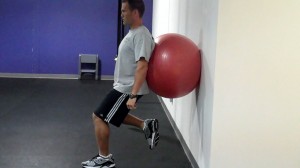
Shallow Single Leg Wall Sit
So, my client saw the orthopodic doctor I sent her to on Wednesday. He called me and said he felt it was primarily patello-femoral arthritis and some irritation of the medial retinaculum (fold of tissue along the inside portion fo the kneecap). When I pressed him about the mensicus (remember the chiro suspected this injury), he felt my client at 35 was young to have an attritional meniscus tear, but he did decide to get an MRI to be 100% sure she did not have a tear of the medial meniscus.
For now, the plan is to let her run and train with me while we await the results fo the MRI and progress training based upon her pain/symptoms. So, what are good exercises for PF pain in runners? Obviously, I focus a great deal on strengthening the hip musculature, particularly the gluteus medius, as well as the quads and hamstrings. Essentially, reducing the amount of pronation, valgus load at the knee, and IT Band tigthness is important for female runners.
Below is a list of a few key exercises I include in this particular marathoner’s routine with me:
- Single leg stiff-legged dead lifts
- Single leg squats with opposite leg hip/knee drive
- Lateral ankle band walks
- Single leg lateral reaches
- IT Band foam rolling
Note: It may be necessary to modify the range of motion on single leg squats based on pain or specific hot spots on the kneecap. In this case, I typically work above or below the pain zone. I included pictures of the lateral band walks and lateral reach below (these really target the gluteus medius).
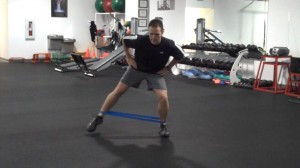
Lateral Band Walk
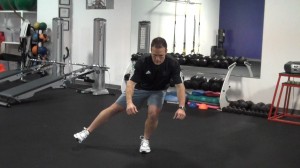
Single Leg Lateral Reach
 Back to top