

Brian Schiff’s Blog
Injury Prevention, Sports Rehab & Performance Training Expert
 0
0
I readily admit I have had an aversion to abdominal exercises that involve straight leg lowering since my days in pee wee football where we were forced to do lifts and holds a few inches above the ground. Some will relate to a modern day version of this exercise known as “six inches.”
As someone with tight hip flexors and who has personally suffered from sciatica in the past, I am NOT a fan of abdominal training that exposes the lumbar spine to large loads and undue risk related to exercises that involve long levers (e.g. throw downs, scissors, etc) and place high shear force on the spine.
I was reminded of why I feel this way in a fitness class this past week. I take a cycle/core class at my local gym and have done a traditional spinning class twice per week for 3 years. After 45 minutes of cycle, we move to a fitness room for core. I have done this new format for three weeks. This week we were asked to do a series of exercises which included “banana rolls.” If you are unfamiliar with this move, check out You Tube for some video demos.
While this exercise may be effective for core strengthening, I can honestly say as one who has never done the move before that trying to execute it as part of a continuous sequence of movements without rest between the moves was very hard to do with proper form. The fatigued state encouraged using momentum and straining to simply get the movement done (not to mention the fact my greater trochanter was sore from the rolling on the hard aerobic floor).
The next day I woke up with low back pain. My back has not hurt like that in years. In light of the role the iliopsoas plays by virtue of its attachment on the lumbar spine, we must consider the impact of reverse muscle action and how it creates shear on the lumbar spine during movements that rely on stabilization with the legs extended against gravity. Additionally, for those clients like me with muscle tightness, increased lumbar lordosis and a history of low back disorders, health and fitness professionals must consistently evaluate safety and efficacy as well as trying to challenge clientele in a workout session.
For all of these reasons, I increasingly rely on neutral spine anti-extension and anti-rotation training exercises in my programming for athletes and clients of all ages and abilities. That is not to say I never do rotational or active movements. They are appropriate given the right order, progression and demands of the respective individual. I just think we must consider form and risk versus reward in exercise programming.
The exercise video below illustrates how to use sliders in a tall plank position to accomplish great core activation and hip/shoulder stability without stressing the lumbar spine with long lever movements. Keep in mind that quality should override quantity in terms of deciding repetition schemes. Do not let the desire to fatigue clients cause form to suffer as this may increase injury risk.
For more specifics on the execution and progression/regression of this particular exercise, click the link below to read my most recent exercise column for PFP Magazine.
Suffice it to say I will not be doing banana rolls again. While I am not completely discarding the exercise, I do think it should be done in a non-fatigued state and taught incrementally if done at all. Most importantly, we as fitness professionals must always remember to program exercises based on fatigue and skill level, while carefully weighing risk versus reward in group or individual sessions.
I work with several overhead athletes ranging from swimmers and tennis players to professional baseball pitchers. One consistent issue I see is tightness in the anterior chest wall coupled with poor scapular activation and stability. For that reason, I often turn to snow angel exercises. I wanted to share two variations I have written on before. The first version utilizes a foam roller. The movement is performed throughout a full arc of movement upward and downward.

Top position

Bottom position
Click here for more details on the execution of this exercise
This is an excellent exercise that can be integrated as part of a warm-up/movement prep session as well as used in recovery and the cool-down to address soft tissue tightness in the chest, facilitate proper posture and encourage scapular retraction and depression.
I often use this exercise in combination with pec minor myofascial release and thoracic spine extension mobilization on the roller. It is a staple in all of my rehab and prehab programs with all of my overhead athletes.
The second version involves moving to an upright position and can prove more challenging. The exercise is also designed to promote scapular stability. When done properly, the client will demonstrate proper upward rotation (avoid tipping and winging of the scapula) on the ascent, and then emphasize recruitment of the rhomboids and lower trap to achieve proper downward rotation on the descent.
It can be a very fatiguing activity and somewhat frustrating for clients when starting out. Be sure to cue them accordingly, and let them know it may not be easy to keep full contact. It may also be necessary to utilize soft tissue mobilization for the pecs/lats as well as stretching beforehand to promote a more normal movement pattern.

Top position

Mid position

Bottom position
In this anti-gravity version fatigue becomes more of an issue, so emphasizing quality movement and using less repetitions may be indicated. Do not push through any painful motion.
Click here for more details on the execution of this exercise
I always look for exercises that allow me to actively elongate traditionally short muscles while encouraging proper muscle activation of weak/poorly recruited muscles. This exercise does just that. If you are interested in the impact of pec minor tightness and shoulder impingement, check out the article from JOSPT below:
As a parent, coach and sports physical therapist, this is a topic I am both passionate about and often confronted with. I remember growing up in a small town where I played a different sport every season. No one played year round soccer, baseball or AAU basketball – it was not even an option for those around me.
Now, I live and work in a competitive sports-minded environment where I see 13 y/o baseball pitchers with elbow and shoulder pain, 13 y/o female soccer players with ACL reconstructions, and too many adolescents suffering from overuse injuries like anterior knee pain and tendonitis. I witness coaches teaching 10 and 11 year olds to throw curve balls, hear athletes tell stories about how they are strongly encouraged or pressured to play only one sport if they want to excel and make a team, and parents who are pushing their kids hard at an early age in pursuit of college scholarships.



Is it all worth it? In a short answer – NO. In a recent article in the May/June 2013 issue of Sports Health, Jayanthi et al. performed a comprehensive search of PubMed and OVID from 1990-2011, gathering articles discussing sports specialization, expert athletes, or elite versus novice athletes including original research articles, consensus opinions, and position statements.
Click here to read the abstract
My own personal bias and opinion is that we should encourage youth to participate in multiple sports/activities and not pursue one sport or activity until they reach high school. I believe there is so much to be gained in terms of coordination, neuromuscular training, recovery and building general athleticism that gets lost with early specialization. However, I see many young athletes swept into early development programs and travel/AAU teams that naturally discourages or eliminates time/opportunities for other activities.
With that said, I will readily acknowledge that certain sports/activities (gymnastics and playing an musical instrument for example) do require an early commitment in terms of practice and skill mastery if one is to reach elite status. So, what should we as health and fitness professionals be telling our clients? How intensely do they need to train and at what age is it okay to focus on one sport?
I think we need to know what the evidence we have says and how we can best use knowledge to make meaningful change in society. In addition, we need to evaluate the mental and physical injuries that are occurring with the choice to specialize at a very young age. Consider that participation at age 6 and under has increased from 9 to 12% from 1997 to 2008.
So, for us to make a difference we need to investigate and scrutinize how we coach and train young athletes and become an advocate for their long term health as well as short term success.
Here are the key bullet points from the article I referenced above:
- Coaches are the most influential in beginning intense training and the decision to specialize
- Less than 1% of athletes 6-17 years old achieve elite status in basketball, soccer, baseball, softball or football
- Early diversification is more likely to lead to success based on multiple studies and may lead to more enjoyment, fewer injuries and longer participation
- Early diversification is more likely to lead to success based on multiple studies and may lead to more enjoyment, fewer injuries and longer participation
- Data currently suggests enjoyment of sport and intrinsic motivation predicts attainment
- Exposure is the most important risk factor for injury and there is a significantly increased risk for injury when participating > 16 hours/week
- Cumulative match exposure also carries a significant injury risk
- Prospective 10 year analysis of 481 youth baseball pitchers reveals a 3.5x increased risk for injury when pitching more than 100 innings per year
What about burnout? Consider the following:
- Swimmers who specialized early spent less time on the National team and retired sooner
- Minor league hockey players (boys) who dropped out started earlier and spent more time in off-ice training than those who continued to compete
- One retrospective review revealed that 1 out of 5 elite athletes reported injury as the reason for quitting
- In the end, the authors conclude that some specialization is necessary to attain elite skill, but the exclusion of other activities should be delayed until late adolescence.
To foster diversification, we must do a few things in sports medicine:
- Educate parents, coaches and athletes on the injury risk and facts about the impact of early specialization
- Promote the benefits of diversification in terms of joy, diminished stress to excel, athletic development and physical recovery
- Remind everyone involved not to take sports too seriously as only a very select few will move on to elite status, and instead encourage them to enjoy competing, learn to be a good teammate and reap the other rewards in sports (discipline, sportsmanship, learning to overcome adversity, working hard to achieve a goal, etc) that last well beyond a trophy presentation or game
I was just asked a few days ago by the parent of a 9 year old baseball player if I thought it was good for him to play multiple sports since he is pretty good in baseball. I encouraged this mother to have him do as many sports as he can for the next several years. Why put so much pressure on kids and expose them to increased injury risk? Every family and athlete needs to make their own personal decision, but for those who do opt for early specialization, I want to make sure I can help educate them on cross training, rest and recovery to minimize the risk for burnout and injury.
For those familiar with my blog, you know I like to post research updates and exercises that prevent injury and maximize performance. In my setting, I get to work with a very active population ranging in ages from 10-50 in most cases, including elite and professional athletes. I am pointing this out simply because I have an opportunity to test and measure unique and challenging exercises every day with fit, athletic clients.
As part of my world, I am often faced with restoring shoulder, core and hip stability. As clients progress through rehab and conditioning, I am always seeking advanced training options that are feasible and functional. One training tool I like to employ, especially in upper body, core and hip training is the BOSU Balance Trainer.
Emphasizing co-contraction and scapulothoracic and glenohumeral stability is essential for optimal shoulder function. But more importantly, addressing kinetic chain function in the shoulder, torso and hips is a must if we are to soundly address energy leaks and reduce injury risk. To that end, I like to incorporate unstable closed kinetic chain training when my athletes are ready. The video below demonstrates two upper body step-up progressions (forward and side-to-side) on the BOSU Balance Trainer that I utilize for higher level clientele.
Upper Body Step-ups
Regression – in place stepping (this can be used to prepare clients for the step-ups)
This regression can also be a very effective training tool especially if the client lacks sufficient strength, endurance and form to execute the full step-up patterns. Pain and form should always guide exercise selection and progression.
Below are two links to my Functionally Fit columns describing the execution and application of these exercises:
I am big fan of lat pull downs and pull-ups. I think when done properly, this is a fantastic way to improve postural strength and safeguard the shoulder against injury. In April 2012, I wrote a column on lat pull downs addressing shoulder pain (click here to read that post).
I decided to add to that previous post and discuss a recent article published in the February NSCA Strength and Conditioning Journal. In the article, the authors present some research regarding how altering hand orientation and grip width affects muscle activity during the exercise.
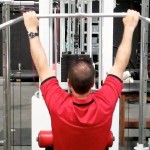
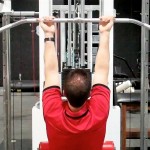
Grip Width Summary
Lehman J Strength Cond Res 2005
- No significant difference between narrow supinated grip and wide pronated grip with biceps and latissimus dorsi
- Highest level of latissimus dorsi activity occurs with seated row with retracted shoulders
Lusk et al. J Strength Cond Res 2010
- No difference in biceps, latissimus or middle trapezius activity (note – wide grip only slightly larger than narrow grip)
Sperandei et al. J Strength Cond Res 2009
- In front of the head pull downs with standardized width and hand orientation revealed higher activation for posterior deltoid and latissimus compared to behind the neck
- This study did NOT compare different grip widths
Hand Orientation Summary
Youdas et al.J Strength Cond Res 2010
- Pronated grip during pull-ups (56 +/- 21% MVIC) was most effective for activating the lower trapezius compared with the supinated grip
- Pronated grip also resulted in greater infraspinatus activation (45 +/- 22% MVIC) compared with the perfect pull-up
- Perfect pull-up showed higher latissimus activity (130 +/- 53% MVIC) than the supinated grip of a chin up
- Supinated grip of the chin-up revealed an increase in pec major (57 +/- 36% MVIC) and biceps brachii (96 +/- 34% MVIC) versus 44 +/- 27% (pec major) and 78 +/- 32% (biceps brachii) for the pronated version
- Posterior deltoid showed no difference in all hand orientations
Lusk et al. J Strength Cond Res 2005
- Pronated grip during lat pull-downs elicited a 9% greater muscle activation of latissimus dorsi compared to supinated grip
- No difference between middle trapezius and biceps brachii in pronated or supinated grip
My Takeaways
- If your goal is maximizing latissimus activity and improving scapular stabilizer and rotator cuff function opt for the pronated grip
- Supinated grip elicits greater activation in the pectoralis major and biceps – no surprise here based on physics and kinesiology -> easier for clients to do and also not going to stress the shoulder as much in the presence of any inflammation or pathology
- Range of motion, scapular dyskinesia, pain, soft tissue restrictions and imbalances play a vital role for each client so they may need some preparatory work to make the most of this exercise
- Small tweaks (in my opinion) can make a big difference in comfort level and performance of the exercise (refer to number 3 for why) so do not be afraid to experiment between wide and narrow in a pronated grip
- The authors mention that if individuals elect to do the behind the neck version they should have adequate range of motion to do it safely. Let me be clear – there is NO reward big enough to justify the risk involved in doing behind the neck pull-downs. Save your neck and shoulders by eliminating this option altogether as I would bet most of us do not have perfect bony anatomy, mobility and optimal muscle firing throughout the motion to ensure that potential repetitive micro trauma will not occur over time.
For my CrossFit friends – optimal shoulder mobility, scapular stability and adequate thoracic spine extension and rotation is a must to minimize risk with kipping and less than perfect pulling form. I much prefer unweighting or assisting the body through pull downs, bands or partner assists to build pre-requesite strength initially until the client is better able to manage the movement under full body weight.
Quality movement ABSOLUTELY matters over hundreds and thousands of reps.
As far as research goes, I think we still need further studies on grip width and specifically how it may directly impact not only muscle activation but force on the glenohumeral joint itself. For me, I opt for pronated pull-ups and or pull-downs once per week with a moderate grip width in my own routine. I hope this information serves you well. Happy lat training!!
 Back to top