

Brian Schiff’s Blog
Injury Prevention, Sports Rehab & Performance Training Expert
 3
3
With the new year, millions of people have made a resolution to lose weight. Along with that, comes the idea they will flatten their midsection. If you are like me, you share a certain disgust for the infomercials marketing the “next” latest and greatest abdominal machine.
For years, people have sought out how to build the perfect six pack. Obviously, nutrition is probably the single biggest factor in achieving a sculpted midsection. But, beyond that people often wonder what exercises to do to target the upper and lower abs as well as the obliques. Is this really possible?
Well, I thought I would share the results of a recent study in the Journal of Strength & Conditioning Research. The authors wanted to look at the use of other training tools versus just a body weight only exercise. In the study, they looked at surface EMG activity for the upper rectus abdominus (URA), lower rectus abdominus (LRA), external obliques (EO), internal obliques (IO), transverse abdominus (TA) and rectus femoris (RF) with the following exercises:
- Abdominal floor crunch
- Supine V-up
- Prone V-up on slide board
- Probe V-up on stability ball
- Probe V-up on TRX
- Prone V-up on power wheel
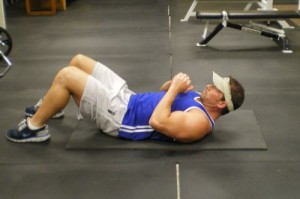
Crunch
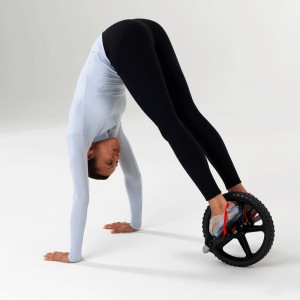
Prone V-up with power wheel
In short the major results are as follows:
- The most muscle activity overall occurred with the power wheel
- There was no significant difference for activation of the EO, URA and LRA
- RF was much less active only during the abdominal crunch
Practical applications include:
- There is no realistic way to isolate portions of the abdominal muscles, but keep in mind one limitation may be that the study looked at MVC (contraction at only one point in the motion)
- The RF is NOT a spinal stabilizer but rather a hip flexor and therefore it can cause an anterior pelvic tilt if overly active which can be viewed as potentially harmful
- Focus on training the core globally as an integrated segment of the kinetic chain to maximize activation and understand how the hips affect completion of the movements
I hope this post stimulates your thinking with respect to abdominal training. If you do use training tools, simply stop for a moment to consider the desired training outcome, as well as the impact the body position and muscle firing patterns have on the exercise itself.
Most adult males are in search of that ever elusive six pack, right? Well, most intelligent trainers and strength coaches are well aware that there is so much more than just crunches to making the core functional.
With that said, I believe abs may be one of the most over trained sets of muscles today. Some people are doing ab work daily. Why? Our abs function daily to stabilize and resist force, as well as activate trunk movements.
In reality, the aesthetics of the midsection have far more to do with nutrition and body fat than the number of crunches one does. My aim today is not to discuss this, but instead to talk about an interesting article in the latest Strength and Conditioning Journal that discusses the effects of over training the rectus abdominis on weightlifting performance.
In this article, Ellyn Robinson discusses the best way to allow athletes to stabilize weight overhead during complex lifts such as snatches, cleans and jerks. She aptly points out that if an athlete cannot stabilize the weight overhead, he/she could miss the lift in front or behind the body.
I was asked to comment on a thought provoking blog post on MyPhyscialTherapySpace.com. There is ongoing discussion with respect to the exact role a therapist should play in the continuum of care for patients. I enjoyed reading the posts on there and I have posted my reply on my blog for you to see (not to mention the fact the blog site would not let me post my entire repsonse in a single comment). To read the original post click the link below:
Now my comments…….
I would say as a cash based practitioner currently living in the sports performance and post-rehab fitness realm (I own a fitness training facility), I would say that many of my therapy colleagues do not truly understand how to push and/or fully rehabilitate people to a high enough level that meets the pre-injury functional capacity.
I often see referrals that have already failed traditional rehab or are getting inadequate therapy. Why? In many cases, PT’s are following basic protocols, not supervising exercise progression closely enough, moving too slowly or in some cases (ACL rehab) moving too fast. I also find clinicians are often hesitant or perhaps unwilling to change treatment progressions within the sessions, reps or sets even if the client’s response to the stimulus indicates such a change.
At this phase of my career, I have been around long enough and successful (or rather blessed) enough to be considered an expert in my field. This affords me the opportunity to see and work to fix complicated client issues as well as teach others how to do the same.
One mistake I see time and time again in rehab and sports training is a lack of sound sequential and functional progression. I blame part of this on the demise of insurance programs as we once knew them as therapy sessions are now limited both in scope of coverage and number of visits. But, the rest of the blame often falls squarely on the shoulders of therapists, doctors, sports performance specialists and coaches. Okay, parents may deserve a spot in my blame circle too.

Why do I say blame? Well, to be honest we often mislead or let down athletes recovering from injury by not listening enough, pushing them too hard, not pushing them hard enough, using outdated or irrelevant protocols, or incorrectly assuming they will heal like the last person with injury X. Sound at all familiar? Ever wonder why some people with the same injury recover differently and/or suffer a re-injury so soon after going back to sport?
Now, read on as this blog post is not a rant. The point I want to be crystal clear on is that we as caretakers and health providers of young athletes must be on our game at all times. This means we must be willing to continually learn and drop our assumptions, standard protocols, experiences and such at the door each time we see a new case. We must apply and adjust our plan based on each individual we see.
Ont thing I am certain of is that no two humans are exactly alike. Therefore, we must consistently assess and re-assess. I believe the real magic if you will that at times occurs for me with my athletes is less a result of my own doing and more a result of my intuition and ability to communicate and extract information at critical times from my clients.
You may think that this happens in every therapy clinic and sports training realm, but trust me when I say that line of thinking is naive. I have personally heard and witnessed too many failed rehab stories and examples of lackluster care/training to validate it. As trainers and rehab specialists, we must be willing to do the following to maximize the success of our clients:
- Listen to the spoken and unspoken words
- Observe everything (movement, emotion, and facial expressions)
- Encourage the athlete or client to communicate freely, frequently and most importantly honestly
- Craft a daily plan based 100% on how the client is doing at that very moment in time – this is tough as you may have to scrap your entire preplanned workout
- Challenge our own beliefs, assumptions and strategies all the time – it becomes easy to get stuck in a rut or fall back on doing the same thing for similar problems. We must guard against complacency in our programming. We must always seek new and better ways to do things.
- Involve the athlete/client in the decision making process – in other words explain the “why” behind things and relate it to their activity, rehab or sport. Most of the time they will work harder and cooperate more when you do this simple thing.
- Provide routine progress updates verbally (I call them affirmations) to the client and their family. We all like to know how we are doing and being vague and having no clear direction or goals is simply unacceptable. Encourage your clients and let them know how they are progressing in straightforward terms.
These are just the seven biggies that come to my mind right now. The takeaway here is that training and rehab is and always should be exacting, yet flexible at the same time. Fluid, seamless tweaking and adjusting are hallmarks of all the greats. Clients should accept nothing less than this precise, analytical and results driven process, nor should we be willing to offer any less.
Following this blueprint will accelerate recovery, maximize performance gains and minimize injuries. Isn’t that what it is all about? Here’s to harnessing our passion and giving the absolute BEST to those we are fortunate enough to serve.
Core training is common terminology thrown around in fitness circles today. However, not much research has specifically addressed more advanced stability ball exercises and muscle activation until now.
A recent article released in the May 2010 Journal of Orthopedic & Sports Physical Therapy looked at 8 stability ball exercises and maximal voluntary isometric contraction (MVIC) versus traditional bent knee curl ups and crunches.
The 8 stability ball exercises studied with EMG were:
- Roll out
- Pike
- Knee up
- Skier
- Prone hip extension left
- Prone hip extension right
- Decline push-up
- Seated march right

Pike (end position)
All exercises were performed with a cadence of 1/1/1. A metronome was used to ensure uniform repetitions and holds. Researchers concluded that the pike and roll-out were the most effective exercises based on EMG activation. However, keep in mind that these also require the greatest effort and pose a high degree of difficulty.
Why is this stuff important? Research done by Cholecki and VanVliet concluded that no single core muscle can be identified as the most important for spinal stability. Additionally, they believe that the relative importance of the muscle varies based on the direction and magnitude of the load imposed on the spine.
We have known for years the spine is least stable and most vulnerable in trunk flexion (as in the knee bent curl up), and that no one muscle contributes more than 30% to overall spine stability. Choosing more demanding core exercises also typically increases spinal compressive forces as well. This may be contraindicated in some populations.
Therefore knowing your client and condition is essential. For example, flexion is often contraindicated with active disk pathology, whereas it may be indicated in those with facet arthropathy or spondylolisthesis. Over the past decade or so, much attention has been placed on the transversus abdominus muscle.
The prevalent thinking has been that it is a major contributor to spinal stability, although this is somewhat controversial and has not been unequivocally validated with science. Another flaw here is that isolated contractions of it have not been demonstrated in higher level activities (e.g. sports).
So, where is the functional tie in here? The transeversus abdominus has shown similar activation patterns (within 15%) to the internal obliques with exercises similar to those in this study. The highest activity from internal obliques was during the pike, roll-out, knee up, skier and hip extension left exercise. This may indicate that transveresus abdominus activation is also high, but further research will need to be done.
The last critical piece of data involves looking at hip flexor activation as the psoas generates remarkable spinal compression and anterior shear forces at L5-S1. This can be especially troubling for individuals struggling with lumbar disk pathology. The exercise in this stud that demonstrated moderate hip flexor activation were:
- Bent knee sit-up
- Pike
- Seated march
- Hip extension exercises
So, if you or your client has a weak rectus abdominus and/or obliques or lumbar instability, these exercises may be contraindicated. In the end, know that the stability ball provides much greater muscle activation compared to traditional bent knee sit-ups and crunches on the floor. The caveat is identifying which ones are appropriate and most efficient in your case.
As a general rule, I suggest that you avoid long lever arm action with the legs in the presence of active disk pathology and instability. You may opt for stability based exercises in a neutral spine position like planks as there is minimal shear and compressive loading here until clients develop more stability and strength. With healthy and mroe advanced clientele, many of the stability ball exercises studied would be good alternatives to traditional crunch work to build muscle strength for the core.
 Back to top