

Brian Schiff’s Blog
Injury Prevention, Sports Rehab & Performance Training Expert
 4
4
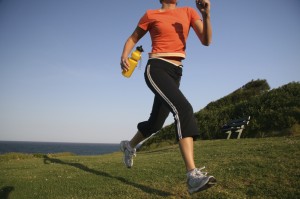
According to research, more than 70% of people in the US will experience at least one episode of low back pain (LBP) in their life. What is known about LBP and jogging? Keep in mind running is an extension activity in the spine. It also involves obvious repetitive compression/loading with ground impact.
A recent study in the Journal of Athletic Training (Sept./Oct. 2009) looked at the impact of lumbar paraspinal muscle fatigue and postural adjustments seen in running. Poor lumbar extension endurance has been linked to increased risk for developing LBP. In this study, researches looked at 25 recreationally active participants with a history of recurrent episodes of LBP and 25 healthy controls.
The testing process included:
- 5 minute warm-up on the treadmill
- 60 seconds of treadmill jogging at self selected pace
- 1 set of fatiguing isometric lumbar extension exercise
- Another 60 second treadmill jog at the same speed
For your reference, the fatiguing lumbar exercise consisted of repeated cycles of 10 second, gravity resisted isometric contractions followed by a 10 second rest on a lumber hyper extension chair. So, what did the results show?
In a nutshell, those with a history of recurrent LBP showed much less postural adjustment with the muscle fatigue compared to their healthy counterparts. The healthy subjects tended to exhibit a more forward trunk lean (1.1 degrees or less lumbar lordosis) and increase lateral bend during jogging gait.
On the flip side, those with recurrent LBP, they tended to stay more upright (0.2 degrees of additional lean on average). The authors feel this may indicate a coping mechanism due to core instability and a way to effectively stabilize the spine. Increased trunk lean would increase forces on the spine and intervertebral disc. The lack of change in the population with LBP may help explain excessive fatigue in the muscles that support the spine, pelvis and hips.
So what does this mean for those who have LBP? The postural change, or rather lack thereof, may be an Aha moment in regard to the need for improved core training for runners and athletes. It should also indicate that long term running or athletic competitions may increase the risk for more frequent LBP or a greater back injury.
There are three big takeaway messages here:
- Include low back extension endurance training in your workouts
- Integrate appropriate core exercises (planks, side planks, 3 dimensional exercise) to improve strength and stability of the hips, pelvis and spine
- Get professional evaluation and training from a knowledgeable fitness pro if you have LBP
If you have been following my blog, you are aware one of my marathoners has been battling increased medial knee pain. I initially suspected and diagnosed it as patello-femoral irritation. I have known she has some chondromalacia (softening or weakening of the cartilage behind the kneecap) ever since I began training her 2 years ago.
I spoke with the MD Thursday and he confirmed by MRI she has no meniscus tear and just patello-femoral arthritis and inflammation. I was relieved to know I had hit the mark (remember the chiro said meniscus tear). The MD I referred my client to wants me to do a specific PF strengthening program with her. The good news – no surgery needed that will derail training for the Columbus Marathon. The bad news – she may have to contend with some discomfort related to the pounding for now.
It is always hard to tell a runner to rest. That is one four letter word that really ticks them off! So, the answer for my client is relative rest (avoiding excess mileage, not running down too many hills, and increasing recovery windows when possible) as well as implementing a more specific PF rehab program.
We have been doing lots of quad (VMO specifically) work and gluteus medius strengthening already. So, what I will be adding or changing? Well, we will be integrating more repetitively the following:
- Weighted straight leg raises in flexion and adduction
- Modified box step-downs in the terminal range of knee extension to emphasize VMO contraction in a closed chain manner
- Modified lunge and squat progressions working around the pain
I will be continuing with single leg strengthening for glutes, hamstrings and quads, while challenging hip stability in the frontal plane as she may be experiencing unwanted force transmission here with impact. Additionally, I will continue with IT band rolling/stretching and hamstring flexibility.
This client is tough and will run through the pain if need be. My job is to reduce and eliminate the pain without taking her running away. That is never easy but it can be done with careful progression of exercise and cooperation from the client. The key point for strength and conditioning specialists is to modify programming based on the client, while the key point for all runners out there is to be open and honest about pain, as well as willing to comply with modifications in the short term training plan to achieve the same long term goal – finishing the race.
Below is a picture of a modified squat progression (an isometric single leg stability ball wall squat/sit). I use this exercise with athletes and runners with patello-femoral pain issues when they can’t squat due to pain. If you want to see exactly how to do this exercise, subscribe to PFP Magazine and read my online column, Functionally Fit, here. My newest column will be out next week and address double and single leg isometric squats for patello-femoral pain.
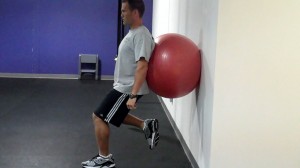
Shallow Single Leg Wall Sit
So, my client saw the orthopodic doctor I sent her to on Wednesday. He called me and said he felt it was primarily patello-femoral arthritis and some irritation of the medial retinaculum (fold of tissue along the inside portion fo the kneecap). When I pressed him about the mensicus (remember the chiro suspected this injury), he felt my client at 35 was young to have an attritional meniscus tear, but he did decide to get an MRI to be 100% sure she did not have a tear of the medial meniscus.
For now, the plan is to let her run and train with me while we await the results fo the MRI and progress training based upon her pain/symptoms. So, what are good exercises for PF pain in runners? Obviously, I focus a great deal on strengthening the hip musculature, particularly the gluteus medius, as well as the quads and hamstrings. Essentially, reducing the amount of pronation, valgus load at the knee, and IT Band tigthness is important for female runners.
Below is a list of a few key exercises I include in this particular marathoner’s routine with me:
- Single leg stiff-legged dead lifts
- Single leg squats with opposite leg hip/knee drive
- Lateral ankle band walks
- Single leg lateral reaches
- IT Band foam rolling
Note: It may be necessary to modify the range of motion on single leg squats based on pain or specific hot spots on the kneecap. In this case, I typically work above or below the pain zone. I included pictures of the lateral band walks and lateral reach below (these really target the gluteus medius).
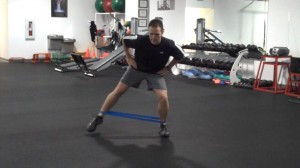
Lateral Band Walk
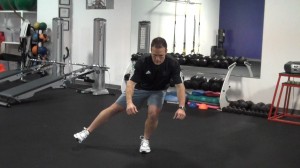
Single Leg Lateral Reach
Have you ever experienced sudden intense anterior knee pain or pain along either the medial or lateral joint line? What about catching, popping or locking? Well, if so you are not alone. Many people suffer from patello-femoral pain and meniscus tears.
I am currently working with a marathoner who recently ran her own personal best 3:34 at the Boston Marathon. She has had various overuse injuries over the few years I have worked with her as distance runners often do. However, after I came back from vacation the second week of this month she had an increased pain along the medial part of her knee. It all began after running hills 5 days in the same week.
My initial thought was she probably had increased inflammation of the patello-femoral joint as all the downhill running creates a more compressive load between the back of the knee cap and the femur. Not to mention 5 days in one week was simply too much. Needless to say I did not advise her to do as much.
Her initial exam revealed some mild medial joint line tenderness, no swelling and no gait deviation. Her biggest issue was with squatting below 45 degrees and pain near the medial border of the patella. She also had no pain with rotation of the knee with that foot fixed on the ground (I was particularly looking at valgus loading with rotation to tweak the medial meniscus). My initial assumption was that the pain would resolve with relative rest and minimizing compression at the P-F joint.
Relative rest really does not enter into the realm of reality for marathoners. So, my client continues to complain of knee pain after running (not so much during). Her chiropractor feels she may have torn her medial meniscus. I re-evaluated her yesterday. Findings: mild medial joint line tenderness, no swelling, no locking, negative Apley compression and McMurray testing. But, she did have pain with internal rotation of the femur when standing on just the affected leg. Hmmm???
Now, most meniscus tears occur with trauma that typically involves twisting and compression or an associated ACL tear. However, in runners, the repetitive nature of running can cause a gradual degeneration of the meniscus particularly if there is arthritis present in the knee. For more info on meniscus tears click here.
So, she will be seeing the sports medicine doc next week. She may have a small tear. She may just have an irritated P-F joint. She may have both. The take home message is really this: the most sensitive test for meniscus tears (whether medial or lateral) is joint line tenderness so we need to be sure in her case. If you work with female clients, you can safely bet most of them will have some form of patello-femoral arthritis by the time they are in their thirties. If they are overweight, the relative chances and rate of progression are simply higher.
I will keep you posted on the verdict with my client as she does not have a straightforward case in my opinion. She exhibits an inconsistent pattern of symptoms so I am not willing to rule out the tear at this point. Regardless, this situation calls for rest (as much as she will concede to), modification of strengthening to reduce P-F compression, and also evaluating hamstring work greater than 90 degrees as this too will pull on the menisci and can potentially increase pain and strain on that tissue. Stay tuned and keep your knees fit!
Golf is in the air in Dublin, OH as Tiger and the PGA have invaded my neck of the woods for the Memorial Tournament. Too bad I am on vacation missing it!! Anyway, I just read a new research article validating what many of us have been saying for years about dynamic warm-up – this time it relates to golfers.
Do you care about club head speed, accuracy and consistent ball contact? Then listen up. In the most recent edition of the Journal of Strength and Conditioning Research, Jeffrey Gergley reveals some important findings relative to a passive stretching regime coupled with an active dynamic (AD) warm-up versus just an AD warm-up and its effects on golf performance.
In a nutshell, his study involved 15 young male competitive golfers. Immediately after the warm-up, each subject was instructed to hit 10 full-swing golf shots with their driver after their normal pre-shot routine with 1 minute rest intervals between each shot. The results are as follows:
Golfers who used the 20 minute passive stretch routine in addition to the AD warm-up with golf clubs saw:
- A 4.91% decrease in club head speed
- A 5.62% decrease in distance
- A 31.04% decrease in accuracy
- A 16.34% decrease in ball contact consistency
Wow!! The take home message is this – golfers should focus their warm-up routine on active movements with the golf club emphasizing the bio mechanical range of motion needed in the golf swing itself. Using a thorough dynamic warm-up will adequately prepare golfers to hit the ball better and reduce injuries.
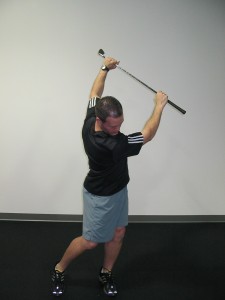
Want such a warm-up? Check out my Healthy Golf Shoulders E-Book for such a warm-up at www.healthygolfshoulders.com. A sample warm-up move from it can be seen below.
 Back to top