

Brian Schiff’s Blog
Injury Prevention, Sports Rehab & Performance Training Expert
 0
0
I recently relased an article on coaching mistakes in our local market. In it, I talk specifically about 5 critical mistakes coaches make with respect to athletes. The article will likely ruffle some feathers. I am not anti coaches in any way (I am one). However, I do believe coaches need to be educated about how to integrate training to maximize sport performance and reduce injury risk.
Today, I witnessed another example of how good intentions coupled with lack of proper insight about the impact of conditioning can harm an athlete. We had a new lacrosse athlete in our facility today working with one of my performance coaches. At the end of the session, my coach asked me to look at the athlete’s knee as the client apparently had anterior knee pain.
The staff member and father informed me that the lacrosse player’s coach was having everyone on the team not participating in a fall sport train for the Columbus half marathon coming up in October. The aim was simply to accomplish team building (an admirable goal) and keep them fit. You may know where this is heading.
I performed a movement screen on the athlete and discovered decreased hip strength and reduced ankle mobility. The player had obvious imbalances on both sides, left greater than right. The player then mentioned shin splints on the left leg as well for the past week (now 3-4 weeks into the 1/2 marathon training).
So, after performing a thorough knee eval, I concluded the athlete has anterior knee pain and left sided shin splints related to muscle imbalance and overuse with the recent addition of 4 days of distance running. Is running bad? In a word, no. But this type of running for this particular athlete is not helping further performance goals.
The father enrolled the athlete in our program to work on speed, agility and power for lacrosse. The bottom line is that this 1/2 marathon training is going to work against the very training adaptations my staff is working to achieve, not to mention now causing more knee pain and shin splints.
I am not opposed to the idea of scheduled conditioning for athletes not participating in a sport. However, coaches need to step back and ask themselves what is the best way to condition their players for optimal performance and injury prevention. In this scenario, I have all the confidence in the world the coach has the very best intentions for his players.
Unfortunately, the results may be less than expected here – more importantly they may be counterproductive as the wrong energy system training and adaptations are being emphasized, while some players may suffer injury.
In my professional opinion, the player should probably consider dropping out of the half marathon training for three very important reasons:
- Resolve pain and shin splints
- Focus on fixing muscle imbalances
- Maximize the training with us
This seems so simple, right? Well, I see situations like this every week in my facility. I see too many injured athletes. Why? In many cases it has to do with faulty conditioning principles or over training. My mission is to educate coaches about how best to blend injury prevention with performance conditioning relative to their respective sport. We have to remember that one size never fits all either.
Thoughts, comments or questions? Let me know. I am happy to address them in a constructive and positive public forum.
In last week’s post I revealed my core lower body reaches using one leg for stance and the other leg fro dynamic movement. Today, I will show you 3 fundamental upper body patterns I use with many of my athletes.
They include anterior hand touches, ipsilateral hand touches and contralteral hand touches. You may progress from a 12″ cone all the way to tape on the floor. The rotational reaching should only be added after the other two progressions have been mastered. Perform 1-2 sets repetitions for these exercises.
The purpose of these exercises is:
- Increase strength
- Increase stability
- Improve proprioception
- Improve mobility
- Reduce injury risk
I highly recommend incorporating some of these simple yet effective training strategies if you are a field or court athlete or someone who works directly with this population. In addition, any clients prone to ankle sprains or with a history of knee injuries should be doing some form of these routinely if they are still actively competing.

As fall sports near, many athletes are taking to the field again. We have been busy training soccer, field hockey, football and lacrosse athletes this summer. I am doing a speed clinic for a local varsity female field hockey team in 2 weeks. One of the things I always educate coaches and players on is single leg reaching progressions.
Why? Because they can be implemented on the field quickly and easily without equipment. In addition, they address balance and strengthening together. Most athletes I see need hip strengthening anyway, and these drills will provide dynamic strength work for them. This will inevitably decrease injury potential.
I have included a series of single leg reaches that you can easily implement in your training protocols as well. If you are not using these, please consider adding them immediately. You may be surprised to find that even your best athletes may struggle with some of these or have poor balance/stability. Any athletes with hypermobility will benefit from the stability training and likely see fewer ankle and knee injuries.
I will show you a series of lower leg reaches today as follows:
- Anterior reach
- Posterior reach
- Anterior to posterior reach
- Lateral reach
- Diagonal cross-over reach

Stay tuned, as I will share my single leg upper body reaching progression in the next post.
If you have been following my blog, you are aware one of my marathoners has been battling increased medial knee pain. I initially suspected and diagnosed it as patello-femoral irritation. I have known she has some chondromalacia (softening or weakening of the cartilage behind the kneecap) ever since I began training her 2 years ago.
I spoke with the MD Thursday and he confirmed by MRI she has no meniscus tear and just patello-femoral arthritis and inflammation. I was relieved to know I had hit the mark (remember the chiro said meniscus tear). The MD I referred my client to wants me to do a specific PF strengthening program with her. The good news – no surgery needed that will derail training for the Columbus Marathon. The bad news – she may have to contend with some discomfort related to the pounding for now.
It is always hard to tell a runner to rest. That is one four letter word that really ticks them off! So, the answer for my client is relative rest (avoiding excess mileage, not running down too many hills, and increasing recovery windows when possible) as well as implementing a more specific PF rehab program.
We have been doing lots of quad (VMO specifically) work and gluteus medius strengthening already. So, what I will be adding or changing? Well, we will be integrating more repetitively the following:
- Weighted straight leg raises in flexion and adduction
- Modified box step-downs in the terminal range of knee extension to emphasize VMO contraction in a closed chain manner
- Modified lunge and squat progressions working around the pain
I will be continuing with single leg strengthening for glutes, hamstrings and quads, while challenging hip stability in the frontal plane as she may be experiencing unwanted force transmission here with impact. Additionally, I will continue with IT band rolling/stretching and hamstring flexibility.
This client is tough and will run through the pain if need be. My job is to reduce and eliminate the pain without taking her running away. That is never easy but it can be done with careful progression of exercise and cooperation from the client. The key point for strength and conditioning specialists is to modify programming based on the client, while the key point for all runners out there is to be open and honest about pain, as well as willing to comply with modifications in the short term training plan to achieve the same long term goal – finishing the race.
Below is a picture of a modified squat progression (an isometric single leg stability ball wall squat/sit). I use this exercise with athletes and runners with patello-femoral pain issues when they can’t squat due to pain. If you want to see exactly how to do this exercise, subscribe to PFP Magazine and read my online column, Functionally Fit, here. My newest column will be out next week and address double and single leg isometric squats for patello-femoral pain.
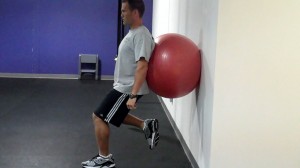
Shallow Single Leg Wall Sit
So, my client saw the orthopodic doctor I sent her to on Wednesday. He called me and said he felt it was primarily patello-femoral arthritis and some irritation of the medial retinaculum (fold of tissue along the inside portion fo the kneecap). When I pressed him about the mensicus (remember the chiro suspected this injury), he felt my client at 35 was young to have an attritional meniscus tear, but he did decide to get an MRI to be 100% sure she did not have a tear of the medial meniscus.
For now, the plan is to let her run and train with me while we await the results fo the MRI and progress training based upon her pain/symptoms. So, what are good exercises for PF pain in runners? Obviously, I focus a great deal on strengthening the hip musculature, particularly the gluteus medius, as well as the quads and hamstrings. Essentially, reducing the amount of pronation, valgus load at the knee, and IT Band tigthness is important for female runners.
Below is a list of a few key exercises I include in this particular marathoner’s routine with me:
- Single leg stiff-legged dead lifts
- Single leg squats with opposite leg hip/knee drive
- Lateral ankle band walks
- Single leg lateral reaches
- IT Band foam rolling
Note: It may be necessary to modify the range of motion on single leg squats based on pain or specific hot spots on the kneecap. In this case, I typically work above or below the pain zone. I included pictures of the lateral band walks and lateral reach below (these really target the gluteus medius).
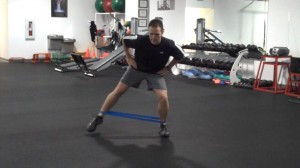
Lateral Band Walk
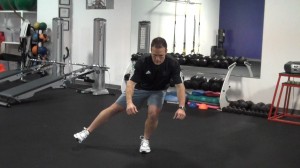
Single Leg Lateral Reach
 Back to top