

Brian Schiff’s Blog
Injury Prevention, Sports Rehab & Performance Training Expert
 0
0
This is the second installment of corrective “go-to” exercises I am highlighting here and in my online column for PFP magazine. Click here to read the post on resisted overhead squats. The in-line lunge allows for the observer to pick up flaws or asymmetry by placing the body in a narrow stance with a wide stride to assess hip, knee, ankle and foot mobility and stability of the client. It places the upper and lower extremities in alternate asymmetrical patterns.
Limited mobility or hip disassociation will produce movement dysfunction with the in-line lunge (see picture below for how it is assessed during the FMS).

A common corrective exercise prescribed to improve mobility is the leg lock bridge.
Execution: Begin in supine flexing one leg up to the chest. Hold the flexed leg against the chest while keeping the extended (down) leg in line with the center of the body and the knee flexed. A small ball (pictured below), pillow or towel roll may be placed between the thigh and chest for tactile feedback regarding the lock position.
Next, push down through the extended leg on the floor to elevate the hips off the ground into a bridge. The height of the bridge should be limited to the point where contact can be maintained between the thigh of the flexed hip and the chest keeping the extended hip/thigh in the in-line position. Perform 2-3 sets of 10-15 repetitions.

Application: The ability to stride in a lunge position without forward trunk lean during the in-line lunge can be inhibited by tight hip flexors. Soft tissue work and stretching is certainly helpful, but this active mobility exercise will improve reciprocal movement and facilitate hip disassociation. It is a great exercise to include as part of your corrective exercise series and/or movement and pillar prep work with your clients.
If clients struggle or experience hamstring cramping, consider adding a small step beneath the foot of the extended leg to increase the hip flexion starting position. Modifications and adjustments to sets, repetitions and distance between the flexed thigh and chest as well as the extended foot and ground should be considered with exercise prescription.
Weakness in the gluteus maximus and gluteus medius is often cited in contributing to patellofemoral pain, IT band problems, hip pathology and even back pain. Furthermore, activating the glutes and minimizing tensor fascia lata (TFL) activation is preferential to avoid synergistic dominance with abduction exercises. This is a common finding on my clinical exams.

Photo from Myers
In the February 2013 issue of the Journal of Orthopaedic and Sports Physical Therapy (JOSPT), Selkowitz et al. examined several exercises to determine which ones had the highest gluteal-to-TFL muscle activation (GTA) index. The clam exercise proved to be the best with an index value of 115. The second highest exercise was a sidestep with elastic resistance with a value of 64.
The other three exercises to score a GTA index of 50 or higher were: Unilateral bridge (59), quadruped hip extension w/knee extended (50) and quadruped hip extension with knee flexed (50). Below is the clam executed against a wall as described in the study referenced.

Clam with resistance
Additional research done by Wilcox and Burden (published in the May issue of JOSPT) suggests that a neutral spine alignment and 60 degrees of hip flexion is the best position for gluteal activation during the clam. This study was done without resistance but offers additional insight to positioning. I try to mimic this hip flexion angle in the standing single and double leg versions I employ with mini-bands as part of my gluteal activation series in the clinic as well.

Single Leg ER (left)
In the Selkowitz study, participants performing the sidestep were instructed to step to the left replacing 50% of the distance between the feet in the start position and follow with the right leg also stepping at this 50% increment. This was then repeated to the right to return to the starting position for a total of 3 cycles.
This exercise has one of the lowest TFL activation and reinforces proper frontal plane mechanics and can be used with clients and athletes to reduce anterior knee pain and injury risk. To increase resistance and/or difficulty, bands can be moved to the ankles or a band can be applied above the knees and at the ankle. In my practice, I typically have clients sidestep for 10 yards in one direction (using the 50% rule) and then repeat moving back to the other side for 10 yards.
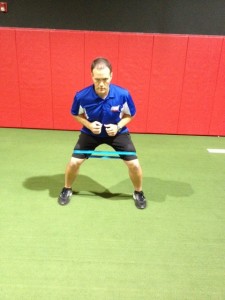
Sidestep
Another option is to perform the sidestep exercise with a staggered stance. For example, lead with the right leg forward moving to the right and vice versa. Again, small steps replacing 50% of the original stance is best to ensure quality work.

Staggered sidestep
For additional information on execution and application for these exercises, click on the links below for the online columns I wrote for Personal Fitness Professional Magazine:
Sidestep with elastic resistance
I utilize bridging as an assessment and exercise tool in my training and rehab programs. Posterior chain/hip stability is poor in many clients. The ability to maintain a neutral spine, engage the glutes and fight rotation is NOT an easy task by any means. So, coaching and cueing proper bridging is a great way to enhance pillar strength and reduce injury risk, while facilitating better movement patterns in sport.
I wrote a recent column for PFP magazine entitled iso bridge with alternate knee extension. Click here to read the column and the application, regression and progression of the exercise. In addition, I have included a short video below showing double leg and single leg bridge exercises that can be used to work on the hips and core. The second exercise is the dynamic version of the iso alternate knee extension bridge I write about. I show you some of the single leg progressions that come after mastering the iso bridge as well.
I hope this video and article is useful to you. I also want to take this opportunity to thank you for reading my blog and wish you a very Happy New Year!
I work with lots of patients and clients who consistently demonstrate inadequate hip and core stability. I see this show up routinely as asymmetrical 1’s for the trunk stability push-up, in-line lunge, hurdle step and rotary stability movements on the FMS. Unfortunately, this has been a recurring them in many of my females recovering from ACL reconstruction as well as runners with persistent pain/dysfunction in one lower extremity.
I am always looking for better ways to train the body in whole movement patterns as well as functional positions. One of my preferred positions is to test and challenge my clients in a split squat position. I begin with an isometric split squat cueing proper alignment and muscle activation. As clients master isometric postural control, I will allow them to add an isotonic movement by squatting in the position.
As they progress, I will add in perturbations to stimulate changes or challenges to their center of gravity. Often, you will see them struggle much more on the involved side. But to be honest, I find most people have an incredibly hard time maintaining proper alignment for long without cheating or falling forward or to the side. Allowing clients to lose form is okay provided they are cued to fix their alignment or they naturally self correct.
An additional wrinkle I throw in for this training is using the BOSU Balance Trainer. Below is a video that shows how I use this progressing from shin down to just the toes as a support on the trail leg. The second version will burn up your clients’ thighs and quickly become one of their least favorite exercises. The great thing is that you do not have to offer much resistance to create a significant perturbation.
For more detail on this exercise and application, click here to read my PFP column featuring it this week.
While I treat a vast number of knee ailments in my practice, the focus of my training and rehab is often more proximally directed at the hip. Understanding the role of hip muscles and how the hips and pelvis work together to impact knee alignment and closed chain function is critical in resolving knee pain and dysfunction.
Below is a “go to exercise” exercise I use for gluteus medius activation and core/pelvic stability training. Using a mini-band provides an adduction force cueing the client to abduct and activate their external rotators to maintain proper alignment. Additionally, they need to avoid a drop on one side of the pelvis (look at the ASIS).
Click here to read my entire column dedicated to this exercise in PFP’s online magazine. I hope you find this exercise and information useful for you and/or your clients.
 Back to top