

Brian Schiff’s Blog
Injury Prevention, Sports Rehab & Performance Training Expert
 6
6
It is widely accepted that decreased hip strength and stability leads to knee valgus. Excessive frontal plane motion and valgus torque increase the risk for non-contact ACL injuries. While we know that hip abductor weakness is more of an issue in females than males, the question remains to what degree other factors are involved.

Claiborne et al (1) noted that only 22% of knee variability could be linked solely to hip muscles surrounding the hip. In light of this we must look at the whole kinetic chain when assessing movement dysfunction and injury risk. In the most recent issue of the IJSPT, researchers sought to discover how activating the core during a single leg squat would impact the kinematics of 14 female college-age women. They excluded participants with current pain or injury to the lower extremities or torso, or if they had a history of any lower extremity injuries or surgeries in the past 12 months.
The participants were assessed for their capacity to recruit core stabilizer muscles using lower abdominal strength assessment as described by Sahrman (2). This testing model has 5 levels of increasing difficulty used to challenge participants to maintain a neutral spine. The draw back of this method is that it is done in supine versus the standing position of this study, but the author acknowledges this limitation. Out of a possible high score of 5, five of the participants scored a 1 or 2, while the other nine scored a zero.
For the study, a six inch step was used to assess 2 reps of a single leg squat. Each participant was asked to perform the test with the dominant leg to standardize conditions. They performed the reps under two conditions:
1. CORE – engaged abdominal muscles as they had been instructed to do so during the Sahrman test
2. NOCORE – no purposeful engagement of abdominal muscles
Results
- The CORE condition resulted in smaller hip displacements in the frontal plane but had no effect on hip angular range of motion – essentially there was less medial/lateral movement
- The CORE group did not exhibit any changes in knee displacement but did exhibit greater degree of knee flexion – this may suggest higher function assuming more knee flexion is desired during squat tasks in sports and functional activities
- Those scoring the lowest on the core assessments had larger improvements in performance when they did in fact activate the core musculature
How do we use this information to affect our practice? Well, in terms of rehab it seems straightforward and many of us may already encourage patients to activate their core during treatment. However, I think the greater contribution may come in injury prevention programs (particularly ACL programs) where we are looking at all facets of neuromuscular control and appropriate muscle activation patterns.
With any prehab or rehab strategy, we as clinicians, trainers and strength coaches are essentially trying to reprogram the brain to summon and execute a better motor pattern or strategy – feedforward training. We know that healthy individuals tend to have better transverse abdominus and multifidus muscle activation, so it only makes sense to consider activation of local stabilizers as we work on global muscles. Improving core and pelvic stability should only help reduce unwanted frontal plane motion.
With that said, the authors of this study readily acknowledge more work needs to be done with larger clinical populations (including EMG work) to more clearly identify what magnitude the core musculature has on lower extremity motion and displacement.
Keep in mind the proper program will always stem from your ability to assess movement impairment and tissue dysfunction. I suggest beginning with a FMS in the athletic population and incorporating parts of that or the SFMA to compliment your evaluation in the clinic. This will generally reveal the priorities for the corrective exercises. For now, we can use this information in this particular study to be more intentional with our patients and clients suffering knee and hip dysfunction by adding this one simple step to our programming.
References
1. Claiborne TL, Armstrong CW, Gandhi V, Princivero DM. Relationship between hip and knee strength and knee valgus during a single leg squat. Journal of applied biomechanics. 2006;22(1):41.
2. Faries MD, Greenwood M. Core training: stabilizing the confusion. Strength & Conditioning Journal. 2007 ;29(2):10.
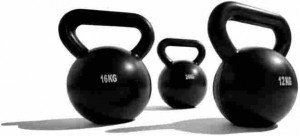
Kettlebells are very popular training tools these days. I find them useful in many ways – improving grip strength, core activation, asymmetrical loading, etc. With that said, I also feel with movement flaws and/or improper technique, they carry an inherent injury risk.
It is interesting to note that some people find swings to be very therapeutic and good for their back, while others who are capable of lifting very high loads with traditional lifts find them to be irritating to the spine. So why is this?
If you are like me, knowing the “why” or “cause and effect” behind exercise is very important. I am not one to blindly use an exercise without knowing its intended purpose and then quantifying risk vs. reward and results. So, it was with great interest I read Stuart McGill and Leigh Marshall’s recent article on kettlebell swings, snatches and bottoms-up carries in the NSCA Journal of Strength & Conditioning Research (Jan 2012).
While the sample size is small, I think the article provides some gems in regard to training given no one has really looked at spine loading during various swings and carries. The authors used surface EMG to record muscle activation of the back, hip and core muscles throughout the various exercises – swing, swing with Kime (abdominal pulse at top of the swing), swing to snatch, racked carry and bottoms-up carry.
Without going into all the tiny details, I wanted to share what I consider to be some key takeaways for rehab and training:
- Unlike traditional low back extension exercises such as lifting a bar or squatting exercises, the swing creates a relatively high posterior shear force (namely L4 on L5) in relation to the compressive load – this may explain why some powerlifters have no issues with heavy dead lifts but are bothered by swings
- Both compressive and shear forces were highest at the beginning of the swing
- From a compressive standpoint loads with a 16 kg kettlebell (swing) are less than one-half of that of lifting 27 kg on an Olympic bar and these would seemingly pose a low relative injury risk
- KB swings do appear to require sufficient spine stability in this shear mode to ensure that is is a “safe” exercise selection
- Those with back pain develop movement flaws and the authors report one of the most common is to move the spine under load instead of the hips – so instead of hip hinging, injured clientele are more apt to shift or bend the spine leading to repetitive and harmful forces
- A modified approach to swings with careful cueing and progression is suggested for clinicians
- The bottoms-up carry poses more challenge to the core musculature likely due to requiring more grip strength (thus stiffening the core per McGill in Ultimate Back Fitness & Performance) as well as necessitating more control to carry it, hence making it a good choice for training in terms of activation of these muscles
So, in my mind kettlebell training (like any other form of training) requires proper form, movement assessment and an intimate knowledge of the client’s medical and training history. In addition to that, we must carefully scrutinize execution of the exercise and deliver appropriate feedback and analysis.
While maximal shear occurs at the bottom, I cannot help but wonder about the potential impact of tight iliopsoas muscles given their unique relationship to the lumbar spine and reverse muscle action. It would be interesting to know if those with a greater anterior tilt and tightness are more likely to experience higher shear forces or potential back soreness over time.
This brings the discussion back to quality of movement and movement assessment. In my mind, adequately assessing the hips (flexibility, strength and stability) is also a key variable in determining how best to approach integrating the swings. As Gray would say, the lumbar spine needs stability while the hips require mobility.
A lack of hip mobility is definitely a relative precaution for swings in my mind. On top of that, fundamental hip strength/stability and core strength should be evident. Perhaps even regressing to rudimentary hip thrusts and bridges may be the best place to start for those needing a primer on form and proper movement before moving to a basic swing.
Nonetheless, a big thanks to Stuart McGill and Leigh Marshall for this work and giving us some practical food for thought. I hope this information helps you as much as it did me. May your training be safe and effective!
Through my clinical practice and sports performance training, I continue to focus on eliminating core and hip dysfunction. I think many of the knee problems I see in runners and females are related to weakness in the glutes and small lateral rotators. There has also been quite a buzz about a recent article written in the Strength & Conditioning Journal on crunches and whether spinal flexion may actually be good for you.
This topic alone could take up several posts so, I will not delve into that today. However, as one who has experienced sciatica and disc injury firsthand, I probably tend to fall a little more in the camp of focusing on a neutral spine and resisting external forces as I feel this helps improve performance and reduce injury risk. In that vain, I have been continuing to develop my own core and hip stability progressions with my advanced clients/athletes.
I have been doing a series of posts for BOSU and PFP in my Functionally Fit Column. In my last post, I covered a 3D mountian climber with hip extension. In today’s post, I am covering a great core exercise with the BOSU Ballast Ball focusing on hip extension with the goal of improving shoulder, core and hip stability while promoting hip extension and disassociation.
In the video below you can check out the progressions (incline and decline)
Click here to read the full article on technique and application. The article reviews a regression for those not ready to tackle this quite yet. I think you will find this exercise challenging and rewarding.
I have had the pleasure of authoring a bi-weekly column for PFP’s online magazine entitled “Functionally Fit” for over three years now. This column gives me a creative avenue to display my specific training techniques and teach others how to build a better functional body in the process.
One of the greatest things about exercise is all the different options, variations and tweaks available to bring about a desired physical change in the human body. As Alwyn Cosgrove once said, “Exercise is like medicine.” By this, he means the right dosage and application is critical. I could not agree more.
As training and rehab continue to evolve and become even more intertwined, we as practitioners need to continue seeking ways to get more from our exercises. I personally use lots of different training tools in my trade, but I am always seeking to get the biggest return on my exercise investments. Today, I am sharing one such exercise with you, the 3D Mountain Climber with Hip Extension. Check out the video below:
In this video, I am working to improve shoulder, hip and core stability as well as strongly encourage hip disassociation. Many clients I train and rehab simply are asymmetrical or cannot disassociate their hips which leads to flawed movement patterns and leaks int he kinetic chain.
I used this exercise in our core training series we were doing with the Carolina Hurricanes in their pre-season conditioning sessions that we just recently completed. It is not easy, but delivers so much benefit for just one movement. In the video I display a BOSU balance trainer, but in my online column for PFP, I include a full buildup progression as well. Click here to read the column.
With the new year, millions of people have made a resolution to lose weight. Along with that, comes the idea they will flatten their midsection. If you are like me, you share a certain disgust for the infomercials marketing the “next” latest and greatest abdominal machine.
For years, people have sought out how to build the perfect six pack. Obviously, nutrition is probably the single biggest factor in achieving a sculpted midsection. But, beyond that people often wonder what exercises to do to target the upper and lower abs as well as the obliques. Is this really possible?
Well, I thought I would share the results of a recent study in the Journal of Strength & Conditioning Research. The authors wanted to look at the use of other training tools versus just a body weight only exercise. In the study, they looked at surface EMG activity for the upper rectus abdominus (URA), lower rectus abdominus (LRA), external obliques (EO), internal obliques (IO), transverse abdominus (TA) and rectus femoris (RF) with the following exercises:
- Abdominal floor crunch
- Supine V-up
- Prone V-up on slide board
- Probe V-up on stability ball
- Probe V-up on TRX
- Prone V-up on power wheel
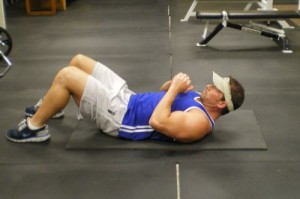
Crunch
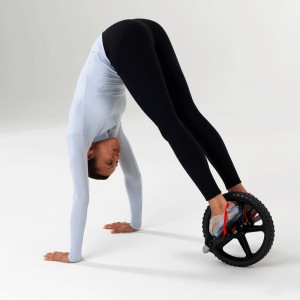
Prone V-up with power wheel
In short the major results are as follows:
- The most muscle activity overall occurred with the power wheel
- There was no significant difference for activation of the EO, URA and LRA
- RF was much less active only during the abdominal crunch
Practical applications include:
- There is no realistic way to isolate portions of the abdominal muscles, but keep in mind one limitation may be that the study looked at MVC (contraction at only one point in the motion)
- The RF is NOT a spinal stabilizer but rather a hip flexor and therefore it can cause an anterior pelvic tilt if overly active which can be viewed as potentially harmful
- Focus on training the core globally as an integrated segment of the kinetic chain to maximize activation and understand how the hips affect completion of the movements
I hope this post stimulates your thinking with respect to abdominal training. If you do use training tools, simply stop for a moment to consider the desired training outcome, as well as the impact the body position and muscle firing patterns have on the exercise itself.
 Back to top