

Brian Schiff’s Blog
Injury Prevention, Sports Rehab & Performance Training Expert
 2
2
I work with many weekend warriors, strength training enthusiasts and overhead athletes in my practice. One of the more common dysfunctions I see in this population is either asymmetrical or general thoracic spine hypomobility (decreased range of motion).
This can predispose you to shoulder, back and hip dysfunction, as well as increase the risk for overuse injuries. In addition, it may also alter the natural biomechanics of movement, thereby negatively impacting performance. With all the sitting and screen time we engage in, it is no surprise we are developing a generation of people with forward heads, rounded shoulders and kyphotic posture.
This leads to reduced thoracic spine extension. Additionally, I often encounter decreased thoracic spine rotation. If this becomes restricted, asymmetrical overhead athletes may face increased stress on the lumbar spine, hips and glenohumeral joint. Common dysfunctions I treat related to this is rotator cuff tendinopathy, labral pathology, mechanical back pain, and hip pain to name a few.
To combat stiffness and promote more optimal mobility, I encourage my clients to perform daily mobility work. I have included a video I filmed for PFP Magazine in my column ‘Functionally Fit’ below that illustrates an effective way to combat reduced T-spine extension.
Be sure to check back for my next blog post on how to increase thoracic spine rotation.
There are several things that contribute to shoulder impingement and rotator cuff pain. Perhaps one of the biggest issues that impacts overhead athletes, Crossfit enthusiasts and the avid weight lifter is limited shoulder mobility. Poor flexibility in the pecs, lats, posterior shoulder as well as limited thoracic spine extension and rotation all contribute to suboptimal movement.
Poor mobility can place the scapula in biomechanically flawed positions, increase glenohumeral internal rotation and restrict shoulder movement at end range creating compensatory movement and pain. The video below is a snippet from my upcoming webinar on rotator cuff dysfunction and nonoperative treatment.
This webinar will be great for strength coaches, exercise enthusiasts, Crossfit athletes/coaches, athletic trainers and physical therapists. If you want to attend the webinar or catch the on-demand version, simply visit www.alliedhealthed.com. In addition, you may find my DVD on rotator cuff training very helpful in overcoming shoulder pain and staying pain free in the gym.

Click here to see a brief video overview of the DVD or visit my site at www.BrianSchiff.com for more info. Use the code Holiday15 at checkout from today until December 25 to save $10 off the retail price.
Have a great Thanksgiving and enjoy your time with family and friends!
I work with lots of runners, both recreational and competitive, who are seeking to improve performance or overcome injuries. The most common issues I see are iliotibial band syndrome (ITBS) and patellofemoral knee pain (PFP). With every runner, I routinely perform FMS and video analysis to get a better understanding of their movement patterns, gait mechanics and asymmetries.

Without question, they tend to ask me if there is a better way to run. Obviously, every accomplished runner has his/her own opinion on the matter. Some prefer forefoot or midfoot strike, while other do just fine with a heel strike pattern. In essence, we do not have any sound research or biomechanical evidence to declare one a winner. Since I work with many injured runners, I am always seeking to find the most efficient ways to reduce injury risk and eliminate pain.
A paper just published in the September 2015 American Journal of Sports Medicine by Boyer and Derrick sought to answer the question of how shortening the stride length or altering foot strike pattern may impact certain variables. Specifically, the authors sought to compare step width, free moment, ITB strain and strain rate, and select lower extremity frontal and transverse plane kinematics when stride length was shortened 5% and 10% in habitual rearfoot and habitual mid-/forefoot runners using both strike patterns while shod.
So many times, athletes and parents alike are singularly focused on the physical rehab necessary after an injury. Often, what the athlete is not talking about is the psychological impact of the injury. Suddenly, their identity and self worth may come into question. They feel disconnected from teammates and coaches. Their daily routine consists of rehab and not practice/play. Deep inside their head they are quietly wondering, “Will I ever be the same again?”

Aside from some of the obvious questions that race through an injured athlete’s mind, one of the biggest and most often unspoken concerns is the fear of re-injury. Having worked with athletes of all sports, ages and abilities, I have seen firsthand how important it is for an athlete to go through a functional and sequential progression that assures that they are able to run, jump, cut, pivot and decelerate again without pain or instability.
I have worked with hundreds of athletes over the course of my career that have suffered ACL injuries. The longer I practice, the more I become convinced that we probably have been pushing or allowing these athletes to go back to their sports before they are really ready (physically and/or mentally). Six months has long been the benchmark for most orthopaedic surgeons. The graft is well healed, but often the mind and body are not really ready.
While I have seen athletes who have great strength, stability, hop testing scores above 90% and look good on movement drills, sometimes these same athletes still have asymmetrical squat patterns, FMS scores lower than 14 or apprehension about returning to their sport. In addition, fear of re-injury is a big factor that impacts confidence and readiness to return to activity.
Consider some of these facts about modifiable factors with return to sports after ACLR from the May/June 2015 Sports Health Journal:
- Motivation, confidence, self-efficacy, optimism and low fear are associated with a greater likelihood of returning to preinjury level after athletic injury and ACLR
- Lower fear of reinjury and greater pyschological readiness to return to sport favored returning to preinjury level after surgery
- Combinable data from 10 studies suggests that fear of reinjury, psychological readiness to return to sport and one’ subjective assessment of knee function were predictive of level of return to sport
- As many as 1 in 2 athletes who do not return to their preinjury level of sport report the main reason is fear of reinjury
Whether doing prehab, rehab or training, I believe in using single leg exercises to attack asymmetries, imbalances and motor deficits I uncover in my assessments. Learning to control one’s body in space with the effect of gravity in a weight bearing position is instrumental for sport and injury prevention.
Furthermore, facilitating ankle mobility and proper knee alignment during a loaded squat pattern is something most athletes and clientele I work with need some help with. to that end, I utilize several different single leg reaching progressions and exercises. One of my favorite ‘go to’ exercises is the anterior cone reach.
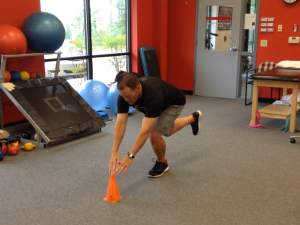
I recently featured this specific exercise in my ‘Functionally Fit’ column for PFP Magazine. Click here to see the video demonstration.
This is a great exercise with progressions and regressions for clients of all ages and abilities.
 Back to top