

Brian Schiff’s Blog
Injury Prevention, Sports Rehab & Performance Training Expert
 2
2

So, I just returned from the Combined Sections Meeting for the APTA that was held in Indianapolis. There was lots of great networking and presentations to be sure. I attended sessions on ACL rehab/prevention, femoroacetabular impingement, elbow injuries in throwers, running gait analysis, and shoulder plyometric training with the legendary George Davies. I thought I would give you my top 10 list of helpful nuggets I picked up over the weekend in no particular order of importance.
1. Performing upper body plyometrics has no effect on untrained subjects so don’t waste time putting it into the rehab program, where as it does benefit trained overhead athletes. The one caveat is it also increases passive horizontal external rotation so keep this in mind when working with athletes who have shoulder instability.
2. A new study coming out in 2015 in AJSM revealed no major differences in throwing kinematics between those following UCL reconstruction (Tommy John) and age-matched controls. This is good news for those worried about pitching mechanics after the procedure.
3. According to Dr. Reiman at Duke, the orthopedic hip exam does a better job of telling us they do not have a labral tear than it does telling us they do have an intra-articular problem. The tests have poor specificity. In fact, he goes on to say that the “special tests are not that special.” That brought a chuckle from the crowd including me. Bottom line – we are not really able to conclusively say “yes you have a labral tear based on my exam today.
4. Reiman also feels we must consider look for mechanical symptoms during the lowering portion of the Thomas test, while considering the fact that fat pad impingement may cause anterior hip pain as opposed to joint pain. Again, things are not always as they appear in the “FAI” crowd so we need to take a great history, look at the classic tests and also see how squatting and loading affects the hip.
5. More experienced pitchers do not drop the glove side arm, but instead tend to move their body toward the glove to conserve angular momentum and overcome small moments of inertia. Less experienced pitchers rotate their trunk sooner in pitching cycles whereas pitchers who threw at higher levels rotated later and produced less torque at the shoulder. Consequently, many players with higher elbow valgus torque and distraction force at the shoulder rotate too early.
Increasing shoulder, torso and hip strength and stability is a common training goal for athletes involved in sport. Facilitating hip disassociation and kinetic chain linking with exercise is always a plus. I like to use a diagonal mountain climber with hip extension to accomplish these objectives. More specifically, I utilize this exercise with my overhead athletes and anyone involved in cutting, pivoting and rotational sports.
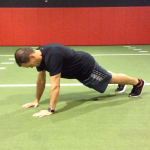
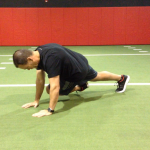
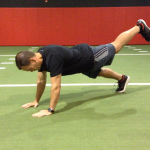
Begin in a tall plank position. The hands should be beneath the shoulders with the feet on the floor and shoulder width apart. Slowly bring the left knee/hip under the body and toward the right elbow. Pause at the end point prior to losing form or control.
Next, return the left leg toward the start position and up into full hip extension in one continuous movement. Pause at the top end of available hip extension and repeat the cycle for 10 repetitions or time on the same leg. Alternate legs and perform 2-3 sets on each side.
Sufficient upper body strength and core/hip stability in a 3 point position is necessary to perform the exercise correctly. At no time should the foot of the moving leg touch the floor or be used to balance the body. As far as a pace, I feel using a 1/1/1/1 cadence works best.
This exercise is an excellent way to promote shoulder, core and hip stability while facilitating hip disassociation as well. Driving the hip back up into extension will activate the gluteals and simultaneously force the stable (fixed) hip to stabilize the pelvis and counterbalance the movement pattern. In addition, the client will have to effectively activate the hip and abdominal musculature throughout to avoid unwanted pelvic tilt/rotation during the movement.
Click here to view the full video of this exercise I did for my ‘Functionally Fit’ column for PFP Magazine.
Baseball pitchers who fail nonoperative care for SLAP injuries will undergo a repair if they wish to continue throwing. The injury may occur at ball release as the biceps contracts to resist glenohumeral joint distraction and decelerate elbow extension. The other thought is that injury occurs in late cocking as the result of a “peel back” mechanism when the abducted shoulder externally rotates. Previous research by Shepard et al. published in American Journal of Sports Medicine (AJSM) measured in vitro strength of the biceps-labral complex during the peel back and distal force and concluded that repetitive force in both scenarios likely causes SLAP lesions.

“Baseball pitching motion 2004“. Licensed under CC BY-SA 3.0 via Wikimedia Commons.
One of the concerns for pitchers after surgery is regaining full shoulder external rotation and horizontal abduction. If too much tension is placed on the glenohumeral ligaments during surgery, regaining motion can be tough. Ironically, external rotation is limited in the early phase of rehab to protect the labral repair which may impair throwing mechanics later on. Appropriate rehab and progression is paramount for long term success.
Laughlin et al. at the ASMI sought out to explore in a labaratory if there are differences in pitchers who underwent a SLAP repair compared to those in age controlled groups without injury. In a paper published in the Dec. 2014 AJSM, the researchers hypothesized that the SLAP group would exhibit compromised shoulder range of motion and internal range of motion torque during pitching. Of 634 pitchers (collegiate and professional) tested at ASMI from 2000 – 2014, 13 in this group were included in the SLAP group as they had undergone a SLAP repair at least 1 year before their biomechanical testing.
All effective prehab and rehab programs for recreational and competitive athletes should include single leg stability exercises. I like to use sliding exercises as one way to improve neuromuscular control of the core, hip and knee. Frontal plane collapse is a common issue with respect to knee dysfunction. Using sliders/gliding discs as well as theraband is an excellent way to improve strength and kinetic chain control. Below is an exercise i recently featured for Personal Fitness Professional:
This exercise is effective in injury prevention and rehab programs for those with ankle instability, anterior knee pain, hip weakness, poor landing mechanics and higher ACL risk if playing pivoting and cutting sports. It will improve core stability, hip and knee strength/stability, dynamic balance, groin flexibility and trunk control.
The band serves to enhance activation of the hip external rotators and further challenge stability of the hip and knee. The band should not pull too forcefully, but just enough to cue the desired muscle activation pattern. A slower cadence on the eccentric portion of the exercise is preferable to maximize stability and strength gains. Do not force through any painful ranges of motion, and remember that form and alignment are paramount so limit the reaching based on the client’s ability to maintain adequate control.
This exercise is an excellent way to increase hip disassociation and more specifically hamstring flexibility. Foam rolling and/or myofascial compression therapy prior to stretching may further enhance range of motion. This exercise can be used with runners and clients struggling with tendonitis, IT band issues and patellofemoral pain. It is also helpful in eliminating asymmetry that appears on the active straight leg raise on the FMS.
This exercise can be used as part of a mobility workout, warm-up, regeneration day or at the end of a workout. Remember that maximally dorsiflexing the foot will increase dural tension and place more stretch across the back of the knee. So, relaxing the foot (or placing the rope more along the mid foot) will reduce this tension and allow for a more concentrated stretch in the hamstring. For clients with a history of sciatica, I would suggest avoiding the stretch with the foot in full dorsiflexion as a general precaution.
 Back to top
