Share   Subscribe to RSS feed

Brian Schiff’s Blog

Injury Prevention, Sports Rehab & Performance Training Expert

Today’s blog post is about an observation and fundamental tenet of my practice today as a sports physical therapist and fitness professional. Having been in the business of rehabbing and training the human body for 15 years, I feel qualified to say I know a thing or two about training and exercise.

Perhaps one of the greatest pearls I can pass along as it relates to being a health and fitness professional involves the art of teaching. You see, I have witnessed firsthand the desire people have to attain knowledge when it comes to their bodies. Just look at how quickly and often people take the web in search of answers from the latest ab workout to the source of and remedy to their every ache and pain.

We live in a society of information overload. Unfortunately, the web, YouTube, FB, Twitter and so on give just about anyone a stage to philosophize and sound off as an “expert.” Many people who claim to know how to “train” you for this and that have little to no real world experience doing it, nor do they possess enough pre-requesite knowledge to truly be considered an expert.
personal-trainer

I find many people mistakenly look for what they perceive to be the most “in” or “intense” training they can find, as they believe this is the way to finally meet their goals. In reality, what they should be seeking is someone interested in teaching them how to better understand their own body and how to apply the proper training principles to it in order to bring about the desired result they are so desperately seeking.

Training typically involves putting together drills, workouts or routines to challenge clients physically. Teaching, on the other hand, is centered on educating clients how to listen to their bodies and use that feedback to appropriately adjust physical loads and exercise programming to avoid injury and make positive physical adaptations.

Continue reading…

In my last post, I shared some practical plyometric drills with you to help teach proper landing mechanics in an effort to reduce ACL injuries.  Yesterday, I presented my comprehensive approach to knee training at our ACL Symposium in Cary, NC.

dsc01389

One of the fundamental errors I see coaches and athletes make is abandoning their pre-season training efforts during the in-season.  While athletes need to spend the majority of the in-season focusing on sports skills, they must also maintain the neuromuscular training adaptations acquired in the off-season and pre-season.

In my mind, the phrase “use it or lose it” is applicable for the neuromuscular training effects we see with balance, strength, agility and plyometric training.  This is especially true for our high risk female athletes like soccer and basketball players who suffer knee sprains, ACL tears and patellofemoral pain at disproportionate rates.

I often hear coaches say, ” I don’t have time to get workouts done and still accomplish what needs to be done at practice.”  While, time management may be difficult, I think coaches could probably squeeze in a single training session lasting 15-20 minutes if they simply knew how important it was to the overall health and performance capacity of their team.

With that said, I like to offer simple, yet effective exercises that can be done on a court or field with the whole team simultaneously without the need for expensive equipment.  Exercises should focus on activating the glutes (including the medius and minimus) as well as training the hamstrings more since most female athletes tend to be quad dominant.

These exercises are just as effective for males too.  So, in the video below I will reveal some exercises I prefer to do to increase strength and reduce injury risk.  Perform 2-3 sets of 8-15 reps focusing on strict form throughout.

As I prepare to present at an ACL Symposium with some of my colleagues this weekend, I thought I would share some of the information I am presenting on injury prevention.

Research consistently shows that neuromuscular training is beneficial in reducing ACL injuries.  This type of training hinges on training our athletes to land, plant and cut on a bent knee while shifting the COM (center of mass) forward.  Too many times, I see female athletes land with stiff knees in an upright posture relying too heavily on their quads.

Emphasizing hip and knee flexion is vital in order to activate the posterior chain and provided a restraint to anterior tibial translation.  When it comes to landing and plyometrics, I feel strongly that we need to focus on repetitive drills that enhance power and teach ideal form.

These exercises should include single and double leg varieties, but more importantly they should challenge the body in the sagittal, coronal and transverse plane.  I have included a short video today that illustrates just a few exercises that I incorporate in my training sessions.

Stay tuned as I will share more details about prevention training in future posts.

With the new year, millions of people have made a resolution to lose weight.  Along with that, comes the idea they will flatten their midsection.  If you are like me, you share a certain disgust for the infomercials marketing the “next” latest and greatest abdominal machine.

For years, people have sought out how to build the perfect six pack.  Obviously, nutrition is probably the single biggest factor in achieving a sculpted midsection. But, beyond that people often wonder what exercises to do to target the upper and lower abs as well as the obliques.  Is this really possible?

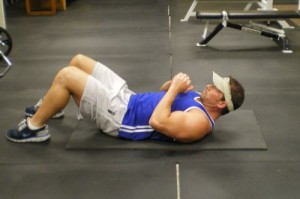
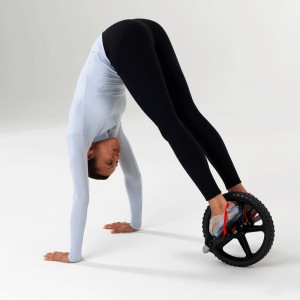
Well, I thought I would share the results of a recent study in the Journal of Strength & Conditioning Research. The authors wanted to look at the use of other training tools versus just a body weight only exercise. In the study, they looked at surface EMG activity for the upper rectus abdominus (URA), lower rectus abdominus (LRA), external obliques (EO), internal obliques (IO), transverse abdominus (TA) and rectus femoris (RF) with the following exercises:

  • Abdominal floor crunch
  • Supine V-up
  • Prone V-up on slide board
  • Probe V-up on stability ball
  • Probe V-up on TRX
  • Prone V-up on power wheel
crunch-start-500

Crunch

Prone V-up with power wheel

Prone V-up with power wheel

In short the major results are as follows:

  1. The most muscle activity overall occurred with the power wheel
  2. There was no significant difference for activation of the EO, URA and LRA
  3. RF was much less active only during the abdominal crunch

Practical applications include:

  • There is no realistic way to isolate portions of the abdominal muscles, but keep in mind one limitation may be that the study looked at MVC (contraction at only one point in the motion)
  • The RF is NOT a spinal stabilizer but rather a hip flexor and therefore it can cause an anterior pelvic tilt if overly active which can be viewed as potentially harmful
  • Focus on training the core globally as an integrated segment of the kinetic chain to maximize activation and understand how the hips affect completion of the movements

I hope this post stimulates your thinking with respect to abdominal training.  If you do use training tools, simply stop for a moment to consider the desired training outcome, as well as the impact the body position and  muscle firing patterns have on the exercise itself.

First off, I want to extend warm Holiday wishes to all of you reading this blog!!  As I sit at home on Christmas Eve morning, I am quietly reflecting back on a big year of accomplishments and changes I experienced in 2010.  It is often hard to take time to appreciate your blessings, Because as a society we are driven to conquer the “next thing.” However, I have been trying to get better at taking time to savor life’s victories.

Last year, I ran my first marathon (thankfully under 4 hours despite horrible cramps), sold my successful 10 year-old fitness business in Ohio, and moved to North Carolina to tackle a new venture at the Athletic Performance Center.  The past year has truly been full of many changes and blessings.

Over the years, I have come to realize that the real gift in my profession is being able to help others. For me, I have an ability to reach consumers through my rehab and performance training, as well as my peers through blogging, speaking and products.  If you read my blog, I hope that I have been able to help you even if it is only in the smallest way.

As I look ahead to 2011, I am excited for new opportunities and feel like it will be a big year of learning and exploration for me.  That will translate into more sharing on this blog and in my monthly Training & Sports Medicine Update Newsletter.  I am continuing to write for PFP Magazine through my online column and will share my latest post with you today on crossing lunges.

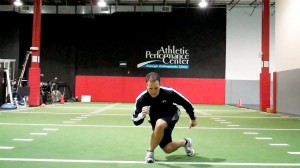
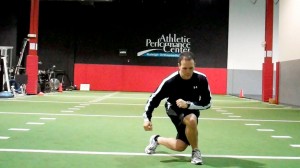
Performing a crossing lunge presents unique challenges to the body – challenges which often exploit muscle imbalances, mobility issues, and balance deficits.  It is a rotational activity that is more challenging then it may appear.

I once had an athletic trainer question the safety of them in an exercise class I was teaching.  She thought they were harmful for the meniscus in the knee.  Hmmm…. If that is true , why would I do them?  Well, like any exercise you do in the gym, there is always risk of an injury IF you do the exercise improperly.  That is a key takeaway point.  For the record, I never recommend an exercise I think is dangerous – in most cases it simply comes down to form and knowing your limitations.

Crossing lunges are very effective in strengthening the entire lower body, but particularly the hips.  Whether choosing the backward or forward variation, they call for hip internal/external rotation, knee stability and ankle mobility.  Beyond that, they are very functional for sport and athletic movement.

Think about field or court sports for a minute.  How many times does an athlete cross over to dribble, scoop up a ball or evade a tackle?  You may see the forward variation more, but the backward variation is seen as well with drop steps, pivot motions and even along the baseline in tennis.

So, if you train athletes or are an athlete, this is a great example to keep in your personal exercise tool box.  I have included pictures of the forward and backward version below.  See the link below the photos for my full column and explanation of how to do the exercise properly.

Backward Crossing Lunge (onto right)

Backward Crossing Lunge (onto right)

Forward Crossing Lunge (onto right)

Forward Crossing Lunge (onto right)

Click here to read my full online column, Functionally Fit, pertaining to this lunging exercise.  Thanks for reading this, and I wish you all the best in the year to come!