Share   Subscribe to RSS feed

Brian Schiff’s Blog

Injury Prevention, Sports Rehab & Performance Training Expert

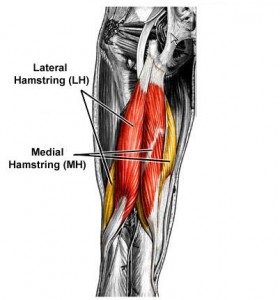
So, I have been swamped with work and marathon training, hence the recent delay in a new blog post.  Well, yesterday during a short 3 mile run (I am in taper mode with a 10/17 event) I experienced an acute left hamstring strain.

Hamstring strains are common and can produce incredible pain and limit function.  Most hamstring strains occur as the swing leg is coming forward and the knee is nearing full extension.  Essentially, it is a stretch type injury as the hamstring works to decelerate the momentum of the lower leg.

Injuries may be casued by inadequate warm-up, a sudden increase i training intensity/volume, fatigue, stiffness, weakness or muscle imbalances.  A prior injury may also increase your risk for re-injury.

hamstring

I have been running for years and am 5 months into my marathon training, so why now?  I honestly think it may be related to my speed yesterday.  My body naturally leans toward a 7:25 pace, but when I looked down at my Garmin yesterday at the point of pain, it said 6:54.  Yikes!  I was 1.25 miles into the short run.

I decided to keep running and slow my pace back to 7:30.  While I was able to complete the run, my lower hamstring was very tight and sore after the run.  Obviously, I have been icing regularly the last 24 hours.  No running today either.  I anticipate a quick recovery since the strain is mild and I am very fit.  But, what is the best way to prevent re-injury?

I have a quick article summary from the Journal of Sports & Orthopedic Physical therapy Journal for you to read that underscores how important functional movement rehab is in comparison to just static stretching and strengthening.

Click here to read the summary of the journal article

Now, with respect to running, agility may not be necessary.  Running is fairly linear (straight line) so what may be more important to gage capacity to return to running may be some of the following:

  • Absence of pain with active knee straightening
  • Absence of pain with walking
  • No pain with single leg hopping
  • Minimal to no muscle belly tenderness

In the end, you will need to let pain guide you.  Some will return faster than others, but inside of 21 days (the end of the subacute healing phase) you must be aware of the fragility of the tissue as it heals.  I am confident this will not derail my marathon, but the lesson learned is to watch your starting pace as it may lead to some muscle strain.

I was asked to comment on a thought provoking blog post on MyPhyscialTherapySpace.com.  There is ongoing discussion with respect to the exact role a therapist should play in the continuum of care for patients.  I enjoyed reading the posts on there and I have posted my reply on my blog for you to see (not to mention the fact the blog site would not let me post my entire repsonse in a single comment).  To read the original post click the link below:

http://bit.ly/cW790b

Now my comments…….

I would say as a cash based practitioner currently living in the sports performance and post-rehab fitness realm (I own a fitness training facility), I would say that many of my therapy colleagues do not truly understand how to push and/or fully rehabilitate people to a high enough level that meets the pre-injury functional capacity.

I often see referrals that have already failed traditional rehab or are getting inadequate therapy.  Why?  In many cases, PT’s are following basic protocols, not supervising exercise progression closely enough, moving too slowly or in some cases (ACL rehab) moving too fast.  I also find clinicians are often hesitant or perhaps unwilling to change treatment progressions within the sessions, reps or sets even if the client’s response to the stimulus indicates such a change.


Continue reading…

The longer I work with clients, the more hip issues I see.  Generally speaking, I find the major issues to be related to decreased mobility, poor stability and muscle imbalances.  These may occur in isolation or combination.

It is a no-brainer that most people have tight hip flexors and external rotators given all the sitting that takes place in our computer age.  This inherently creates weakness and tightness.  I feel that a natural propensity to be positioned in hip external rotation may actually reduce the firing of these muscles which in turn allows for more valgus moments at the knee and reduces lower limb stability.

Typically, female athletes fail to adequately fire the gluteus maximus (hip extension and external rotation) and prefer to dominate movement with the quads.  So, how do we begin to change this?

Well, first we must focus on better hip mobility.  I believe we must work to gain better hip extension by stretching the hip flexor group.  I also believe we need to do this dynamically and not just passively.  A dynamic approach also allows us to improve knee stability on the opposite side as we work on hip mobility.  It will also allow us to resist internal rotation of the femur and the valgus moment at the forward knee.

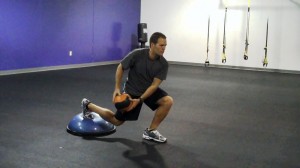
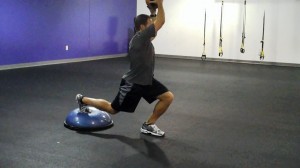
Look at the images below:

bosu-split-squat-diagonal-chop-1

bosu-split-squat-diagonal-chop-2

I am demonstrating a BOSU split squat diagonal chop.  This is the first of a series of BOSU exercises I am doing for PFP Magazine.  The upward chop forces hip extension on the right side and the downward motion reinforces firing of the left glutes to reduce internal rotation and valgus.  What a perfect combo right?

To read more about this exercise, click here.

Now, you should start on the floor with just the arms and progress from there.  This is a great prehab exercise or warm-up activity, but it cna also be used for strengthening too.  I hope you find it as beneficial in your routine as I do.

So, for Labor Day 2010, I decided to take my family to Kings Island.  I have always been a fan of thrill rides and it has been well over a decade since I had been to Kings Island.  It was also before I have experienced more than one bout of sciatica.

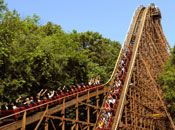
My nieces live nearby and they agrred to watch my sons for a brief time while my wife and I headed off to ride some of the bigger rides.  I insisted we ride the Beast – a coaster classic by any standards.  It is the world’s longest wood coaster and lots of fun.

beast_thumb

What I failed to remember was just how much jarring and abuse the good ol’ Beast could inflict on one’s body in those tiny little cars.  After 4 minutes of fun, it all came back to me.  For those who don’t know, I have been training for a marathon and admittedly after most 19 plus mile runs (I did one on Sunday) my back is stiff for a day or two.

Perhaps riding the Beast (and the Racers too at my wife’s insistence) the day after a long run was not such a wise move.  🙂  I woke up this morning with what I term “old man back.”  Now while that may sound funny, to anyone who has experienced it, you know how unpleasant it is. 

I crawled out of bed and managed to teach a boot camp class at 5:30 AM without incident.  Beyond the stiffness, my day has been marked by difficulty bending forward and lots of ice.  I am not complaining as much as I am telling you that as we get older (unfortunately I mean older than age 30) our shock absorption qualities in the spine begin to decline.

You see, our discs between the vertebrae act as a cushion and help prevent injury.  But, as we age, they naturally begin to degenerate in our thirties (degenerative disc disease – bummer).   This ultimately means we are more vulnerable to harmful forces and stress on the spine.  Ever wonder why those signs warn you not to ride if you have neck or back pain? 

It is likely the sudden torque, twists, turns and bumps that may leave you feeling rough then next day.  Am I saying not to ride?  NO!!  I love coasters.  I will be back at it again in the near future.  What I am saying is know your own personal situation and if you have some past back issues like me, be prepared to endure “old man back” for a few days as you hit the theme parks.

I will be over it in a day or so.  As a matter fo fact I ran 4 miles today with no pain.  Some keys to spinal fitness are:

  1. Practice good body mechanics with bending, lifting, sitting, etc.
  2. Don’t sit too much without standing up.  Our bodies need balance, and too much sitting (flexion) is bad for the discs in the back.  Be sure to stand up no less than once per hour as your back craves to be in extension an equal amount of time.  Standing back bends (sets of 5-10) is a great way to improve spinal fitness if you have a desk job.
  3. Stretch and strengthen the abdominals, but avoid full sit-ups.
  4. Strengthen the low back muscles and hips.
  5. Avoid flexion and rotation moments.

In the end, if you have a flare-up, then use ice and let pain guide your movements.  One last tip: stick to the steel coasters for a smoother ride!

So, I read a very interesting article yesterday in the local paper here, The Columbus Dispatch.  The title was “Children May Be Vulnerable in $5 Billion Youth-Sports Industry.”

I have a vested interest in this discussion for two reasons:

  1. I profit directly from youth sports training in my business
  2. My two boys participate in youth sports

Consider some stats from this article:

  • Youth sports has more than 6x the athletes than high schools
  • 99% of high school coaches have also coached a youth team
  • 90% of HS athletes played youth sports
  • 50% began playing between 6 and 9
  • 31% of athletes paid more then $1500/year to play
  • 26% of those hurt while playing youth sports said their injury affected their ability to play any sports
  • 20% say their parents pressured them to play youth sports

Perhaps the final bullet point may be the most disturbing, right?  Who wants pressured?  Well, we all know parents want the best for their kids, or so they should.  Sometimes, they simply push too hard as they may want their child to get an elusive scholarship, or perhaps they are trying to live vicariously through the child. 

While I am a firm believer in giving kids every opportunity to excel, there needs to be a healthy balance and perspective too.  Kids at age 5 don’t need to be doing sport specific training.  I don’t think elementary age kids need to be playing tackle football either.  Why not work on coordination, cutting safely and general movement skills?  The biggest thing I hate to see is specialization at an early age.

Kids should play multiple sports and work on multilateral sport development and not unilateral sports that often lead to overuse and premature injuries.  Specializing in a sport is something to be considered during the high school years and beyond. 

Back to the article.  Consider this: one woman spent $30,000 to send her teenage son to IMG in Florida to train 6 days per week for 6 months.  Another parent would drive through the night back to the Pittsburgh from Florida so his son could pitch on an elite team there on the weekend and be back in time for school for 3 straight months in the winter.  Is this crazy or what? 

I do not want to sound too judgmental, but at what emotional, psychological and physical cost do we draw the line?  One 11 year old club soccer player gave the sport up because her coach screamed at her so much.  Now she runs.  Seriously?  Coaches are driving youth athletes away and toward burnout daily due to elitism and ultra competitive coaching tactics/behaviors.

Perhaps we should be ashamed of ourselves?  I try hard not to be a part of this.  I will openly turn away sessions if I feel the athlete has too much other stuff going on.  I did this just the other day as one mother called and said her son was playing soccer and running cross country.  She mentioned he had some mild knee soreness.  I know why.

I told her training with us was not a good option right now and that he should come back in the winter when he was not playing a sport.  After talking, she thought this made perfect sense.  She was not a pushy parent and truly understood that more is often not really better (refreshing).

One of my own athletes who has worked with me since age 10 recently had to give up the sport of soccer.  She suffered multiple concussions, and now at age 16 is dealing with recurrent memory issues, medications and altered mood states.  Wow!  Is that the norm?  No, but we must consider she plays soccer year-round and has since an early age.  Her situation is not one in which the parents or coaches share any blame.  The concussions are just an unfortunate risk in soccer.

However, as athletes play more competitively at younger ages, we may very well see more injuries and a higher severity as well since the exposure risk increases.  It is certainly worth looking at in the years to come.  Is all the training, extra practice and grueling competition really detrimental long term?  It may be hard to say for sure, but if you coach, train athletes or are a parent, I beg you to consider the overall maturation and life cycle of your children as it relates ot sport.

Let them have fun and choose what they want to do.  Let them be free to play and don’t look down on them if they walk away from your sport or chosen activity.  Don’t be in a hurry to make them the next best (fill in the blank).   Let’s all work together to make youth sports fun, safe and enjoyable again.   

Oh yeah, and let’s make sportsmanship a priority again.  One referee in the article was quoted as saying, “The parents are ruder.  They don’t care about sportsmanship or if they are hurting a kid.  They just argue.”  While coaching my son in flag football this past Spring, one parent on an opposing team was trash talking.  I mean really inappropriate stuff too.  I never agree with this kind of  behavior, but I think that at ages 4 and 5 it is utterly ridiculous.  I will save that rant for another day.  LOL 

In the meantime, stand with me and be protectors of our youth athletes by using sound judgment, staying current on research, and listening to our kids as they grow.