One of the most common PT clients I see is an injured runner. There can be a umber of different reasons or factors involved leading up to a running injury, but I wanted to focus on this idea of gait retraining that is taking place today. With the advent of Born to Run and minimalist footwear, people have begun to question and debate what the best way to run is.
Is this suited for everyone?
Let me just say right away that I do not believe there is a simple answer here. Human beings are all unique and have different genetic and biomechanical makeups. What this means in effect is that they have their own set of “issues” if you will that I classify into common categories such as:
Static alignment problems (arch, knee, hip, etc)
Static and dynamic balance deficits
Inefficient gait mechanics
Muscle imbalances
Soft tissue tightness
Recurring pain patterns
The list could go on and on, but you get the point. The idea of “re-teaching” someone how to run differently than their natural motor pattern dictates in not easy and is a decision that should be well thought out and based on sound decision making. We are pre-programmed at birth with certain native motor patterns and running is one of those patterns. Generally, your brain finds the most efficient way for you to run in your own body.
Now granted, some run much better than others. Perhaps we can say athleticism plays a role in this, but as we grow and reach skeletal maturity our body type, training experience, strength and environment are also major factors . With that said, I know that runners with recurrent and/or chronic pain are looking for a finite solution to their problem. They grow frustrated when they are unable to log all their miles or finish a race.
If traditional PT or relative rest fails to alleviate the pain, we must delve deeper and look more closely at their gait. I think video analysis is a great tool for doing this. We use Dartfish at my clinic, and this is very useful for breaking down gait mechanics and detecting things like heel versus forefoot striking, overpronation, asymmetry side-to-side, trunk inclination, etc. Once we find things on video we must also correlate these findings to our clinical screening to uncover a cause and effect relationship.
By far the most common problem I see in the clinic is shoulder pain. Most of the time it is related to overuse, rotator cuff tendonitis/impingement and labral tears. Because we are geared more toward sports rehab, I also treat a lot of overhead athletes (baseball players, volleyball players and swimmers).
A common thing I will see in those suffering from impingement or rotator cuff pain is scapular winging. Most of the time the muscle is simply deficient in strength/endurance and it along with the lower trap become overpowered by the upper trap, levator or even the rhomboids. Shortened scapulohumeral muscles, poor posture and pec tightness can also impact winging.
There are many traditional exercises such as serratus punches, push-ups with a plus, and serratus plank push-ups to name a few, but I wanted to include a closed chain exercise that can be very effective for facilitating proper activation of the serratus – quadruped rocking.
In the video, I show it with both hands fixed on the floor progressing to one hand (on the involved side). The key is quality of movement throughout. After you check out the video, be sure to scroll down and click the link to a full column I wrote for PFP magazine on this exercise as it further explains the technique and application.
Click here to read the online column for PFP Magazine.
Well, Thanksgiving is upon us in 2011. I want to wish you and your family a wonderful holiday. In today’s post I will review a November 2011 article in the American Journal of Sports Medicine that looked at the effect of the Nordic hamstring exercise on hamstring injuries in male soccer players.
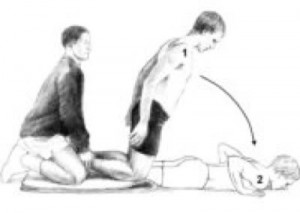
For those not familiar with Nordic hamstring exercises, see the photo below:
In this randomized trial, the researchers had 54 teams from the top 5 Danish soccer divisions participate. They ended up with 461 players in the intervention group (Nordic ex) and 481 players in the control group. The 10 week intervention program was implemented in the mid-season break between December and and March because this was “the only time of the year in which unaccustomed exercise does not conflict with the competitive season.
The trial was conducted between January 7, 2008 and December 12, 2008 with follow-up of the last injury until January 14, 2009. In the intervention group, all teams followed their normal training routine but also performed 27 sessions of the Nordic hamstring exercises in a 10 week program (as follows)
Week 1 – 2 x 5
Week 2 – 2 x 6
Week 3 – 3 x 6-8
Week 4 – 3 x 8-10
Weeks 5-10 – 3 sets, 12-10-8 reps
Weeks 10 plus – 3 sets 12-10-8 reps
The athletes were asked to use their arms to buffer the fall, let the chest touch the ground and immediately get back to the starting position by pushing with their hands to minimize the concentric phase. The exercise was conducted during training sessions and supervised by the coach. The teams were allowed to choose when in training it was done, but they were advised not to do it prior to a proper warm-up program.
Shoulder impingement and scapular dysfunction are common issues that plague many clients. Research indicates that certain muscles tend to dominate others while other muscles fatigue easily leading to faulty movement patterns and increasing the risk for impingement. Muscle length and posture are also key factors to consider.
I like to use a mini-band retraction with clients exhibiting excessive scapular abduction. In the video below, you will see a simple, yet effective exercise to address this faulty alignment of the scapula. Keep in mind, you must observe the client or patient from behind with the scapula exposed to properly assess alignment and movement.
This exercise is designed to strengthen the middle trapezius and rhomboids. In addition, it will improve scapular stability. Scapular abduction is usually more evident with elevation from 90-180 degrees as the ratio of scapular movement to glenohumeral movement is 1:1 instead of the normal 1:2 ratio throughout since the scapula is already in an excessively abducted posture at rest.
To read more on the application and exact execution of this exercise, click hereto read my column for PFP Magazine.
I work with many runners in our clinic. I often see restrictions in the soleus. While the running community is warming up to soft tissue mobilization, many runners are still resistant to embrace it routinely and engage in it more so only when they are hurt or lacking flexibility.
STM (soft tissue mobilization) should be part of every runner’s maintenance program. Why? Simply put, repetitive stress takes its toll on the body. Rolling or releasing the tissue increases blood flow, eliminates trigger points, and facilitates optimal soft tissue mobility and range of motion.
In the diagram below, you can see common trigger points in the soleus. The X represents the trigger point & the red shaded area is the referred pain caused by the trigger point.
In the case of the soleus, restricted dorsiflexion could lead to other biomechanical compensations with running. Initially, this often creates a dysfunctional and non-painful (DN) pattern. Over time, this may eventually become a dysfunctional and painful (DP) pattern forcing runners to seek medical care. The terms DN and DP come from Gray Cook’s Selective Functional Movement Assessment (SFMA).
The gait cycle is certainly altered from dysfunction in this muscle. If ankle joint dorsiflexion is compromised (a common effect of soleus restrictions), there can be increased strain on the quads and altered movement in the hip. Overpronation and excessive hip adduction and internal rotation are common compensations seen with running. Other signs and pathology that may be associated with a soleus trigger point may include:
Plantar fasciitis
Heel pain
Shin pain
Knee or hip pain
Back pain
As such, restoring mobility is important. A recent study revealed that immediate improvement in ankle motion can be attained with just a single treatment (click here for the abstract).
So how do you effectively resolve soft tissue issues in this area? I suggest using a foam roller or better yet the footballer and baller block in the Ultimate 6 Kit for Runners by Trigger Point (see pic below)


 0
0



 Back to top