Share   Subscribe to RSS feed

Brian Schiff’s Blog

Injury Prevention, Sports Rehab & Performance Training Expert

I have trained hundreds of soccer players over the years ranging in age from age 8 to the ranks of MLS professionals.  The sport has taught me such an acute appreciation for body control and field agility.

For years, I have focused my lower body training on ground based movements such as lunges, squats, and multiplanar reaching progressions with great success.  To me, the lunge has always made great sense in terms of the apparent functional carry over or at the very least the related muscle activation pattern with sprinting, cutting and changing direction, not to mention acceleration.

A recent study in the May Journal of Strength and Conditioning Research looked at how walking forward lunges and jumping forward lunges impacted delayed onset muscle soreness, hamstring strength and sprinting performance.

Interestingly enough, after 6 weeks of training, the group doing walking lunges showed a 35% increase in concentric hamstring strength, while the jumping group had improved sprint running performance.  In past studies of 10 weeks of training using Nordic hamstring exercises, soccer players typically showed an 11% increase in eccentric hamstring strength. 

Meanwhile, neither group expereinced an increase in quadriceps strength, but the  control group actually saw a 7% reduction in quadriceps strength.  This would lend credence to my belief that while all the running in soccer is quad dominant, running itself does not increase quad strength per se.

Now, in regard to muscle soreness, there were no significant differences between groups per se, but delayed onset muscle soreness as measured 2 days after exercise did negatively impact running and jumping, but not strength.  No real surprise here.

The takeaways for coaches is that incorporating lunge walks and jumping lunges in training may bring about dual benefits.  Improved sprint performance is desirable as well as better hamstring strength for the prevention of muscle and knee injuries.  Increasing hamstring strength obviously is helpful in balancing Quad/Ham ratios for the reduction of ACL injuries as well as hopefully decreasing the likelihood of hamstring strains at ground impact through mid stance in running.  On the latter point, I favor deeper or reaching lunges to provide a greater stretch or elongation of the proximall hamstring fibers as well. 

I also like to employ a walking lunge with trunk rotation as part of my dynamic warm-up with my soccer players.  I ask them to rotate the trunk to the side of the lead leg which helps encourage hip abduction thereby activating the gluteus medius and reducing the internal rotation and valgus moment at the knee.  So, if you coach or train young soccer players, be sure to consider adding these body weight lunge exercises to your program 1-2x/week in the off-season and pre-season.

Golf is in the air in Dublin, OH as Tiger and the PGA have invaded my neck of the woods for the Memorial Tournament.  Too bad I am on vacation missing it!!  Anyway, I just read a new research article validating what many of us have been saying for years about dynamic warm-up – this time it relates to golfers.

Do you care about club head speed, accuracy and consistent ball contact?  Then listen up.  In the most recent edition of the Journal of Strength and Conditioning Research, Jeffrey Gergley reveals some important findings relative to a passive stretching regime coupled with an active dynamic (AD) warm-up versus just an AD warm-up and its effects on golf performance.

In a nutshell, his study involved 15 young male competitive golfers.  Immediately after the warm-up, each subject was instructed to hit 10 full-swing golf shots with their driver after their normal pre-shot routine with 1 minute rest intervals between each shot.  The results are as follows:

Golfers who used the 20 minute passive stretch routine in addition to the AD warm-up with golf clubs saw:

  1. A 4.91% decrease in club head speed
  2. A 5.62% decrease in distance
  3. A 31.04% decrease in accuracy
  4. A 16.34% decrease in ball contact consistency

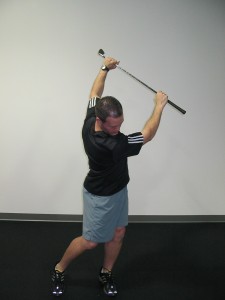
Wow!!  The take home message is this – golfers should focus their warm-up routine on active movements with the golf club emphasizing the bio mechanical range of motion needed in the golf swing itself.  Using a thorough dynamic warm-up will adequately prepare golfers to hit the ball better and reduce injuries.

Want such a warm-up?  Check out my Healthy Golf Shoulders E-Book for such a warm-up at www.healthygolfshoulders.com.  A sample warm-up move from it can be seen below.  

    golf-ebook018

I had a former client of mine email the other day and ask for some hamstring exercises to relieve stiffness and soreness.  This female athlete suffered two ACL tears in high school in the same knee within 7 months of each other.  The first one was non-contact and the other was due to a questionable slide tackle  from a competitor only a few weeks after she returned ot full play.

Needless to say, I rehabbed her both times and she did great.  This girl is a phenomenal athlete to be sure.  She moves powerfully but gracefully at the saem time.  She is going to play for Clemson next year on scholarship.  After her surgery, she had some mild hamstring stiffness and soreness that eventually resolved in her return to play progression with me.    Since she needed some summer rehab exercises to knock out the stiffness again, I decided to put together a short video sequence of exercises for her to do.

Keep in mind, many field and court athletes suffer hamstring strains.  This athlete just had some residual stiffness related to her surgeries.  In the female athlete, we cant’ spend enough time strengthening the hamstrings.  However, here are some critical errors I have seen strength coaches and therapists make over the years:

  1. Focus too much on isolation exercises
  2. Rely too much on passive stretch/pain response
  3. Under emphasize eccentric proximal closed chain work
  4. Disregard the rotational component of the hamstrings 

Any one or combination of these things will lead to incomplete rehab or almost guarantee a recurring injury and chronic inflammation.  while I do not profess to know it all when it comes to these things, I do have firsthand experience (two torn hamstrings – ouch!) and I have put athletes with chronic hamstring issues back to full play in as little as 3 weeks when they have had up to 12 weeks of unsuccessful rehab elsewhere.  Magic?  Not at all.  It involves systematically tarfeting the tissue and properly preapring it for the activity to come.

So, I have included a series of 5 exercises I think you should include as part of a performance, prevention or rehab plan for your athletes in this short video (less than 60 seconds).  Not only will these exercises make your athletes healthier, they will also improve strength, mobility, and balance as well.

I want to wish everyone a Happy Memorial Day.  I have included a clip of a recent interview I did with the local Fox News affiliate on the rise in certain injuries I have seen in youth sports.  Unfortunately, I continue to see certain overuse injuries and other patterns of injuries that we, as strength and conditioning professionals, can reduce with proper training.

By far, I help more people with knee and shoulder problems in my profession.  As a therapist and fitness pro, I often use lingo that some do not fully understand.  In fact, I often find myself analyzing gait patterns of people at the grocery store and even the ringmaster at the circus this past weekend. LOL

I guess I am a biomechanics geek of sorts.  It just seems as if faulty mechanics stick out like a sore thumb for me wherever I go.  Now, when it comes to bony alignment, you can thank  your parents to a large degree for your shape and knee alignment.

Obviously, girls have wider hips so they naturally tend to exhibit greater tendencies to have valgus overload (knees cave in with squatting or landing) than males.  However, other factors that contribute to valgus overload are:

  • Hip tightness (adductors and IT Band)
  • Hip weakness (gluteus medius)
  • Foot pronation (flatter or collapsing arch)
  • Pain (which leads to compensation)
  • Improper muscle firing patterns

So, we know valgus is bad.  Does this mean neutral and varus are free from worry.  Not so.  I have seen many people with neutral alignment fall into valgus due to imbalances, poor muscle memory and faulty motor patterns.  Varus knees are often subject to excess stress (compression) along the inside of the knee and gapping along the outside of the knee stressing the lateral collateral ligament.  Valgus knees offer increased compression on the lateral knee and gapping along the medial knee stressing the medial collateral ligament.

In the end, you simply want to know your alignment and then assess how gravity and ground reaction forces impact your joints.  Squatting and gait provide ample cues.  Once you know the imbalances, you can address them with exercises. 

I helped do orthopedic screenings last night for a local high school and noticed a few steady trends:

  1. Nearly all of the soccer players had varus knees
  2. All of the offensive and defensive linemen had valgus knees
  3. Cheerleaders had the best single leg squat strength and balance
  4. About 75% of the athletes I saw had less than exemplary single leg dynamic strength/balance

I included two very different pictures below of high school female soccer players doing a drop landing test from an 18″ box.  Obviously the valgus landing is more predictive for ACL and knee injury.

abbey-2

Minimal valgus at landing

carly-2

Significant valgus at landing

Obviously the girl in the second picture has a higher inherent risk of a serious non-contact knee injury.  I recommend a knee prevention program for all cutting and jumping athletes, but when you see this type of valgus loading   sound the alarm and be sure to implement a corrective exercise plan to reduce injury risk.

I am putting the finshing touches on my ACL prevention DVD as I write this.  You can still take advantage of the pre order sale if you act now.  Visit www.fitknees.com for more info.