

Brian Schiff’s Blog
Injury Prevention, Sports Rehab & Performance Training Expert
 0
0
Increasing hip strength and stability is a common focus in training and injury prevention programs. Current research indicates hip and knee strengthening is more effective than knee strengthening alone in those suffering from anterior knee pain. I routinely use mini-bands to strengthen the hips and maximize proximal stability.
Many clients struggle with poor proximal hip stability that shows up as excessive frontal plane adduction and compensatory trunk lean. This exercise targets the hips and closed chain control needed for those participating in jumping, running, cutting and pivoting activities. It is an excellent way to warm-up and activate the hips as well as reduce patellofemoral overload and prevent knee injuries.
It is no secret that running is synonymous with overuse injuries. Despite the best intentions, human nature craves more and more, while the competitive nature in us all to push a little harder also tends to get the best of us at times. One of the most rewarding parts of my job and profession is putting together plans that restore health and maximize performance.

The following story highlights both in an endurance athlete who I had an opportunity to work with last year. Normally I write about research, training and exercise on this blog. This post allows me to share the insight and perspective of one of my clients. I know that many of my readers have battled injuries. I am confident that this story of recovery and learning how to use the RIGHT training will resonate with you.
Click here to read about Anthony’s journey back to running
Many people struggle to activate their gluteal muscles while running, jumping or performing athletic activities. Turning on these muscles and “priming” the body to utilize the glutes in its normal neuromuscular programming is helpful in improving alignment and reducing injury potential. The band rotation exercises cue external rotation with the resistance pulling the knees toward one another.
Activating these muscles prior to doing multi-joint lifts, sprinting, plyometrics, etc. is beneficial in promoting optimal activation/stabilization in order to control excessive pronation with deceleration and eccentric training. The rotations can easily be added to the dynamic movement prep or even used as part of the normal training program. I also like to use them prior to incorporating side stepping and forward/backward walks with the bands.
The video below is one I created as part of my Functionally Fit series for PFP Magazine. It is a staple in our rehab programs and movement prep routines for our athletes at EXOS Athletes’ Performance at Raleigh Orthopaedic as well.
This is the fourth corrective exercise I have featured in my “Functionally Fit” online column for Personal Fitness Professional Magazine. All of the correctives are based on screening assessments from the FMS.
The active straight leg raise (ASLR) assessment (as part of the FMS) is an essential part of any assessment I do on my athletes and runners. It provides a great look at a client’s ability to stabilize their spine/pelvis and we observe hip separation with one hip moving into flexion and the other fixed hip moving into greater relative extension.
Why does hip disassociation matter? Simply put, a lack of ideal separation can negatively impact step and/or stride length, reduce propulsion and create other compensations that increase energy expenditure and reduce overall running form. Some deviations that may occur include hip drop, increased rotation or circumduction of the swing leg, excessive torso rotation, increased knee flexion and diminished stride length to name a few.

Execution: Lie on your back. Using a doorway, place one leg against the doorway in a position that allows you to keep the lumbar spine flat while the other leg is extended and on the floor. Next, flex the down hip to the height of the other fixed leg extending the knees. This leg will remain unsupported. Now, point the toes of the unsupported leg and reach out toward the ceiling. Slowly lower the leg to the floor or the lowest point where you can still maintain a neutral lumbar spine (a bolster may be placed beneath the leg if needed). Perform 10 repetitions and repeat 2-3 sets on each side.
Progress the activity by lowering the leg further and/or sliding closer to the doorway to increase the hip flexion and total hip separation. Do not allow the lumbar spine to extend as this is a common compensatory motion for limited mobility in the iliopsoas.
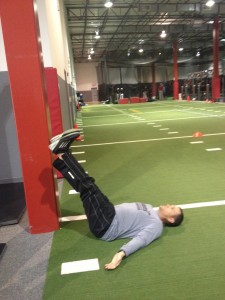

Application: This activity will improve active mobility of flexed hip as well as promote continuous core stability and available hip extension of the opposite hip. It challenges the client’s ability to disassociate the lower extremities while maintaining stability in the pelvis and core. Keep in mind it is more than just a hamstring flexibility activity as it also addresses static (pelvis/spine) and dynamic (hip) stability in asymmetrical hip separation pattern.
This separation pattern is essential for optimal running mechanics. Poor hip disassociation can lead to asymmetrical or bilateral movement flaws, thereby reducing performance and leading to compensatory motion with an elevated risk for injury. This simple technique can be done daily to enhance hip mobility and pelvic/hip stability.
Every year I like to look back and reflect on things I have learned, things I have changed my mind about and of course clinical pearls that stand out. Over the past year, I have been sharpening my IASTM skills, begun to practice dry needling techniques, and scrutinizing my hip and core exercises that I routinely use in rehab.
I look forward to sharing more about my clinical experiences with dry needling in 2014, but I feel the most critical and recurring theme of 2013 has been the overwhelming impact I have seen poor ankle dorsiflexion have on my patients. I treat scores or runners, triathletes and clients with knee pain. The most common issues in this group of clientele tends to be IT band friction syndrome or patellofemoral pain.
When I assess this group of patients, I routinely find the following:
- Poor dorsiflexion
- TFL dominance
- Glute weakness
Any time I evaluate a runner, I assess closed chain dorsiflexion (DF) mobility. This can be assessed in half kneeling on the floor or standing at a wall. I suggest removing the shoes during the assessment to eliminate any rise from the heel in the shoe that may bias the movement. In addition, I hold the ankle in subtalar neutral to get a true assessment without allowing pronation.
The image below simply demonstrates the assessment position as well as the corrective exercise that can be used to facilitate better motion.

Clients should be able to attain about 5 inches of clearance beyond the toes without lifting the heel or relying on pronation to get there. I routinely see limited mobility, and more importantly almost 100% of the time I find asymmetry on the side of the affected knee.
I recently evaluated a 29 y/o active female client who does Crossfit 3x/week and likes to run. She has not been running much due to chronic right lateral knee pain and medial calf pain. Her goal is to get back to running half-marathons. Upon evaluation, her overhead squat assessment revealed pronation and external rotation bilaterally, right greater then left. Her standing wall DF assessment revealed nearly a 1 inch deficit on the right side (about 3 inches), while her left side was 4 inches.
Below is how she looked on the treadmill video analysis I performed:

You can see the highlighted areas in the photo above. She has a marked amount of pronation in mid stance as well as left pelvic drop due to poor gluteal activation. The poor hip stability and activation on the right side also plays directly into TFL dominance with the repetitive femoral internal rotation and adducted position of her right hip..
This poor biomechanical chain is set into motion by poor dorsiflexion mobility. Runners can get away with this for shorter distances (3-4 miles) in many cases, but increased mileage leads to shin splints, calf strains, IT friction syndrome and patellofemroal pain. You can see how this poor kinetic chain movement leads to ongoing microtrauma and eventually debilitating pain and dysfunction. No matter how much one rests, going back to higher mileage will yield the same result.
In my client’s case, she also had a trigger point in her medial soleus – another issue connected with the ankle mobility problem. Her primary treatment plan will focus on soft tissue mobilization for the gastroc/soleus complex, TFL/ITB and glutes/piriformis, ankle dorsiflexion mobility exercises, IASTM to her gastroc/soleus/Achilles, single leg balance and strengthening and hip/core activation and stability work.
I am confident all of this will effectively resolve her pain. However, it all begins with restoring ankle mobility. They say a picture is worth a thousand words. I strongly believe the picture I included of my client on the treadmill speaks volumes as to how poor ankle mobility can lead to unwanted compensatory motion, gluteal inhibition and overuse injuries. The take home message here is be sure to assess ankle mobility in the presence of any lower extremity pain or dysfunction as it is often a critical piece of the puzzle in the face or recurring injury and chronic pain.
 Back to top