

Brian Schiff’s Blog
Injury Prevention, Sports Rehab & Performance Training Expert
 2
2
So many times, athletes and parents alike are singularly focused on the physical rehab necessary after an injury. Often, what the athlete is not talking about is the psychological impact of the injury. Suddenly, their identity and self worth may come into question. They feel disconnected from teammates and coaches. Their daily routine consists of rehab and not practice/play. Deep inside their head they are quietly wondering, “Will I ever be the same again?”

Aside from some of the obvious questions that race through an injured athlete’s mind, one of the biggest and most often unspoken concerns is the fear of re-injury. Having worked with athletes of all sports, ages and abilities, I have seen firsthand how important it is for an athlete to go through a functional and sequential progression that assures that they are able to run, jump, cut, pivot and decelerate again without pain or instability.
I have worked with hundreds of athletes over the course of my career that have suffered ACL injuries. The longer I practice, the more I become convinced that we probably have been pushing or allowing these athletes to go back to their sports before they are really ready (physically and/or mentally). Six months has long been the benchmark for most orthopaedic surgeons. The graft is well healed, but often the mind and body are not really ready.
While I have seen athletes who have great strength, stability, hop testing scores above 90% and look good on movement drills, sometimes these same athletes still have asymmetrical squat patterns, FMS scores lower than 14 or apprehension about returning to their sport. In addition, fear of re-injury is a big factor that impacts confidence and readiness to return to activity.
Consider some of these facts about modifiable factors with return to sports after ACLR from the May/June 2015 Sports Health Journal:
- Motivation, confidence, self-efficacy, optimism and low fear are associated with a greater likelihood of returning to preinjury level after athletic injury and ACLR
- Lower fear of reinjury and greater pyschological readiness to return to sport favored returning to preinjury level after surgery
- Combinable data from 10 studies suggests that fear of reinjury, psychological readiness to return to sport and one’ subjective assessment of knee function were predictive of level of return to sport
- As many as 1 in 2 athletes who do not return to their preinjury level of sport report the main reason is fear of reinjury
Whether doing prehab, rehab or training, I believe in using single leg exercises to attack asymmetries, imbalances and motor deficits I uncover in my assessments. Learning to control one’s body in space with the effect of gravity in a weight bearing position is instrumental for sport and injury prevention.
Furthermore, facilitating ankle mobility and proper knee alignment during a loaded squat pattern is something most athletes and clientele I work with need some help with. to that end, I utilize several different single leg reaching progressions and exercises. One of my favorite ‘go to’ exercises is the anterior cone reach.
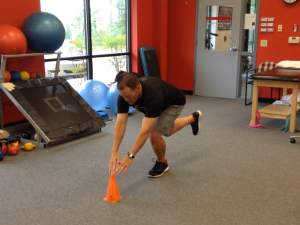
I recently featured this specific exercise in my ‘Functionally Fit’ column for PFP Magazine. Click here to see the video demonstration.
This is a great exercise with progressions and regressions for clients of all ages and abilities.
 As a father, coach and physical therapist working in a sports medicine environment, I am all too familiar with youth injuries. While we can not prevent every injury, I do believe we need to do everything possible to keep our young athletes out of harm’s way. In today’s ultra competitive society, parents are faced with pressure to “keep up” or fall behind.
Contrary to what research and real life has to say about it, organizations and coaches who want to win now tell parents and players you need to choose one sport at an early age if you want to be the best. I see the club fees that organizations charge, the emotional heartbreak of not making the top tier teams and the grind of all the “extra” training sessions for skill work, speed training, etc. that athletes endure.
Gone are the days where just playing for your school team is enough to garner attention at the next level. It seems as if athletes must play in AAU, clubs, travel teams or showcase opportunities to stand out. It is apparent to me as if we have become hyper focused on training our children to obtain a scholarship at such an early age. Some of the things I hear parents say illustrate to me their are pushing their children very hard to meet these expectations. The idea that sports should be fun for young kids seems to be lost on the coaches and parents in many cases.
My 9 y/o son (picture above running the ball) told me one reason he does not want to play Pop Warner football next Fall is because of all the practice time required. We practiced 5 days per week in August, followed by two hour practices 3 nights per week and a Saturday game during the regular season. He loves the game and was one of the best players on his team, but the time and exhaustive training simply wore him out. So, he says he wants to play soccer next Fall instead. I told him this was fine as he needs to be the one that wants to play – not me telling him to play. He also plays basketball in the Winter and soccer in the Spring.
As a parent, I want to encourage others to listen to their kids and put their own goals and interests aside. We should not try to live vicariously through our kids on the court or field. Sports should not be work for young people, and adults should not care more about the game than the participants at a young age. As coaches and medical professionals, we need to do everything in our power to promote health and life balance for young people.
Running is in full force as Spring has sprung. If you have ever experienced shin pain during or after your training runs, you know firsthand how aggravating this condition can be. I treat many runners with overuse injuries. Common issues include anterior knee pain, IT band pain, plantar fasciitis and of course shin splints.

Click here to read an earlier post on the link between poor ankle mobility and overuse injuries. Unfortunately, shin splints can progress to a more serious stress fracture if not diagnosed and treated properly. Recently, I was interviewed for a series of articles on thew topic of shin splints by Fitness Magazine. You can read those articles below:
How to prevent, treat and heal shin splints
If you follow my blog, you may remember that about this time last year I posted some info about a compilation of body weight training resources. Well, a new version is back for 2015, and as a person who contributed to the project, I wanted to make you aware of the offering. It is available from today until March 27 at 11:59 PM and includes content from different disciplines within the health and fitness community.

Get the NEW Bodyweight Bundle 2.0 bundle here
It includes:
8 Bodyweight muscle building resources
6 Bodyweight fatloss programs
6 Bodyweight “trick” manuals
7 Bodyweight video/workout programs
4 Bodyweight flexibility/rehab programs (including my shoulder e-book)
Plus…
… fat-burning recipes, meal plans and more.
You can harness the power of bodyweight exercises from multiple experts to transform your body and your life. You can own all 37 resources for only $37 for a limited time! Click on the image below for more information.

 Back to top