

Brian Schiff’s Blog
Injury Prevention, Sports Rehab & Performance Training Expert
 0
0
This post is dedicated to improving mobility in two areas I commonly find restrictions in among my clients – the ankle and thoracic spine. Specifically, I often find limitations in dorsiflexion and thoracic spine rotation that create undue stress on other parts of the kinetic chain.
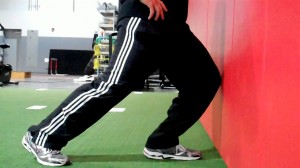
Standing wall touch
Recently, I wrote an article for the WeckMethod site on how to assess and improve ankle mobility. As a clinician and coach, I see this issue in many runners and athletes I work with. At times, it is joint restriction, while in other cases it is soft tissue limitations that impact mobility.
There are several potential reasons why one might possess less than optimal movement in the ankle. The most common causes include: joint stiffness following injury and/or immobilization, soft tissue tightness in the gastroc/soleus complex, scar tissue from a prior injury, anterior ankle impingement, chronic ankle instability and adaptive shortening of the Achilles tendon. Want to read more?
Click here to read my article on the WeckMethod site
Decreased mobility in the thoracic spine often creates dysfunction and stress on other parts of the kinetic chain, namely the shoulder and lumbar spine. In many cases, clients will demonstrate asymmetry based on their sport, activity level and injury history. In light of this, I often prescribe a simple, yet effective corrective exercise they can do at home to restore motion. The exercise below is taken from my ‘Functionally Fit’ column I recently did for PFP Magazine.
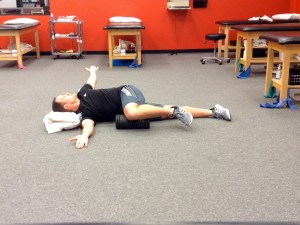
Side lying t-spine roll
In the full online column, I reveal two ways to do this and the applications for it. This exercise also offers a way to assess your own range of motion, while teaching you a straightforward corrective exercise to improve mobility.

Halo Trainer
I recently received a Halo Trainer from Bryce Taylor, its inventor and program director. I am fortunate enough to test and sample many new products related to fitness and rehab. Many of them are one dimensional, full of fluff or new takes on an old product. This product really delivers for those in the rehab and fitness worlds.
Disclaimer: I am not being compensated for this product review or paid to endorse this product. I simply love what it has to offer. The Halo Trainer offers countless training possibilities for so many people despite their backgrounds and abilities.
In fact, here is an excerpt from the Halo Trainer website:
Halo Training currently consists of 4 levels of difficulty for functional bodyweight training. We all know that people have various levels of strength, flexibility, coordination, etc. so we at Halo Rehab & Fitness believe that individuals should not be performing the same exercises. Although it is always to goal to increase the challenge, it is not always appropriate. Sometimes an exercise can be advanced and other times an exercise needs to be made a little easier to meet the specific level of the individual.
For this reason, the Halo training development team has created four distinct levels of difficulty based on scientific principles. Our team has created levels of difficulty for over 300 exercises so that you can create a specific progressive individualized program to maximize bodyweight training. Just pick a starting level and progress to the next level when you are able to complete the challenges of your current level.
All effective prehab and rehab programs for recreational and competitive athletes should include single leg stability exercises. I like to use sliding exercises as one way to improve neuromuscular control of the core, hip and knee. Frontal plane collapse is a common issue with respect to knee dysfunction. Using sliders/gliding discs as well as theraband is an excellent way to improve strength and kinetic chain control. Below is an exercise i recently featured for Personal Fitness Professional:
This exercise is effective in injury prevention and rehab programs for those with ankle instability, anterior knee pain, hip weakness, poor landing mechanics and higher ACL risk if playing pivoting and cutting sports. It will improve core stability, hip and knee strength/stability, dynamic balance, groin flexibility and trunk control.
The band serves to enhance activation of the hip external rotators and further challenge stability of the hip and knee. The band should not pull too forcefully, but just enough to cue the desired muscle activation pattern. A slower cadence on the eccentric portion of the exercise is preferable to maximize stability and strength gains. Do not force through any painful ranges of motion, and remember that form and alignment are paramount so limit the reaching based on the client’s ability to maintain adequate control.
Facilitating better lower leg stability is always a priority in my rehab and training programs. I have long been an advocate of single leg training to resolve asymmetry and reduce compensations and injury risk. Once a client masters form on the ground, adding in more proprioceptive challenges can take their training to a new level.
Today I wanted to share a previously unpublished video I shot for my ‘Functionally Fit’ column that demonstrates a single leg squat exercise on the BOSU Elite Trainer. It is a relatively new exercise tool that offers some tweaks on the original BOSU balance trainer.
Lateral quickness is an important part of athletic development. Having the ability to effectively decelerate and and then re-accelerate the other way is critical for success in field and court sports. Incorporating such movements as part of a multi-directional speed training plan will pay dividends for athletes. In this video I demonstrate how to use the BOSU Elite Balance Trainer to improve lateral speed and quickness.
This exercise is an excellent way to increase lateral foot speed and quickness. In addition, it allows you to introduce energy system training, improve proprioception and enhance dynamic lower limb stability. It is also a great way to train body control and deceleration – two key things necessary for injury prevention in jumping and cutting athletes. Athletes may tend to stand upright once they come back down to the ground, so coaching and cuing them to stay low and not allow their shoulders to move outside the outside leg may be necessary.
You can read more about this exercise in my upcoming column Functionally Fit at www.fit-pro.com.
 Back to top