

Brian Schiff’s Blog
Injury Prevention, Sports Rehab & Performance Training Expert
 0
0
Today I have some exciting news to share. I have recently partnered with OpenSky to make some of my very favorite training and rehab tools available online to you as well. Essentially, at OpenSky I am able to send my readers to my own personal supply shop.
In this shop, I will be showcasing products I believe in and use in my daily practice to help my clients achieve peak health and fitness. For now, I only have three products in my shop, so you are essentially only getting a “sneak peek” as I quickly pull the curtains back for you.
In a few weeks, I will have a grand opening of sorts with many more products to offer. So, what’s in the shop and how does it relate to me? Well, today, I wanted to briefly discuss the importance of using a rolling device to facilitate myofascial (soft tissue) release. Many of you know I run and train runners and athletes of all sports. One of the most common issues I see (especially in runners) is problems or pain related to trigger points or soft tissue tightness.
How do I solve this? When I injured my soleus training for the half marathon last fall, I used a roller to resolve pain and tightness before and after each run. Using a self roller such as the Tiger Tail is very effective in resolving these trigger points and areas of tightness. You will not be able to enjoy maximal strength and power production in your workouts if these trigger points are interfering or limiting you because of persistent pain.
You would like to think stretching alone would rid you of such issues, but this is just not the case. Once you effectively relieve the trigger points, the muscle balance is restored and you can get back to 100% again. So if you or someone you know always complains of tightness or soreness in one calf, hamstring, IT band, etc., this may be just the answer.
The best part the Tiger Tail is that it is very affordable and easily transportable if you are on the go. You control the pressure and location of the release. In just 5-10 minutes you will be on your way to feeling much better.
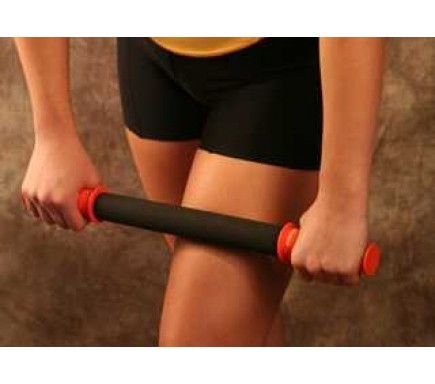

Be sure to check it out today at my store by clicking here or on one of the images above. I look forward to sharing more of my favorite training tools in the near future.
Wow, it has been a while since I posted. After battling what may have been H1N1 for nearly 2 weeks I am back at it. I just returned from the Sports Physical Therapy Section Meeting in Las Vegas held last weekend. All the brightest minds in the industry were there covering the latest research with an emphasis on knees and shoulders this year.
I must say I came away most impressed with Dr. Scott Dye. He is an orthopedic surgeon at the University of San Francisco, CA. He spoke on several topics but continued to highlight this concept of respecting the “envelope of function” in regard to activity and healing. It really resonated with me as it sounded a lot like my concept of threshold training.
He believes we have a set envelope of function, if you will, that predetermines how much stress our body will absorb before breaking down. There is the natural envelope and then an area he termed “supra physiologic load.” Once we break this barrier of supra physiologic load, then mechanical tissue failure ensues.
He preached using bone scans as a diagnostic tool for measuring whether your body was really at tissue homeostasis as opposed to still being inflamed. His assertion is that often we push people back to full activity too soon based upon subjective reports of no pain and clinical tests as opposed to measuring the joint itself with a scan to see if it is still reactive.
He raised a few eyebrows when he suggested that he does not let athletes return to play after ACL reconstruction until somewhere near 18 months. While that may seem crazy, he had some interesting research he has done to show how his post-op patients do not get early arthritis at follow-up as far out as 15 years after surgery.
In essence, he explained that we as practitioners must progress rehab and training in a very sequential and client specific way based upon this envelope of function theory. While I am not sure I bought his rehab time lines lock, stock and barrel, I do believe he is right on track with this envelope of function idea.
I have been saying for years that pain is not a good sign during training or rehab. My critics have often said you can push through some pain with frozen shoulder, rotator cuff pain and the likes with training in order to move forward. I have always countered that your body has a threshold to activity. The only surefire way to progress without re-injury is to adequately gage and understand the threshold level, while adding stress to the system only as able while staying within the threshold.
How do I measure the threshold? I have included my basic definition below:
With a proper training threshold, the athlete or client learns how to grade and evaluate the stress on his/her body during every practice/training session, while gaining an understanding of the exact threshold itself. The threshold (activity tolerance level) should increase or progress with subsequent training, and the use of pain or soreness in response ot said stress should be the guiding factor in adding more load or volume.
Key parameters to track include:
- Pain at rest or before activity
- Pain during activity
- Pain after activity
- Length of time for pain (if present) to resolve or return to baseline
Teaching athletes and clients to track and understand this concept is critical to long term health. First, you must get them to honestly report their symptoms. Then, you must earn their trust by reassuring them your goal is to return them to full activity as soon as possible but as safely as possible. Finally, you must implement the system and relate it to the exercises for them to understand how to measure their body’s response.
As I work with elite level athletes and everyday folks struggling with SLAP tears, rotator cuff impingement and knee arthritis to name a few, I become more convinced that accurately gaging their threshold or envelope of function is the key component when it comes to successful exercise program design and progression.
I am often asked when is it safe to go back to play after an injury. In most cases, I am dealing with lower body or back injuries with my athletes, so for the purposes of this post, I will address a lower body functional return to play paradigm.
The tricky part about this question is that no two injuries are created equal. Sure, I will be the first to acknowledge that I have general approaches to certain injuries and have a sense of how long it should take most of the time. But, over the past 13 years I have seen enough irregularity and differences to say that everyone heals and recovers differently.
For example, I have had athletes with a simple grade 1 ankle sprain not go back to sport for 6 weeks, whereas those with much more severe grade 2 or even grade 3 sprains go back in much less time. Why? There may be several reasons including compliance, body structure, previous medical history, fitness, pain tolerance, and the quality of the rehab to name a few.
In the end, rehab professionals and strength coaches must have sound knowledge of pathophysiology, tissue healing, and program design that ensures maximal progression with optimal tissue loading. Messing up the stress gradient (too little or too much) will slow the return to play process. Below are some major milestones my athletes must clear in order before we even get to what I term “functional rehab” or preparatory movement prior to controlled practice:
- Full active range of motion
- Normal strength on muscle testing
- Normal walking gait
- Symmetrical squat and lunge patterns
- Single leg squat (back, hip or knee injury) and/or calf raise (ankle injury) within normal limits compared to uninvolved side
- Single leg hops in place x 10 equal to uninvolved side with no pain or instability
- Normal running gait on treadmill x 5′ without pain or instability
- Lateral gait cycle within normal limits (shuffle, carioca and cross stepping)
- Planned and predictive controlled agility without pain or instability
- Low level plyometrics in 3 planes without pain or instability
After moving through this fundamental progression (may take days or weeks), the athlete may then begin to perform more demanding neuromuscular work. This would involve more rotational work, full intensity sprints an cutting, and gradually the transition to reactive agility and speed drills. Once the athlete completes this process, he or she is ready for controlled practice.
This is an area where I see student athletes get in trouble. They get “cleared” so to speak by the MD and go back to practice. Cleared to a coach means full go, right? The athlete should ease back into practice even after a carefully prescribed rehab plan like the one I just laid out. However, too often, I see athletes rushed back to full practice too soon. In the case of soft tissue and stress reaction injuries, this often sends them back to the training room or sideline much sooner than the coach or athlete would like.
What is the answer? Controlled practice progressions with the idea of first increasing volume (total minutes) prior to restoring maximal intensity. Athletes know what is hard and what hurts. We just need to communicate with them. Allow them to do the easier drills and fill up time with those prior to ramping up the intensity for the entire practice.
Let’s take soccer as an example. Dribbling, passing and light shooting are lower level drills. In contrast, set pieces and small sided games are much more demanding. Athletes and coaches must use discretion when returning form play to avoid re-aggravating an injury. Measuring pain before, during and for 24 hours afterward is crucial in determining how the body is absorbing the force and responding to the training stress.
If soreness is lingering for more than 24 hours, this is a red flag that the volume and/or intensity is too much. I educate all my parents, coaches and athletes to follow this simple 24 hour rule. I have found if you do, you end up with predictable results in terms of recovery and return to play. So, if you have suffered an injury, be sure to consider moving through a set functional progression and be sure to used a controlled return to play approach to ensure you make a full recovery. Have questions? Leave a comment or shoot me an email.
Well, it is just days before I embark on my 3rd half marathon. Just one short run to go. And no, I am not suffering from shin splints (lol). But as I approach the Columbus Half Marathon on 10/18, I am reminded about all the patients and clients I see who are in some way affected by shin splints.
Shin splints, more commonly referred to as medial tibial stress syndrome (MTSS) in medical circles, plague many runners, walkers and athletes. So, what is a shin splint? People often report pain and tenderness along the outer or innermost portion of the lower leg. Anterior shin splints affect the anterior tibialis muscle and are seen more commonly (my experience) in people who walk rapidly for the first time or do several hills without training for them. I saw a camper of mine who runs regularly develop shin splints doing a 5K walk and trying to walk fast and keep up with another camper. She never has had shin splints in years of running.
Posterior shin splints are probably more widely seen among most runners. They tend to be more common in females as well. The source of pain was commonly linked to the posterior tibialis muscle, but is now thought to be along the origin of the medial soleus muscle and its deep fascial insertion. Hmmm….. the soleus – now if you have read my earlier posts, that is a muscle I personally know a thing or two about when it comes to injury.
What are some causes of shin splints?
- Tight hamstrings (affects closed chain biomechanics)
- High or low arches (twice the injury incidence as those with normal arch height)
- Faulty training surfaces (uneven sidewalks and asphalt can be brutal)
- Improper training technique or progression (this is a biggie for sure)
- Muscular imbalances (weak hips anyone?)
- Excessive foot pronation (flattens out or rolls in too much during gait)
- Worn out or improperly fitted/cushioned footwear
What else may cause such pain? It may be a good idea to see a medical professional for diagnostic testing to rule out a stress fracture (often severe pin point pain along the medial tibia), exercise-induced compartment syndrome, and a possible popliteal artery entrapment (Tolbert and Binkley – NSCA Journal 2009).
Outdoor boot camps and running are gaining in popularity these days. Both activities are great for weight loss but also carry a higher risk of shin splints for participants, especially overweight women. Proper warm-up, selective footwear and stretching are great strategies to reduce or prevent injury.
If you have been affected already and are seeking help, I suggest the following:
- Relative or absolute rest from the offending activity
- Ice the affected area daily (2-3x/day)
- Standing hamstring stretch (flat back) with and without foot rotation in and out – hold for 20-30 seconds in each position (repeat twice)
- Calf stretching on a step – knee straight – hold for 20-30 seconds (repeat twice)
- Soleus stretching ona step (knee slightly bent) – hold for 20-30 seconds (repeat twice)
- Single leg calf raises to strengthen the posterior tibialis muscle (once able to do pain free) Perform 2-3 sets of 10-15 reps
- Single leg balance on a slightly bent knee – perform 2 sets of 30 seconds without touching the other leg down (advance to eyes closed for more difficulty)
In the end, combine prevention with sound footwear and a proper training progression and you will have no trouble at all with shin splints. At the first sign of pain, step back and evaluate if you need to adjust your training as trying to go through it will not make things better. Happy training all!
Since publishing my rotator cuff manual over 4 years ago, I have received emails from all over the world with shoulder related lifting questions. Invariably, I discover that many shoulder injuries are simply caused by repetitive micro-trauma in the weight room.
What does this mean? In effect, it is like taking sand paper and rubbing it over your rotator cuff day in and day out for weeks, months and years until you either create tendinitis or wear a small hole in it. Exercises that often get people in trouble are bench press, dips, flies, lateral dumbbell raises, and military press to name a few. I show modifications for all these in my book.
In my shoulder rehab programs, I have always advocated front lat pull downs. Why? Simply because I can strengthen the posterior chain muscles, improve posture and activate scapular stabilizer muscles while encouraging retraction and downward rotation of the shoulder blade. These are necessary things to balance the shoulder.
Some experts and customers question this technique from time to time because they disagree with taking the arm above shoulder height during periods of inflammation. I say this varies from person to person. I have worked with over 10,000 people and can tell you there is never one certainty among symptoms and response to exercise. With that said, I do not want people to exercise through pain.
To that end, I offer a modified version of the pat pull down to accomplish a similar movement. The straight arm lat pull will effectively target the same things when done properly. I have included a video below showing the technique with a traditional straight bar on a pulley as well as with resistance tubing.

The key points to remember are these:
- Begin at or below shoulder height
- Keep the knees slightly bent at all times
- Maintain a tight core (contract abdominals throughout)
- Keep the elbows straight at all times
- Focus on pulling the shoulder blades closer together on the pulling motion
- Return to the start position under control to avoid momentum taking over
- Breathe out on the way down and in on the way up
I have found this to be an excellent alternative for those unable to continue with traditional lat pull downs during the course of a shoulder injury or rehab. It is 100% safe. The only precaution would be not going forcefully past the hips with the tubing pulls for those with anterior shoulder instability or a known labral tear. This is not an issue with the cable pull as the bar stops prior to this point.
 Back to top