

Brian Schiff’s Blog
Injury Prevention, Sports Rehab & Performance Training Expert
 0
0
The News and Observer (our local paper here in the Triangle) recently ran a great story on overuse injuries in young athletes. I firmly believe this is one of the fastest growing injuries I see in the clinic and in many cases it is preventable. One of the biggest issues now is this commonplace idea that gifted athletes should play the same sport year-round to get ahead.
I remember growing up as a kid and playing football, basketball and baseball in the fall, winter and spring. While AAU basketball and Legion ball existed, most kids were still playing multiple sports. Over my 15 years as a physical therapist I have witnessed several of these one sport stars see their playing time and bodies take a hit due to injury.
The American Orthopedic Society for Sports Medicine (AOSSM) and the American Academy of Orthopedic Surgeons (AAOS) state that overuse injuries account for nearly half of the 2 million injuries seen among high school athletes each year. While soccer and swimming seem to send many athletes into PT, any repetitive throwing or overhead activity bears considerable risk for an eventual shoulder or elbow problem as well. Some of the common injuries I typically see are:
- Patellofemoral pain
- Shin splints
- Rotator cuff injury
- Bursitis
- Shoulder instability
- Little League elbow
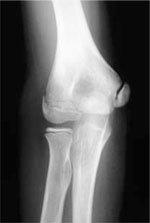
Little League Elbow (medial epicondylar apophysitis)
These injuries are just some of the most common ones I see. In the article, the reporter focused on baseball and throwing. With that in mind, consider research published in the American Journal of Sports Medicine this past February from renowned surgeon James Andrews that revealed players who pitch more than 100 innings in a calendar year are 3.5 times more likely to be injured.
He goes on to say that “these injuries are the result of a system that prepares genetically gifted athletes to play at the highest levels, but eliminates most players because their bodies cannot withstand such intense activity at such an early age.” Sadly, he told the reporter that in 1998 he performed the Tommy John procedure on 5 kids high school age or younger, while in 2008 he did the same procedure on 28 children in the same age range. This injury is usually caused by throwing too much too soon.
Consider the following data on suggested pitch counts per game (source James Andrews, MD & Glenn Fleisig, MD):
- 8-10 y/o = 52 plus/minus 15 pitches
- 11-12 y/o = 68 plus/minus 18
- 13-14 y/o = 76 plus/minus 16
- 15-16 y/o = 91 plus/minus 16
- 17-18 y/o = 106 plus/minus 16
Unfortunately, I can personally relate to this blog post and story. I was a promising young pitcher up until the point I threw my arm out in travel baseball at age 13. The pain got so bad in my arm I could barely throw a ball 10 feet. I remember the orthopedic surgeon telling me that I could not throw again the rest of the summer. The pain (and memory of it) was so bad I elected to focus on position play and not to pitch again until my senior year of high school. At that point, my arm was no longer the same as I had missed three years of practice and development. Now, I too had become one of those kids whose body was never the same.
So, as a rehab and strength & conditioning professional, I want to help educate and promote better awareness to athletes, parents, coaches, trainers, AD’s, ATC’s and anyone who is involved in the care and training of young athletes. Fortunately, people are taking positive steps to reduce overuse injuries. One great initiative is STOP – Sports Trauma Overuse Prevention and you can learn more by clicking here to visit their website.
In the end, we must continue to educate everyone that the old motto of “No Pain, No Gain” is NOT the way to handle overuse injuries as this mentality may ruin the careers of young athletes or lead to an otherwise preventable injury and/or premature musculo-skeletal damage. Pain truly is a warning signal the body gives us to detect mechanical problems and make changes in our training/activity level until we sort out the cause and solution. I hope you will join me in supporting this mission and working hard at making sports fun, safe and free of overuse injuries for young athletes of all ages in the years to come.
References – The News & Observer – May 15, 2011
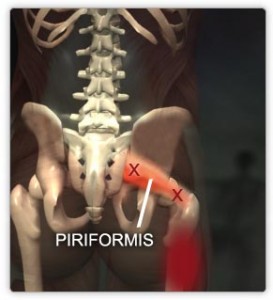
So, have you ever experienced pain in the buttock that radiates down into the thigh? Maybe even felt some numbness and tingling? Recently, I was contacted by an experienced marathoner who has been plagued by pain in the buttock and posterior thigh. He self diagnosed himself as having piriformis syndrome after doing some research on the Internet. So. what is piriformis syndrome?
Some experts debate whether it truly exists, but essentially, it involves the piriformis, a small pear shaped muscle in that helps externally rotate (turn out) the hip and the sciatic nerve which runs down the entire back of the leg and is responsible for sensation and motor movement patterns of many of the muscles in the lower leg.
It is suggested that in this syndrome the sciatic nerve essentially becomes compressed or irritated by a tight piriformis muscle. The sciatic nerve travels above, below or even through the piriformis muscle itself based on anatomical studies.
Some have even suggested that prolonged sitting with the hips turned out or sitting on a wallet can contribute to this problem. I even remember being told in PT school that it is more common in truck drivers. With that said, I think I can count on one, if not both hands the number of patients I have seen in 15 years that I truly believe had piriformis syndrome.
Now back to my runner. He began having pain in his left buttock and hamstring in late December after seeing a trigger point specialist who suggested he had a tight piriformis and did some deep tissue work on it. A short time afterward, he began having symptoms. He saw a physical therapist for 2-3 sessions and was given some stretches to do. Meanwhile, he began getting deep tissue massage focused on the area in January and February.
I am always looking to try and learn new things. There seems to be so much buzz around soft tissue mobilization and release on the blogs and web these days. The longer I practice and treat soft tissue injuries, the more convinced I become of the importance of releasing trigger points and myofascial restrictions.
One of the therapists who works alongside of me every day recently attended a Graston® training course. For those unfamiliar, this is a form of instrument assisted soft tissue mobilization (IASTM) utilizing convex and concave instruments to resolve fascial restrictions that are often present and a source of pain/tightness.
I volunteered to have her work on my IT band immediately when she returned from the course.
Click here to see a short video clip
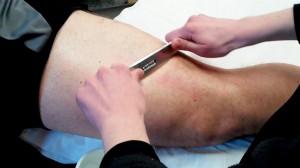
While I have utilized foam rolling, the Stick, deep tissue massage and most forms of stretching, this was a first for me. I must admit, the instruments Liz used seem to find every single tender and gritty spot in my IT Band. Yes, there was some mild discomfort at times. But, the treatment lasted 3 minutes or so and I felt much less tightness and soreness the very next day.
Many people see good results in as few as 3-4 sessions, but results vary. Consider IASTM another tool to place in your collective tool box. It is a great adjunct to stretching, strengthening and corrective exercise. There are other methods out there (SASTM and Gua sha to name a few) but I am not addressing them here today.
If you have specific questions or want more info on GT, visit the link below:
Graston® Frequently Asked Questions
If you are an endurance athlete or someone who has been struggling with chronic soft tissue pain or tendinitis, and have not yet tried this, I might suggest looking into this as it may be a missing link in your rehab plan. If you have personal experiences with the GT, I would love to hear about them.
In most gyms and training circles, people are performing bench press or push-up exercises. There is no doubt in my mind that repetitive heavy full range bench press causes many of the labral and cuff injuries among males I have seen over the years These injuries are often the attritional type – developing over many months and years.
What about push-ups? Is the force development pattern the same? Are they safer? Honestly, I believe in keeping the elbow at a point at which it does not drop below the plane of the body (bench press) or move above the body (push-up). Essentially that means keeping to a 90 degree angle or less. Why? Well, regardless of load, I feel the real risk is not so much in the motion itself but the very repetitive manner in which it occurs with external loads, often lending itself to acquired anterior shoulder laxity, strain on the proximal biceps anchor (think SLAP lesions) and secondary shoulder impingement. The picture below hurts my shoulders just looking at it, and over time this technique will hurt your shoulders too.

But, I say all that to set up today’s post. In a recent article in the February edition of the Journal of Strength & Conditioning Research, David Suprak et al. looked at the effect of position on the % of body mass supported during traditional and modified push-ups.
The study looked at 4 static positions in 28 males (about 34 years old) who were highly trained and members of the special forces or SWAT team (the up and down position for regular and modified push-ups) to determine the change in body mass (BM) supported by the upper body in different ranges of motion. The down positions studied were at approximately 90 degrees (the lowest depth I safely recommend) and all holds were performed for 6 seconds.


In my last post, I shared some practical plyometric drills with you to help teach proper landing mechanics in an effort to reduce ACL injuries. Yesterday, I presented my comprehensive approach to knee training at our ACL Symposium in Cary, NC.

One of the fundamental errors I see coaches and athletes make is abandoning their pre-season training efforts during the in-season. While athletes need to spend the majority of the in-season focusing on sports skills, they must also maintain the neuromuscular training adaptations acquired in the off-season and pre-season.
In my mind, the phrase “use it or lose it” is applicable for the neuromuscular training effects we see with balance, strength, agility and plyometric training. This is especially true for our high risk female athletes like soccer and basketball players who suffer knee sprains, ACL tears and patellofemoral pain at disproportionate rates.
I often hear coaches say, ” I don’t have time to get workouts done and still accomplish what needs to be done at practice.” While, time management may be difficult, I think coaches could probably squeeze in a single training session lasting 15-20 minutes if they simply knew how important it was to the overall health and performance capacity of their team.
With that said, I like to offer simple, yet effective exercises that can be done on a court or field with the whole team simultaneously without the need for expensive equipment. Exercises should focus on activating the glutes (including the medius and minimus) as well as training the hamstrings more since most female athletes tend to be quad dominant.
These exercises are just as effective for males too. So, in the video below I will reveal some exercises I prefer to do to increase strength and reduce injury risk. Perform 2-3 sets of 8-15 reps focusing on strict form throughout.
 Back to top