

Brian Schiff’s Blog
Injury Prevention, Sports Rehab & Performance Training Expert
 1
1
I work with many runners in our clinic. I often see restrictions in the soleus. While the running community is warming up to soft tissue mobilization, many runners are still resistant to embrace it routinely and engage in it more so only when they are hurt or lacking flexibility.
STM (soft tissue mobilization) should be part of every runner’s maintenance program. Why? Simply put, repetitive stress takes its toll on the body. Rolling or releasing the tissue increases blood flow, eliminates trigger points, and facilitates optimal soft tissue mobility and range of motion.
In the diagram below, you can see common trigger points in the soleus. The X represents the trigger point & the red shaded area is the referred pain caused by the trigger point.

In the case of the soleus, restricted dorsiflexion could lead to other biomechanical compensations with running. Initially, this often creates a dysfunctional and non-painful (DN) pattern. Over time, this may eventually become a dysfunctional and painful (DP) pattern forcing runners to seek medical care. The terms DN and DP come from Gray Cook’s Selective Functional Movement Assessment (SFMA).
The gait cycle is certainly altered from dysfunction in this muscle. If ankle joint dorsiflexion is compromised (a common effect of soleus restrictions), there can be increased strain on the quads and altered movement in the hip. Overpronation and excessive hip adduction and internal rotation are common compensations seen with running. Other signs and pathology that may be associated with a soleus trigger point may include:
- Plantar fasciitis
- Heel pain
- Shin pain
- Knee or hip pain
- Back pain
As such, restoring mobility is important. A recent study revealed that immediate improvement in ankle motion can be attained with just a single treatment (click here for the abstract).
So how do you effectively resolve soft tissue issues in this area? I suggest using a foam roller or better yet the footballer and baller block in the Ultimate 6 Kit for Runners by Trigger Point (see pic below)

I have had the pleasure of authoring a bi-weekly column for PFP’s online magazine entitled “Functionally Fit” for over three years now. This column gives me a creative avenue to display my specific training techniques and teach others how to build a better functional body in the process.
One of the greatest things about exercise is all the different options, variations and tweaks available to bring about a desired physical change in the human body. As Alwyn Cosgrove once said, “Exercise is like medicine.” By this, he means the right dosage and application is critical. I could not agree more.
As training and rehab continue to evolve and become even more intertwined, we as practitioners need to continue seeking ways to get more from our exercises. I personally use lots of different training tools in my trade, but I am always seeking to get the biggest return on my exercise investments. Today, I am sharing one such exercise with you, the 3D Mountain Climber with Hip Extension. Check out the video below:
In this video, I am working to improve shoulder, hip and core stability as well as strongly encourage hip disassociation. Many clients I train and rehab simply are asymmetrical or cannot disassociate their hips which leads to flawed movement patterns and leaks int he kinetic chain.
I used this exercise in our core training series we were doing with the Carolina Hurricanes in their pre-season conditioning sessions that we just recently completed. It is not easy, but delivers so much benefit for just one movement. In the video I display a BOSU balance trainer, but in my online column for PFP, I include a full buildup progression as well. Click here to read the column.
So, conventional wisdom and research continues to point to the need for promoting increased gluteus medius and maximus strengthening to promote better knee stability and ward off many other kinetic chain breakdowns. While there are many examples of how to train these muscles, the question is what are the best exercises to promote hypertrophy of these groups.

Whether training or administering rehab, it is important to understand how best to activate these muscles as time may be limited. I think it bears mentioning that core function is closely tied to pelvic posture/alignment so it will be no surprise as you see the best exercises in this post according to recent research released in the International Journal of Sports Physical Therapy. To promote muscle strength, higher MVIC correlates to better strength gains. So, looking at the %MVIC of exercises clinicians and fitness pros alike can better rank the order and appropriateness of certain exercises to maximize health and performance of their clients.
According to a the study at Belmont University, the authors looked at 18 different exercises using surface EMG to study activation of the gluteus maximus and medius. Below is a summary of the top 5 exercises stimulating greater than 70% MVIC for each muscle group:
Gluteus Medius
- Side plank abduction with dominant leg on bottom (103% MVIC)
- Side plank abduction with dominant leg on top (89% MVIC)
- Single leg squat (83% MVIC)
- Clamshell 4 (hip clam – 77% MVIC)
- Front plank with hip extension (75% MVIC)
Gluteus Maximus
- Front plank with hip extension (106% MVIC)
- Gluteal squeeze (81%)
- Side plank abduction with dominant leg on top (73% MVIC)
- Side plank abduction with dominant leg on bottom (71% MVIC)
- Single leg squat (71% MVIC)
Click here to read the abstract of the study. I think it is fairly obvious based on the data presented in the article that core stability and training should be integrated with hip strengthening. I presented a column in Functionally Fit last year on plank with hip extension and abduction using a BOSU. This is more advanced concept than just the traditional plank, but a very good exercise. See the picture below:
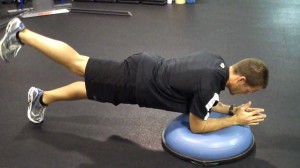
Click here to read the entire column on the BOSU plank with hip extension/abduction. This particular exercise requires hip disassociation and core stability. I just finished a new column for PFP Magazine on BOSU clamshells so stay tuned for that one as it reveals a side lying progression to optimize hip strength as well.
I think it is safe to say most would agree that deadlifts are great for building maximal lower body strength. Elite Olympic weightlifters are generally able to lift more loads in this lift compared to other free weight exercises. I know personally that I like to use it to develop lumbar extensor strength, as well as in place of the squat if I want to avoid spinal compression from the weight of the bar.
In the past I have heard some strength coaches say they don’t use a hex bar for deadlifts because it is not the same as lifting a straight bar. While not always sure exactly what they mean by that, I found a recent article in the July 2011 Journal of Strength & Conditioning Research very insightful. The researchers looked at the difference between straight and hexagonal bar deadlifts in submax loading situations.
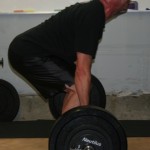
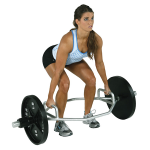
The concern with deadlifting has always been stress on the spine. The study notes:
“For world class athletes lifting extremely heavy loads, lumbar disk compression forces as large as 36,400 N have been reported.”
Lifters have long been encouraged to keep the barbell as close to them as possible to reduce the moment arm. The issue with the straight bar is that it can impinge on the body. Thus, the trap bar or hex bar apparatus was developed. The researchers hypothesized that the hex bar would reduce the joint movements and resistance moment arms. In addition, they hypothesized that larger forces would be produced with the submax loads.
The study use 19 male powerlifters and was conducted 3 months after their most recent competition where most were at the end of a training cycle aimed at matching or exceeding their previous competition performance. The subjects (following their own warm-up) performed HBD and SBD at 10, 20, 30, 40, 50, 60, 70 and 80% of his SBD 1RM. Twelve markers were placed on the body for biomechanical analysis.
Today I am going to share two pieces I have written for other publications as I think the exercises I discuss have real merit and broad application for competitive athletes and weekend warriors. I am a columnist for PFP Magazine and Endurance Magazine and these articles come from those publications.
Single Leg Theraband Activation Squats
The idea behind this exercise is applying progressive gradients of resistance that encourage the faulty motion (pulling the leg into adduction and internal rotation) to facilitate increased activation of the gluteus medius/minimus and small lateral rotators to create an anti-adduction/internal rotation force. Decreasing such moments at the knee will reduce IT Band issues, patellofemoral pain, ACL injury risk and overuse problems often seen in running.
Click here to see how to perform the exercise
Mobility Training for Endurance Athletes
It is no secret that endurance events require repetitive motion and often carry a higher risk of overuse injuries. In light of this, poor thoracic extension and/or limited ankle dorsiflexion negatively impact proper running and riding mechanics and lead to faulty movement patterns. Beyond physical stress, this reduces performance capacity as well. There are two simple mobility exercises to help correct imbalances that may be hindering you.
Click here (go to page 16) to see how to sustain your body with these exercises
 Back to top