

Brian Schiff’s Blog
Injury Prevention, Sports Rehab & Performance Training Expert
 45
45
So, I treat a number of fitness enthusiasts in the clinic and many include Crossfit clients. Recently, I evaluated a 38 y/o male on 2/16/12 with a 3 month history of right shoulder pain. He performs Crossfit workouts 6 days per week. His initial intake revealed:
- Constant shoulder pain that worsens with overhead movements
- Pain with bar hangs, overhead squats and wide grip snatches
- Unable to do kipping (only doing strict form pull-ups)
- Pain if laying on his right side at night
- No c/o neck pain, referred pain or numbness/tingling
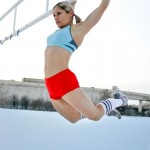
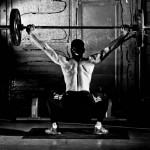
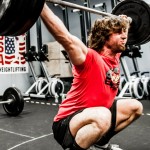
Notice the shoulder position during the kipping pull-up and overhead squat below. This is a position of heightened risk for the shoulder.
His exam revealed the following:
- Normal range of motion
- Strength within normal limits except for supraspinatus and external rotation graded 3+/5 with pain
- Positive impingement signs
- Negative shrug sign
- Negative Speed’s and O’Brien’s test
- Tender along distal supraspinatus tendon
Based on the clinical exam, it was apparent he had rotator cuff inflammation and perhaps even a tear. Keep in mind he had not seen a physician yet. I began treatment focused on scapular stabilization and rotator cuff strengthening as well as pec and posterior capsule stretching to address the impingement. Ultrasound and cryotherapy were used initially to reduce pain and inflammation.
One month following the eval
By 3/14/12, his pain was resolved with daily activity and he had returned to snatches and push-press exercises without pain. He still could not do overhead squats with the Olympic bar pain free, but he could with a pvc pipe. Strength was now 4/5 for supraspinatus and 4+/5 for external rotation. All impingement tests were now negative as were Speed’s and O’Brien’s testing.
One of the most common issues I see in the clinic with active exercise enthusiasts between the age of 20 and 55 is shoulder pain. Weightlifting has been popular for ages, but Crossfit is all the rage these days. Both disciplines involve overhead lifts. The key thing to remember when performing overhead repetitive lifts is how load and stress not only affects strength and power, but how it impacts the joint itself.
Pull-ups and pull-downs are staples for most clients I see. As a therapist and strength coach, I am always thinking and analyzing how variables such as grip, grip width, arm position, scapular activation, trunk angles etc influence exercise and how force is absorbed by the body. One such exercise I have spent time studying and tweaking is the lat pull-down.
Consider for a moment how width and grip impacts the relative abduction and horizontal external rotation in the shoulder at the top and bottom of the movement in the pictures below (start and finish positions are vertically oriented):
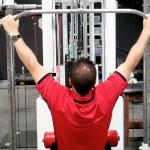
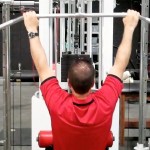
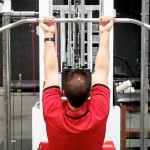
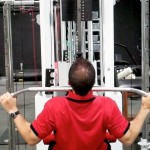
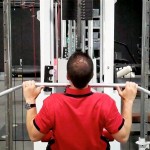
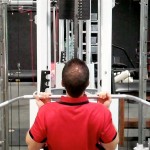
It should be common knowledge for most, but I will state it for the record anyway – you should NEVER do behind the neck pull-downs. Beyond the horrible neck position, this places the shoulder in a dangerous position for impingement and excessively stresses the anterior shoulder capsule. A wider grip (be it with pull-ups, pull downs, push-ups) will always transfer more stress to the shoulder joint because you have a longer lever and greater abduction and horizontal external rotation.
So, what bearing does this have in relation to the rotator cuff and SLAP injuries? For more information and details on the application of the grip choice, click here to read the full column I did for PFP Magazine this month. Stay tuned for my next post (a follow-up to this one) one of my Crossfit patients who now only has pain with overhead squats and how my differential diagnosis and rehab has led me to conclude what is wrong with his shoulder. Keep in mind we must learn to train smarter so we can train harder and longer without pain and injury. Biomechanics and understanding your own body really does matter.
It is clear that our society loves shoes and fashion. The problem is that fashion often does not equate to good function. Keep in mind your feet set the tone for the rest of your body’s biomechanics so it stands to reason that one would want to pay close attention to their foot structure and use the RIGHT shoes more often than not.

I treat and evaluate lots of runners on a weekly basis. I use the FMS, selective testing and gait analysis to help them resolve mechanical issues, overuse problems and improve running efficiency. However, when it comes to making footwear choices, I can only counsel them on what is best.
Recently, I wrote a column for Endurance Magazine on the impact of high heels and flip flops as it relates to injury risk. At the end of the piece, I give some exercises to address shortened muscles and soft tissue. I think all women who enjoy running (symptomatic or not) should give this a read. Click here to read the article.
It is no secret that all the technology in our world has made poor posture even more prevalent than before. I always say the brain picks the path of least resistance for the body and that tendency combined with gravity leads to a natural forward head posture. Hours spent on the computer, texting and sitting often promote a picture like this:
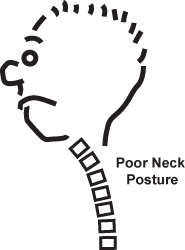
This positioning leads to lower cervical flexion and upper cervical extension thereby creating muscle imbalances. Keep in mind the rest of the spine takes its cues from the head and neck. A forward head encourages thoracic kyphosis, shoulder internal rotation and lumbar flexion. The back muscles give way to hanging on the static structures and the brain grows accustomed to this relaxed posture. The result = increased strain, muscle tension and mechanical deformation. In addition, neuromuscular activation of the proper postural muscles is compromised or shut down completely.
This sequence of events often gives way to postural pain, tightness, tension headaches and eventually even more intense pain and symptoms related to disc pathology. Essentially, the wrong structures spend too much time under tension, while our muscles go on a prolonged siesta throughout the day. Good posture takes hard work and looks like this:
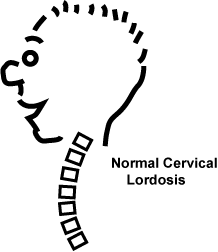
So, some simple strategies to improve posture include an awareness of proper alignment (ears in line with the shoulders), a conscious effort to sit and stand with better posture and consistent postural strengthening. One of my favorite exercises to do is a simple prone neck retraction (see video below)
For a complete description of the exercise, click here to read my full column in PFP Magazine.
Finally, I want to leave you with some information from another clinician, Joe Brence, DPT on pain classification. He addresses the biomedical versus biopsychosocial approach to treating pain on The Manual Therapist’s blog. I tend to believe we must use components of both systems as well as our intuition and clinical experience, but it is an informative post. Click here to read his guest blog post on this.
Research has shown that strengthening the gluteus medius is clearly an essential way to reduce anterior knee pain and improve pelvic stability and function. The exercise I am sharing today is useful for improving hip strength and pelvic stability in a closed chain fashion.
In the video below, I demonstrate a very effective way to strengthen the gluteus medius and improve hip stability.
For a full description of the exercise, check out my latest column, Functionally Fit, by clicking here.
 Back to top