

Brian Schiff’s Blog
Injury Prevention, Sports Rehab & Performance Training Expert
 0
0
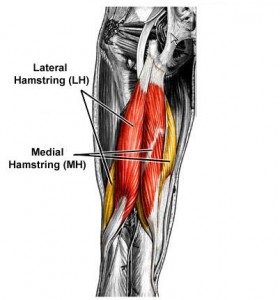
So, I have been swamped with work and marathon training, hence the recent delay in a new blog post. Well, yesterday during a short 3 mile run (I am in taper mode with a 10/17 event) I experienced an acute left hamstring strain.
Hamstring strains are common and can produce incredible pain and limit function. Most hamstring strains occur as the swing leg is coming forward and the knee is nearing full extension. Essentially, it is a stretch type injury as the hamstring works to decelerate the momentum of the lower leg.
Injuries may be casued by inadequate warm-up, a sudden increase i training intensity/volume, fatigue, stiffness, weakness or muscle imbalances. A prior injury may also increase your risk for re-injury.
I have been running for years and am 5 months into my marathon training, so why now? I honestly think it may be related to my speed yesterday. My body naturally leans toward a 7:25 pace, but when I looked down at my Garmin yesterday at the point of pain, it said 6:54. Yikes! I was 1.25 miles into the short run.
I decided to keep running and slow my pace back to 7:30. While I was able to complete the run, my lower hamstring was very tight and sore after the run. Obviously, I have been icing regularly the last 24 hours. No running today either. I anticipate a quick recovery since the strain is mild and I am very fit. But, what is the best way to prevent re-injury?
I have a quick article summary from the Journal of Sports & Orthopedic Physical therapy Journal for you to read that underscores how important functional movement rehab is in comparison to just static stretching and strengthening.
Click here to read the summary of the journal article
Now, with respect to running, agility may not be necessary. Running is fairly linear (straight line) so what may be more important to gage capacity to return to running may be some of the following:
- Absence of pain with active knee straightening
- Absence of pain with walking
- No pain with single leg hopping
- Minimal to no muscle belly tenderness
In the end, you will need to let pain guide you. Some will return faster than others, but inside of 21 days (the end of the subacute healing phase) you must be aware of the fragility of the tissue as it heals. I am confident this will not derail my marathon, but the lesson learned is to watch your starting pace as it may lead to some muscle strain.
It has been known for years that increased coefficient of traction can predispose the knee to catastrophic injury. Hence, the reason we got rid of all the old style astro turf in football stadiums. But, traction is influenced by the sole architecture of the shoes as well as the playing surface. Unfortunately, we are not fully aware of how exactly the sole architecture or this increased traction can lead to injury.
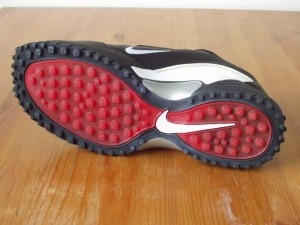
Nike Astro Turf Shoe
Does footwear really matter? I say YES. Case in point – I am not a big fan of Nike Shox because they position the ankle in a plantar flexed position, thereby making it so much easier for ankles to roll inward with cutting. I have seen too many female athletes suffer inversion sprains while running suicides or training in these shoes. I simply believe the design creates a biomechanical mismatch and elevated risk for ankle sprains.
Now what about traction? A study in the American Journal of Sports Medicine by J Wannop et al. recently looked at the difference between two shoe designs in a controlled laboratory study. The tread types of shoes used were either smooth or tread.
The shoe used in the study was the adidas Response 2+ CPT (smooth shoe) and adidas Response=2(A) (tread shoe). The traction testing was performed using a robotic testing machine, while the researchers also observed 13 recreational athletes performing 45 degree V cuts in both shoes. Data was collected using 8 high speed cameras and a force plate.
The results are not shocking. The highlights are:
- The coefficient of translational traction and peak moment of rotation were both significantly higher in the tread show compared to the smooth shoe.
- In addition, the high-traction shoe had much higher peak ankle externalrotation moments, peak knee external rotation moments, peak knee adduction moments, and knee adduction angular impulse compared to low-traction shoe.
The findings of the study indicate that the resultant joint loading increased 12% in the ankle (transverse plane) and 13% and 20% in the transverse and frontal planes for the knee. This increased traction is certainly enough to push the knee into the previously reported mechanical rupture zone.
What we cannot deduce is whether the increases in joint loading is strictly attributable to the higher linear and rotational traction or if there is even a linear relationship between them at all.
You should also note that athletes often choose traction shoes for enhanced performance. In this study, there was no significant difference in the performance measured between the two groups. So, we are left to ponder whether we really need higher traction shoes at all. Future studies will need to address this relationship as preventing knee and ankle injuries just by adjusting footwear seems like a no-brainer if the science supports this.
So, I was meeting with a 14 y/o soccer player referred to me by a physical therapist today who is need of sports performance conditioning (return to play) work after a lateral release. This talented female athlete suffers from a shallow trochlear groove, thereby making her more prone to patella subluxations.
Such an incident led to two recent surgeries and nearly a year away from the soccer field. She has returned to soccer, but has been referred to me for prevention and performance work. I have been thinking about her program, history and all the athletes I have trained in recent memory with knee problems.
I also recall reading an email this weekend from a past intern asking me if there was a single leg training certification out there as she saw me do so much of it at my facility. These thoughts lead me to my post today. If you are a jumping, cutting or competitive athlete using your legs to perform, you should absolutely be integrating single leg training into your conditioning programs.

Why, do I say so? The answer is rather simple in my mind. The human body is often out of balance. The brain is so adept at mastering movement, it learns to compensate for even the slightest deficits on one side. Over time, you end up grooving improper motor patterns and these tend to lead to small imbalances or even overuse issues.
Ever hear about stretch weakness or adaptive shortening? Maybe you are familiar with the terms overactive and under active muscles? Regardless, I can assure you that at any given moment, your body may be susceptible to these patterns.
Through a poper single leg assessment, I see many issues come to light that may otherwise be hidden with two legged squats, lunges, leg press, etc. Let me go back to the young lady sitting in my office this morning. She has bilateral shallow trochlear grooves, yet only one knee to date has given way. Why so? Will the other one follow suit?
There is no way to definitively predict if her other knee will become problematic. But, my hunch is there were some single sided imbalances that may have led to her current injury history. It is now my job to try my best to prevent such an episode on her other knee, as well as make sure she does not have issues on the surgically repaired side.
Anything short of a program heavy on single leg work would be a mistake for her (and many others like her). You see, we often reinforce imbalances and poor technique with heavy squatting, lunging and dead lifts seen in traditional programs. I am not oppose dot these lifts – in fact they can be great for strength and power development.
However, we MUST address and correct the single sided imbalances first. We must also always include some single leg strength work with our athletes to ensure there is no asymmetry developed unknowingly. Most athletes compete using their own body weight. We must train in such a way that we foster control, power and mastery of movement with each limb.
This focus and approach will be most helpful in reducing injuries like ankle sprains, ACL tears, muscle strains and common overuse issues in the lower extremity. So, next time you think about performance training, I want you to consider the importance and relevance of single leg training. No program is perfect. But, I will tell you my track record is pretty solid with prevention, performance and return to play training I have done that relies heavily on this approach to conditioning.
Stay tuned as later this week I will unveil my latest DVD as well as review how traction with footwear affects lower limb joint loading.
I hope you enjoyed part one in this series. Part two looks at a frontal and transverse suspended reach. This is a great way to train the body to better resist shear forces that are encountered in sport.
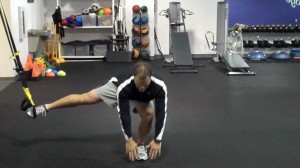
To read more about this progression and see the rotational component, click here. This exercise is a great way to improve hip strength and improve de-rotational capacity, thereby reducing injury risk with planting, cutting and pivoting.
Throughout my speaking and training, I advocate single leg strengthening. Additionally, I try to incorporate balance and stability training progressions that target common muscle imbalances and reduce injury risk.
It is common knowledge that the hip can often affect the knee. Likewise, the foot and ankle complex can also impact the knee. Single leg training often exposes and corrects limb deficiencies and simulataneously improves function and performance.
I have been producing a TRX functionally fit mini-series for PFP magazine. The first two editions focus on single leg suspension reaching progressions. I thought I would share those with you as there may be portions you can apply to your own training or to others.
I use these progressions with runners, court and field athletes, and general clients alike. They work the entire kinetic chain and emphasize anti-gravity control in multiple planes. These progressions can be part of an advanced rehab regimen or fitness program. Below is a picture of the phase one sagittal plane reach:
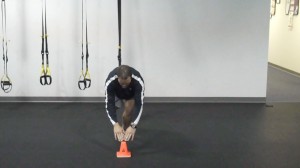
To see the entire progression (part 1), check out my column by clicking on the image below.

 Back to top