

Brian Schiff’s Blog
Injury Prevention, Sports Rehab & Performance Training Expert
 0
0
First off, I want to extend warm Holiday wishes to all of you reading this blog!! As I sit at home on Christmas Eve morning, I am quietly reflecting back on a big year of accomplishments and changes I experienced in 2010. It is often hard to take time to appreciate your blessings, Because as a society we are driven to conquer the “next thing.” However, I have been trying to get better at taking time to savor life’s victories.
Last year, I ran my first marathon (thankfully under 4 hours despite horrible cramps), sold my successful 10 year-old fitness business in Ohio, and moved to North Carolina to tackle a new venture at the Athletic Performance Center. The past year has truly been full of many changes and blessings.
Over the years, I have come to realize that the real gift in my profession is being able to help others. For me, I have an ability to reach consumers through my rehab and performance training, as well as my peers through blogging, speaking and products. If you read my blog, I hope that I have been able to help you even if it is only in the smallest way.
As I look ahead to 2011, I am excited for new opportunities and feel like it will be a big year of learning and exploration for me. That will translate into more sharing on this blog and in my monthly Training & Sports Medicine Update Newsletter. I am continuing to write for PFP Magazine through my online column and will share my latest post with you today on crossing lunges.
Performing a crossing lunge presents unique challenges to the body – challenges which often exploit muscle imbalances, mobility issues, and balance deficits. It is a rotational activity that is more challenging then it may appear.
I once had an athletic trainer question the safety of them in an exercise class I was teaching. She thought they were harmful for the meniscus in the knee. Hmmm…. If that is true , why would I do them? Well, like any exercise you do in the gym, there is always risk of an injury IF you do the exercise improperly. That is a key takeaway point. For the record, I never recommend an exercise I think is dangerous – in most cases it simply comes down to form and knowing your limitations.
Crossing lunges are very effective in strengthening the entire lower body, but particularly the hips. Whether choosing the backward or forward variation, they call for hip internal/external rotation, knee stability and ankle mobility. Beyond that, they are very functional for sport and athletic movement.
Think about field or court sports for a minute. How many times does an athlete cross over to dribble, scoop up a ball or evade a tackle? You may see the forward variation more, but the backward variation is seen as well with drop steps, pivot motions and even along the baseline in tennis.
So, if you train athletes or are an athlete, this is a great example to keep in your personal exercise tool box. I have included pictures of the forward and backward version below. See the link below the photos for my full column and explanation of how to do the exercise properly.
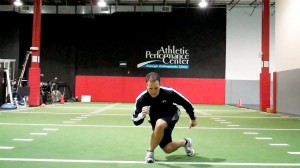
Backward Crossing Lunge (onto right)
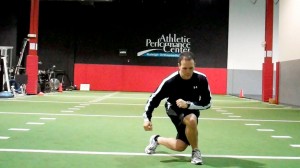
Forward Crossing Lunge (onto right)
Click here to read my full online column, Functionally Fit, pertaining to this lunging exercise. Thanks for reading this, and I wish you all the best in the year to come!
The longer I work with clients, the more hip issues I see. Generally speaking, I find the major issues to be related to decreased mobility, poor stability and muscle imbalances. These may occur in isolation or combination.
It is a no-brainer that most people have tight hip flexors and external rotators given all the sitting that takes place in our computer age. This inherently creates weakness and tightness. I feel that a natural propensity to be positioned in hip external rotation may actually reduce the firing of these muscles which in turn allows for more valgus moments at the knee and reduces lower limb stability.
Typically, female athletes fail to adequately fire the gluteus maximus (hip extension and external rotation) and prefer to dominate movement with the quads. So, how do we begin to change this?
Well, first we must focus on better hip mobility. I believe we must work to gain better hip extension by stretching the hip flexor group. I also believe we need to do this dynamically and not just passively. A dynamic approach also allows us to improve knee stability on the opposite side as we work on hip mobility. It will also allow us to resist internal rotation of the femur and the valgus moment at the forward knee.
Look at the images below:
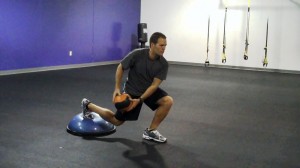
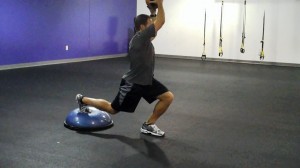
I am demonstrating a BOSU split squat diagonal chop. This is the first of a series of BOSU exercises I am doing for PFP Magazine. The upward chop forces hip extension on the right side and the downward motion reinforces firing of the left glutes to reduce internal rotation and valgus. What a perfect combo right?
To read more about this exercise, click here.
Now, you should start on the floor with just the arms and progress from there. This is a great prehab exercise or warm-up activity, but it cna also be used for strengthening too. I hope you find it as beneficial in your routine as I do.
Over the years, I have worked with hundreds of athletes (male and female). One consistent finding among many I see is weakness in the hips and core. Knee injuries are often the result of poor frontal and transverse plane stability, which is often related to weakness in the glutes (max and medius).
In order to resist valgus/rotational loads effectively, athletes must address this weakness with training. I am always looking for ways to get the most out of exercise provided it makes sense to me. So, I began using the exercise I am sharing with you today – BOSU planks with hip abduction/extension. I use both to work on the gluteus maximus and medius muscles. This exercise targets hip and core weakenss at the same time.
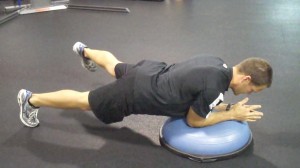
Hip Abduction
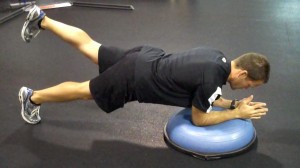
Hip Extension
Click here read how to execute the exercise and apply it to your routines.
I hope you enjoyed part one in this series. Part two looks at a frontal and transverse suspended reach. This is a great way to train the body to better resist shear forces that are encountered in sport.
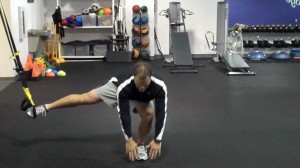
To read more about this progression and see the rotational component, click here. This exercise is a great way to improve hip strength and improve de-rotational capacity, thereby reducing injury risk with planting, cutting and pivoting.
Throughout my speaking and training, I advocate single leg strengthening. Additionally, I try to incorporate balance and stability training progressions that target common muscle imbalances and reduce injury risk.
It is common knowledge that the hip can often affect the knee. Likewise, the foot and ankle complex can also impact the knee. Single leg training often exposes and corrects limb deficiencies and simulataneously improves function and performance.
I have been producing a TRX functionally fit mini-series for PFP magazine. The first two editions focus on single leg suspension reaching progressions. I thought I would share those with you as there may be portions you can apply to your own training or to others.
I use these progressions with runners, court and field athletes, and general clients alike. They work the entire kinetic chain and emphasize anti-gravity control in multiple planes. These progressions can be part of an advanced rehab regimen or fitness program. Below is a picture of the phase one sagittal plane reach:
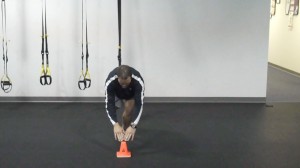
To see the entire progression (part 1), check out my column by clicking on the image below.

 Back to top