Share   Subscribe to RSS feed

Brian Schiff’s Blog

Injury Prevention, Sports Rehab & Performance Training Expert

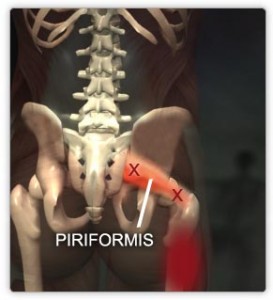
piriformis-skeleton

So, have you ever experienced pain in the buttock that radiates down into the thigh? Maybe even felt some numbness and tingling? Recently, I was contacted by an experienced marathoner who has been plagued by pain in the buttock and posterior thigh.  He self diagnosed himself as having piriformis syndrome after doing some research on the Internet.  So. what is piriformis syndrome?

Some experts debate whether it truly exists, but essentially, it involves the piriformis, a small pear shaped muscle in that helps externally rotate (turn out) the hip and the sciatic nerve which runs down the entire back of the leg and is responsible for sensation and motor movement patterns of many of the muscles in the lower leg.

It is suggested that in this syndrome the sciatic nerve essentially becomes compressed or irritated by a tight piriformis muscle.  The sciatic nerve travels above, below or even through the piriformis muscle itself based on anatomical studies.

Some have even suggested that prolonged sitting with the hips turned out or sitting on a wallet can contribute to this problem.  I even remember being told in PT school that it is more common in truck drivers.  With that said, I think I can count on one, if not both hands the number of patients I have seen in 15 years that I truly believe had piriformis syndrome.

Now back to my runner.  He began having pain in his left buttock and hamstring in late December after seeing a trigger point specialist who suggested he had a tight piriformis and did some deep tissue work on it.  A short time afterward, he began having symptoms.  He saw a physical therapist for 2-3 sessions and was given some stretches to do.  Meanwhile, he began getting deep tissue massage focused on the area in January and February.

Continue reading…

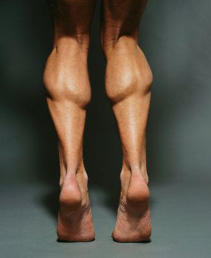
calfmuscles

Some people love their calves, while others hate them.  Ever see people piling on the weight at the gym (barbells, seated calf press machine, etc.) attempting to build shapely calves?  Or maybe you see people performing calf raises on a box with their feet in, straight ahead and out.  The question has long been this: is there any real benefit to doing them beyond the neutral or straightforward position to get maximal activation and strength gains?

Why is this important?  Well, beyond muscle tone, this question has physiological ramifications with respect to performance and rehabilitation.  Consider, for example that as knee flexion angles increase, the medial gastroc becomes increasingly disadvantaged regardless of the ankle position.  This suggests inherent functional differences in the muscle architecture and activation patterns of the medial and lateral heads of the gastroc.

In a study just published in the March 2011 Journal of Strength & Conditioning Research, Riemann et al. investigated the impact of all three positions on gastroc activation.  They used 20 healthy subjects (10 male and 10 female) with no history of a calf injury and all had prior resistance training experience.


Continue reading…

I am always looking to try and learn new things.  There seems to be so much buzz around soft tissue mobilization and release on the blogs and web these days.  The longer I practice and treat soft tissue injuries, the more convinced I become of the importance of releasing trigger points and myofascial restrictions.

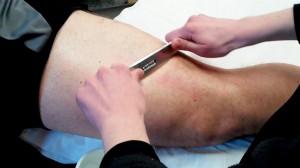
One of the therapists who works alongside of me every day recently attended a Graston® training course.  For those unfamiliar, this is a form of instrument assisted soft tissue mobilization (IASTM) utilizing convex and concave instruments to resolve fascial restrictions that are often present and a source of pain/tightness.

I volunteered to have her work on my IT band immediately when she returned from the course.

Click here to see a short video clip

graston-itb-2

While I have utilized foam rolling, the Stick, deep tissue massage and most forms of stretching, this was a first for me.  I must admit, the instruments Liz used seem to find every single tender and gritty spot in my IT Band. Yes, there was some mild discomfort at times.  But, the treatment lasted 3 minutes or so and I felt much less tightness and soreness the very next day.

Many people see good results in as few as 3-4 sessions, but results vary.  Consider IASTM another tool to place in your collective tool box.  It is a great adjunct to stretching, strengthening and corrective exercise. There are other methods out there (SASTM and Gua sha to name a few) but I am not addressing them here today.

If you have specific questions or want more info on GT, visit the link below:

Graston® Frequently Asked Questions

If you are an endurance athlete or someone who has been struggling with chronic soft tissue pain or tendinitis, and have not yet tried this, I might suggest looking into this as it may be a missing link in your rehab plan. If you have personal experiences with the GT, I would love to hear about them.

In most gyms and training circles, people are performing bench press or push-up exercises.  There is no doubt in my mind that repetitive heavy full range bench press causes many of the labral and cuff injuries among males I have seen over the years These injuries are often the attritional type – developing over many months and years.

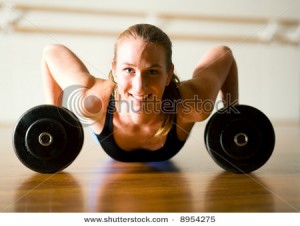
What about push-ups?  Is the force development pattern the same?  Are they safer?  Honestly, I believe in keeping the elbow at a point at which it does not drop below the plane of the body (bench press) or move above the body (push-up).  Essentially that means keeping to a 90 degree angle or less.  Why?  Well, regardless of load, I feel the real risk is not so much in the motion itself but the very repetitive manner in which it occurs with external loads, often lending itself to acquired anterior shoulder laxity, strain on the proximal biceps anchor (think SLAP lesions) and secondary shoulder impingement.  The picture below hurts my shoulders just looking at it, and over time this technique will hurt your shoulders too.

stock-photo-powerful-lady-doing-push-ups-on-dumbbells-8954275

But, I say all that to set up today’s post.  In a recent article in the February edition of the Journal of Strength & Conditioning Research, David Suprak et al. looked at the effect of position on the % of body mass supported during traditional and modified push-ups.

The study looked at 4 static positions in 28 males (about 34 years old) who were highly trained and members of the special forces or SWAT team (the up and down position for regular and modified push-ups) to determine the change in body mass (BM) supported by the upper body in different ranges of motion.  The down positions studied were at approximately 90 degrees (the lowest depth I safely recommend) and all holds were performed for 6 seconds.

modified-push-up push-ups1


Continue reading…

I think most people involved in health and fitness are up to speed on the move to address mobility and stability at the hip as an integral part of our assessments and exercise prescription.  I know in my practice I see lots of issues with both a lack of hip stability and mobility.

As I learn, practice and evolve as a professional, I find myself looking for more bang for my buck with exercises.  A few themes and trends in my own training include:

  1. Increasing emphasis on body weight exercises
  2. More and more single leg training
  3. Integrated movement patterns versus isolation

So, if you are familiar with Gray Cook and Mike Boyle (I am specifically referring to their writing and discussion on the joint by joint approach) you know that they advocate for increasing mobility at some joints and gaining stability at others.  Ironically, the hip has a need for more of both depending on the movement and individual imbalances.

So, I really enjoy exercises that provide some of each and meet the trends I referenced above.  I just released one such hip exercise in my “Functionally Fit” Column in PFP Magazine.  I call it the RDL Hip Driver.

rdl-hip-driver-bottom

rdl-hip-driver-top

Click here to read the entire post with a full description of how to perform the exercise and its functional application.