Share   Subscribe to RSS feed

Brian Schiff’s Blog

Injury Prevention, Sports Rehab & Performance Training Expert

The longer I train (myself) and my clients, the more and more I gravitate to bodyweight and bodyweight plus training.  Why?  Namely because I find people struggle to control their bodies in space against gravity.  No matter what sport or work task people need to complete, they must be able to move, stabilize, and resist and apply force effectively with respect to their body.

I also find myself looking to integrate systemic, progressive and kinetic chain based core strengthening exercises for maximal efficacy.  The lack of proper core stability and strength will often leave the back and other limbs of the body vulnerable to unwanted force dissipation.  That means increased chance for injury. 

Adding a stability ball (when you are ready) to abdominal exercises will add spice to your routine and surely FIRE UP your core too!  In today’s post, I want to share some pics of core based training related to my most recent column in PFP Magazine.  Before I share one of my favorite ball exercises with you, consider the following pre-requesite steps before attempting this particular exercise:

  • Master floor based planks
  • Master static stability ball planks
  • Master static holds in hand supported plank position (balance/stability)

Pictured below is the stability ball ab circles.  This is great exercise for shoulder stability training and core activation.  Trust me when I say you will feel it after 10 good slow reps.

stability-ball-ab-circle-cw-left

Ab Circle to the Left


stability-ball-ab-circle-cw-right
Ab Circle to the Right


 Click the image below to check out my column on how to execute the stability ball ab circles.

brian_columnI have used Thera-Band Stability balls for years and love them.  If you are looking to add a stability ball to your training tool box, click on the stabilityball images below to grab your very own today.  The 55 cm ball works great for the ab circles for most people.  Enjoy!

thera-band-balls

So, if you know me well at all, you know my first “law of exercise” is to ALWAYS know why you do what you do.  I read a newsletter by Mike Boyle yesterday.  He talked about being a cook or chef when it comes to exercise.  He advises those with less than 5 years of expereicne not to mess with the recipe much so to speak.  Since I have been doing this for 12 years, I consider myself to be much more of a chef.

I am constantly creating and tweaking my programming to deliver the best results.  So, when I decide to use a training aid or piece of equipment, I have to believe in it 100%.  My athletes and adult clinets alike love bands, vests, balls and training toys if you will.

But, I have to remind them (and myself at times) that the training aid exists only to further advance the original exercise or its desired outcome.  Using these things just for variety is not really a sound plan.  Today, I have a short video for you that reveals four progressive ways to use the Thera-band stability trainer.

I have used this in the rehab setting and in my fitness programs with great success.  Please note – all of the exercises I show you should be mastered on flat ground first.  After that, the stability trainer adds a great new dimension to the exercises and provides a very natural disturbance to balance and stability throuhg the kinetic chain that exists in sport and life.

Now, these are a just a small sampling of some of my favorite Thera-band trainer drills.  The cool thing about this item is that it comes in three different levels of difficulty moving from green (easiest) to black (hardest).  I tend to prefer the blue as it is middle of the road, making it easy enough for those without the skill of an Olympian and yet challenging enough for even the more advanced athletes.  However, starting with the green may be necessary for those with ankle/knee instability or limited experience with stability training.

You can grab your very own blue Thera-Band trainer in my OpenSky Shop.  Click the image below to head on over and get free shipping for a limited time as well.

tb-stability-trainer

Well, I just finished day two of the 2nd IYCA Youth Summit.  I attended last year as well.  Each year I took away some new info, reinforcement about what I am currently doing along with motivation to become a better coach.  Yet, the best part of attending these live events is building relationships. 

I have met so many incredible coaches and people.  Whether having breakfast with the likes of Kwame Brown and Carlo Alvarez or chatting with Dave Jack and Chris Mohr, I am reminded that greatness is not about ego or self seeking.  Rather, greatness comes from giving, humility and most importantly “doing the right things” for our clients.

What does this look like in my fitness and sports performance business?  Well, it involves the following:

  • Putting 100% of my passion into products, training and consulting
  • Assessing the needs, abilities and goals of my clients
  • Constantly re-assessing to “tweak” programming and exercise prescription
  • Being willing to admit when you are wrong or change the way you do or see things when it is in the best interests of the client
  • Continually learning and striving to get better each day
  • Delivering results through sound evidenced based training (knowing “why” I do what I do)
  • Being honest and dedicated to improving the lives of my clients

So, you may be asking why I am telling you all this.  I have a simple answer.  I want you to trust me and look to me as a credible expert when it comes to corrective exercise, rehab and sports performance.  I also want to assure you it really is the proper application of knowledge that defines success with exercise.  It is an exact science.

The types of exercise, reps, sets and such really do matter.  See what one client recently said about my shoulder rehab program:

I began using your exercises immediately.  In just 6 days I have seen significant change.  I have been able to use my hamd/arm again to wash my hair, close my car door, reach for items and just stop holding it up and against my body.  Today I had a weekly massage (she was formerly a PT) and she was amazed at my progress.  I feel there is hope again.  I know the book cost a fee, but I still want to say thank you for creating an exercise plan that does not include torture.

Wow, torture is never good, right?  Exercise should never be painful – just effective.  If you have not seen significant positive change within 30 days, this should raise a red flag.  So, beware of ultra hype and too good to be true claims, yet understand that you should see some measurable results in a reasonable time frame.  I will always stand behind my programs and products. 

With that said, I will be revealing a series of specific exercises I use with my clients over the next month.  In these posts, I will show you the exercise, explain the applications and reveal the training tools I use to make them work.  The posts will give you real exercises you can use to fix muscular imbalances, improve strength and maximize physical health and performance.  Most importantly, you can rest assured I remain 100% committed to doing things the “right way.” 

I am sure you or someone you know has suffered with or been affected by a frozen shoulder at some point.  Known in the medical world as adhesive capsulitis, this condition can be downright miserable for folks.

Who gets it?  It is often brought on after injury or a period of immobilization (e.g. arm in a sling after surgery or dislocation).  However, it also comes on insidiously too.  Statistics indicate it more commonly affects women and those with diabetes are at more risk for getting it in both arms.

Some feel it may ultimately be an autoimmune reaction that triggers it.  So, what is it exactly?  Well, in plain terms your shoulder joint has folds of connective tissue we refer to as a joint capsule.  In frozen shoulder cases, the capsule becomes shortened and inflamed making arm movement painful and limited at best. 

There are three distinct phases:

  1. Freezing
  2. Frozen
  3. Thawing

These phases may progress over the course of months or in some cases last as long as 2-3 years to resolve.  In time, the condition will correct itself. 

Symptoms may include:

  • Stiffness
  • Difficulty sleeping
  • Pain along the shoulder or down into the arm
  • Certain movements more restricted than others
  • Progressive worsening of motion and decreasing pain

No one wants to suffer with this for any prolonged period of time.  So, how do you accelerate the healing process?  You must move the shoulder daily within your available range of motion.  But doing the right exercise is critical.

In addition, I believe having an experienced therapist do joint mobilizations is critical in loosening up the capsule provided it is done within pain tolerance of the patient and followed up by appropriate stretching.  For those without insurance or looking to avoid the grueling stretching some docs and PT’s advocate, I recommend looking at my home therapy guide.

Want more info?  Visit www.frozenshouldertherapy.com for success stories and more details on my proven home remedy.  You can also click on the image below:

frozen3dflat

In addition, I think you can complement rehab with a tool like the Rotater to help restore mobility.  I have trialed this product myself and I really like the ease of use and control the patient has with the stretching intensity.  For more details, click on the image below:

Discover the #1 Shoulder Rehab Tool

Today I have some exciting news to share.  I have recently partnered with OpenSky to make some of my very favorite training and rehab tools available online to you as well.  Essentially, at OpenSky I am able to send my readers to my own personal supply shop. 

In this shop, I will be showcasing products I believe in and use in my daily practice to help my clients achieve peak health and fitness.  For now, I only have three products in my shop, so you are essentially only getting a “sneak peek” as I quickly pull the curtains back for you.

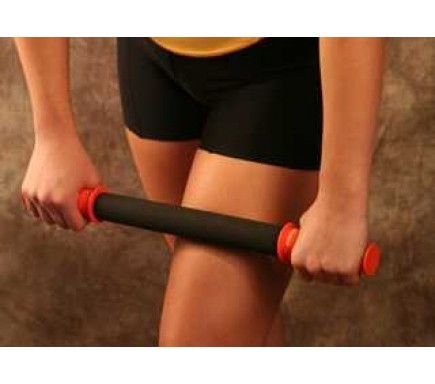
In a few weeks, I will have a grand opening of sorts with many more products to offer.  So, what’s in the shop and how does it relate to me?  Well, today, I wanted to briefly discuss the importance of using a rolling device to facilitate myofascial (soft tissue) release.  Many of you know I run and train runners and athletes of all sports.  One of the most common issues I see (especially in runners) is problems or pain related to trigger points or soft tissue tightness.

How do I solve this?  When I injured my soleus training for the half marathon last fall, I used a roller to resolve pain and tightness before and after each run.  Using a self roller such as the Tiger Tail is very effective in resolving these trigger points and areas of tightness.  You will not be able to enjoy maximal strength and power production in your workouts if these trigger points are interfering or limiting you because of persistent pain.

You would like to think stretching alone would rid you of such issues, but this is just not the case.  Once you effectively relieve the trigger points, the muscle balance is restored and you can get back to 100% again.  So if you or someone you know always complains of tightness or soreness in one calf, hamstring, IT band, etc., this may be just the answer. 

The best part the Tiger Tail is that it is very affordable and easily transportable if you are on the go.  You control the pressure and location of the release.  In just 5-10 minutes you will be on your way to feeling much better.

tiger-tailtiger-tail-2

Be sure to check it out today at my store by clicking here or on one of the images above.  I look forward to sharing more of my favorite training tools in the near future.