Share   Subscribe to RSS feed

Brian Schiff’s Blog

Injury Prevention, Sports Rehab & Performance Training Expert

male-knees1

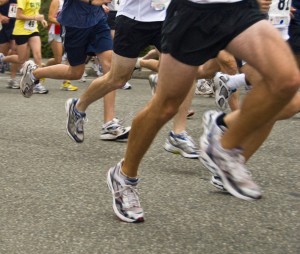
Whether you are for or against running, its popularity is likely at an all time high.  People run to lose weight, stay fit, compete or simply escape from the stress of the world.  Unfortunately, running often brings injuries for its participants. 

So, what are the risk factors directly associated with injury?  Researches in the Netherlands recently performed a prospective study with 532 novice runners (306 females and 226 males).  The runners trained for a 4 mile event and were advised to run 3 times per week (Monday, Wednesday and Saturdays) at a comfortable pace.

They were randomized into 8 and 13 week training programs.  There was no difference in findings among the different training groups so they were counted as one for the puprose of the study results.  The results are interesting.  Risk factors for running related injuries (RRI) in males included:

  1. Higher BMI
  2. Previous injuries – those with previous injuries are 2.6 x more likely to suffer an injury
  3. Type of previous sports activities – those participating in axial loading sports were less likely to be injured than those who participated in non axial loading sports (cycling and swimming for instance)

Predictors of RRI in females were:

  1. Increased navicular drop – this in turn leads to increased pronation and femoral internal rotation thereby increasing the risk of developing medial tibial stress syndrome

Some hypothesize that limited joint mobility leads to injury with the repetitive nature of running as force is dissipated unevenly along the kinetic chain.  Interestingly enough, lack of range of motion in the ankle and hip were not found to be related to RRI in novice runners.  Type ‘A’ personality influence in terms of pain resistance was also ruled out as contributing to sustaining an injury in this study.

What are the takeaways here? 

  • The key thing to see is that males and females have different risk profiles. 
  • Males that carry more weight may be comparatively at a greater risk for injury than females. 
  • Pronation and proper foot mechanics may be a bigger issue in females as they are much more prone to develop stress fractures
  • Further research is needed to better predict female risk factors
  • There are several limitations in this study such as: inconsistent training days, different running surfaces, different running speeds/intensity and weather to name a few

In my mind, it also further illustrates the need to fully rehabilitate injuries, prepare the body for events thru smart progressive axial loading and to target the hips with strength and power work in runners to better control femoral internal rotation and reduce ground reaction forces.

For more info, read the full article in the February 2010 edition of the American Journal of Sports Medicine.  Stay tuned this week, as I will review another running research article discussing the impact of slope (hill) running on the body.


Whether you are lay person, trainer or therapist reading this blog, I try to keep you up to date on science, training and my interpretation/application of exercise based upon the research and practical application in my practice.

Today, I want to touch on an article just published in the Journal of American Sports Medicine.  It was based on a  study conducted by Tim Tyler et al in New York.  They set out to determine what effect decreasing GIRD (aka glenohumeral internal rotation deficit) and posterior shoulder tightness had on reducing symptoms associated with internal shoulder impingement.

For those unfamiliar with GIRD, it basically looks at total shoulder motion side to side but focuses on deficits in internal rotation.  Throwers often lack internal rotation on their dominant arms and exhibit excessive external range of motion for cocking and ball velocity.  We tend to call this acquired laxity.  Pitchers tend to have higher GIRD as well.  Keep in mind total shoulder motion is critical as well.  So, you cannot assume one will have problems just becasue there is decreased internal rotation.

You may see similar GIRD and psterior shoulder tightness patterns in other overhead athletes (swimmers, tennis players, volleyball players, etc.)  This particular study looked at the effect on 11 men and 11 women who received manual mobilization by a PT combined with ER ROM, posterior shoulder stretches and scapular strengthening.

They studied all 22 subjects (range of symptoms from 1 to 24 months) and then compared data on the patients with and without symptom resolution.  In effect the study revealed that posterior shoulder tightness was significantly improved in 12 of the subjects that had complete resolution of symptoms (more so than in the 10 who did not).  In addition, changes in GIRD did not seek to impact the results.

What is the take away from this study?  In a nutshell, if you have symptoms related to internal impingement, you should be doing posterior shoulder stretches.  So, what are the best ones to do?  There was a recent article in the NSCA Strength and Conditioning Journal (December 2009) that laid out some effective stretches (two of which I will show you in the video).  Also, you should note that this pattern of tightness is common in weight lifters.

I have included a short video clip with 3 effective stretches that easily can be done at home.  The stretches are as follows:

  1. Standing cross chest shoulder pull (across the chest) – this is a basic stretch I start most clients with who are experiencing pain.  The drawback is that the scapula is not stabilized (or fixed) so you do not isolate the posterior shoulder effectively.  However, it tends to be more comfortable for many early on and you will still get some benefit.  When you are ready, it can be done against a wall to fix the scapula.
  2. Side lying cross chest shoulder pull – this would be equivalent to doing stretch number 1 against a wall.  The floor acts to stabilize the scapula and then you pull the arm up and hold.
  3. The sleeper stretch – go easy with this one as pushing too hard may actually increase inflammation in my experience.  You may also vary the angle of the upper arm to hit different portions of the joint capsule.  For example, you may elect to stretch at 90, 70 and 45 degrees.

I advocate holding each stretch for 20-30 seconds and repeating 2-3 times daily.  If you are in therapy, the stretching should be done following the joint mobilization by your therapist.   Click the video below to see the stretches.

Well, I have an update on player x.  She saw my preferred soccer/knee orthopedist in town on Wednesday.  He examined her and read the comments I gave to her mother as well.  In summary, he agreed with me that she had patello-femoral pain/inflammation.

He also told the mother she had just gone back to soccer too quickly and never fully regained her quad strength.  He told her if she continued to work around the deficit, she would likely suffer another injury.  This is often the case.  So, at this point the plan of action is to take a one month hiatus from soccer and do formal rehab three times per week.

While this process will be much slower and less active for player x, it probably will be for the best in the long run.  In the short term, she may suffer some loss of fitness, but she needs to focus on strengthening right now.  I will keep you updated on her progress as time goes by.  She will likely return to me for conditioning to transition her safely back to full soccer once therapy winds down.

In the last post, I identified the issue I believed to be going on with player x.  Keep in mind the player returned to  see me the week of 12/15 intially.  The first line of treatment for PF issues in most clinical scenarios involves the following:

  1. Rest
  2. Ice
  3. Stretching (quads, hamstrings, IT band and hip musculature)
  4. Straight leg raises
  5. Short arc quads (mini-knee extensions from 30-0 degrees if you will on a bolster) although I am not a huge fan of these
  6. Mini-squats
  7. Calf raises

I advocated relative rest, ice and stretching with my athlete in addition to the following exercises initially:

  1. Single leg step-downs (side progressing to front version) in pain free range
  2. Single leg stiff legged dead lifts
  3. Single leg bent knee floor hamstring bridges
  4. Lateral ankle band walks for gluteus medius work
  5. Multi-planar lunges in pain free range of motion

She did well with all of the exercises after week one but noted pain with front step-downs and deeper lunges.  On 12/22 I made a significant discovery: she had adopted a compensatory hip strategy to avoid normal knee kinematics with deceleration.  What am I referring to?  I call it a quad avoidance lunge pattern.  She would shift her trunk into extension with foot contact when lunging onto the affected knee as a result of anticipation of pain. (See video clip below as I show a normal lunge pattern, a quad avoidance lunge pattern and the exericse I use to break it)

To help break this cycle, I used an 18 inch box to elevate her unaffected foot and force her into more normal hip flexion on the affected side in a pain free range.  This seemed to work so we added this to the home program using a stair step and eliminated front step-downs altogether, choosing instead to focus on the side step-down in the 40-0 range if you will.  I also added single leg soccer kicks (no ball) forward and in a crossing fashion to work on stability, strength and proprioceptive control.

The athlete returned on 12/31 and seemed to be progressing but still had discomfort with running.  So, I felt she was not ready for full go as of yet.  She also still had discomfort with short and long shuffles moving to the involved side.  At this point, her mom wanted to know what I thought. about practice.

I advised her that player x needed to continue with strengthening 3x/week and try to ease back into jogging as able.  She said the first indoor practice was coming up the week of 1/4.  My thoughts? Indoor soccer fields and PF pain are a bad fit – period.  But, I told her to let her daughter warm-up and do a few drills to get a feel for things.

The verdict?  I got an email on Saturday saying she could not practice due to the same discomfort.  Her next stop is back at the surgeon’s office for a closer look at the knee tomorrow.  I will keep you posted on the diagnosis and treatment as this is an issue that all of us who work with athletes face and struggle with.  Finding the right balance and progression between rest, rehab and return to play is tricky.  So stay tuned for more details.

I have posted on the perils of patello-femoral pain in the past on this blog.  Today, I will share how surgery to fix one knee problem may lead to a new problem.  For privacy reasons, I will refer to my client as player x. 

History: Player x is a 15 y/o healthy female soccer player who suffered a lateral menscus tear in the summer of 2009.  She had arthroscopic repair followed by a brief stint (4-6 weeks) of rehab.  Surgery went well, but she did not regain full extension in rehab (she has about 5 degrees of hyper extension naturally).

Prior to fall high school season, player x came to me for sport reconditioning.  She had obvious quad atrophy (particularly the VMO) and lacked speed and explosiveness.  She worked with me 1-2x/week for 4-6 weeks and made good progress but did note some mild persistent soreness in her knee.

She played the entire fall season without injury/limitation but continued to have the same mild persistent knee pain.  The first week she began club practice (fall high school season had ended), her club coach had the players do a lot of plyometrics.  The exercises did not seem hazardous, but player x immediately had a significant increase in knee pain.

Her mother contacted me and she recently came back in for an assessment.  Ironically enough, her single leg squat and single leg broad jump were within 90% of her uninvolved leg.  However, she had mild swelling, Quad atrophy (about a 1 1/2 inch deficit) and she had significant pain with lateral movement to the side of her involved knee and could not decelerate without pain.

Hmmm…..   So what is the issue here?  After carefully evaluating her and performing functional testing I was able to rule out quadriceps tendinitis.  Her pain occurs primarily at or beneath the superioir and lateral portion of the knee cap at 30-40 degrees of flexion when she is weight-bearing.

I am fairly confident she has patello-femoral joint irritation with excess compression along the lateral facet.  Why?

  1. Perhaps the slight extension deficit allowed her to run more on a slightly bent knee (more PF force)
  2. Weak VMO is overpowered by the vastus lateralis creating abnormal lateral translation of the patella
  3. Pain is worse with deceleration and eccentric strength exercise going past (greater quad pull and patellar compression occurs with these activities)
  4. Pain with lateral movement and change of direction suggest lack of proper medial stability and dynamic control of femoral internal rotation which would subject the kneecap to abnormal joint reaction forces especially laterally where her pain is felt
  5. No pin point tenderness consistent with soft tissue inflammation

The entire scenario has likely been perpetuated by the volume of training/running in soccer and was then exacerbated by the plyometrics.  She compensated and ignored the mild pain all fall, but the knee finally reached a breaking point with the plyos (keep in mind she did no plyos in the high school fall season).

I see patello-femoral pain all the time in female year-round soccer players.  What is the solution?  Stay tuned as I will share more details about patella balancing training and my corrective exercise program for player x in the next post.