In all my years as a therapist and strength and conditioning professional, I have seen many active people affected by stress fractures or stress reactions. If you are a runner, you may have experienced such a thing. Likewise, people beginning a new exercise program or rapidly increasing training volume and/or intensity may be at increased risk for such an injury.
Common stress reaction injuries and stress fractures include:
- 5th metatarsal stress fracture
- Shin splints
- Medial tibial stress syndrome (MTSS)
- Tibial and fibular stress fractures
- Femoral neck (hip) stress fracture
- Spinal stress reactions/fractures
Runners, soccer players and gymnasts are often the groups of athletes most likely to suffer these types of injuries. The repetitive impact leads to breakdown in the bone or bone edema (swelling in the bone). What starts out as a mild ache may quickly turn into sharp pain if you fail to heed the warning signs.
Signs and symptoms of stress injuries or stress fractures include: aches or pain with increased loading (running, jumping, and stress at extreme ranges of motion), decreased range of motion, decreased strength and altered gait patterns. Pain may lessen after resting a few days, but often returns as soon as you resume higher impact activity in the case of a stress fracture.
In my practice, I see these injuries much more often in females. This is likely in part due to calcium deficiencies and and perhaps biomechanicaldifferences that increase force on the joints and bones. Women also lack strength in comparison to men and weakness equates ot less force dissipation and higher chances ofinjury. Typical treatment is rest, ice and anti-inflammatory meds. In some cases immobilization and restricted weight bearing is necessary to allow full healing.
Below is a picture of a metatarsal stress fracture:

If you have a persistent nagging ache or pain in the foot, shin, hip or spine, see your doctor to rule out a stress injury with an x-ray. These injuries are easily treated when diagnosed early on. In some cases, neglect may necessitate an operation to remedy the problem. Once you return to training, it is essential to go slow and use the 10% rule each week (not increasing mileage, volume or intensity more than 10% per week) and using a pain dictated progression in regard to exercise.
As I prepare to launch my new arthritis DVD to the general public on May 11, I wanted to give you an effective exercise (included in the actual program) using a simple box to improve quad strength. In this three part progression, you should begin with a 4 inch box. The order (easiest to hardest) is:
- Posterior box step-down – in this version you lower the whole foot or toe of the non support leg to the floor and then return to upright. As it gets easier attempt to only lightly touch down and reduce upper body support.
- Lateral box step-down – in this version you still keep the knee in line or behind the toes and lower the non support leg’s heel to the floor and then return to upright.
- Anterior box step-down – this is the hardest version because the weight shifts forward taking the knee over the toes (yes this is allowed in this case as it simulates descending stairs) and puts more emphasis on the quad muscle and less on the glutes and hamstrings. Again, lightly touch the heel to the ground.
In the video below, I will demonstrate how to do all three progressions with light upper body assistance. Once the knee is strong enough and pain free, eliminate upper body support completely as this will challenge proprioception and stability as well. Remember to work only in a pain free range of motion.
If you want to grab a copy of the arthritis DVD on sale, head over to www.fitknees.com as the price goes up on May 11 with the official launch.
If you know anyone with chronic or acute knee pain related to arthritis, then you know how frustrating and depressing it can be to live day to day, let alone exercise. Arthritis comes in all forms and attacks all ages. I have seen traumatic arthritis ruin professional sports careers, as well as chronic progressive OA make getting out of bed a major obstacle for people.
So, today, I am unveiling two very simple exercises anyone can do at home. These are 100% safe and will not cause any harm to the knee joint. They will allow one to begin inflammation reduction strengthening safely. You see, rest, pills and activity modification goes only so far.
Most people want to live. Whether that is daily function or playing tennis, they will settle for nothing less. That is where the right exercise program comes into play. I am giving you a glimpse into my new DVD program titled Osteoarthritis 101: Your Complete Guide to Safe Exercise and Return to Activity. It will be officially released in the next 2 weeks or so, but you can grab a copy at a significant discount in the meantime (first 100 pre-sales on my site).
In today’s video, I reveal exercise from Phase I (Infammation Reduction) of my specific 6 phase exercise system. Please pass this post along to anyone suffering from arthritis or tweet it.
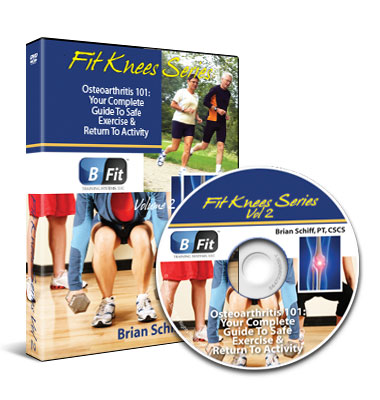
Fit Kness Series - Osteoarthritis 101
Click
here to pre-order and save $ today.
As I continue on with my arthritis series, I am going to talk about a very common problem in women. It is patello-femoral arthritis, also commonly referred to as anterior knee pain, chondromalacia, and patello-femoral pain syndrome.
So what is it exactly? Well, it simply means degeneration of the cartilage lining the back of the kneecap. Take a peek at the facets on the back of your kneecap below.
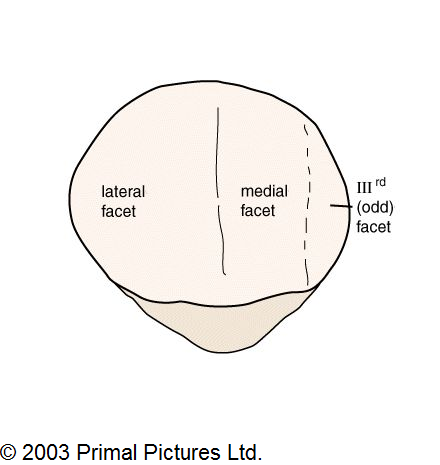
Typically, people with PFP experience pain along the lateral facet as it glides and tracks on the femur. Women see this more so as they tend to have a more laterally tilted or laterally tracking patella. As such, this is why I am against using the knee extension machine as it grinds the facet as you extend the knee. In addition to shear forces, direct compressive force by way of prolonged kneeling, falls, and repetitive impact may damage any part of the facets.
Signs and symptoms of patello-femoral pain may include:
- Pain in the center of the knee or behind the kneecap
- Pain which may radiate along the inside or outisde of the knee
- Pain with kneeling, stooping, stair descension, squatting, jumping and running
- Pain or stiffness with prolonged sitting (desk, car or plane)
- Grinding or “rice krispie” sounds with movement
I included another picture below demonstrating Grade IV chondromalacia (the worst degree).

In the next post, I will give you a few simple exercises to safely strengthen the knee in clients who may be suffering from this type of arthritis.
Today, I am including a picture to better reveal the physical effects of pronation on the knee joint.
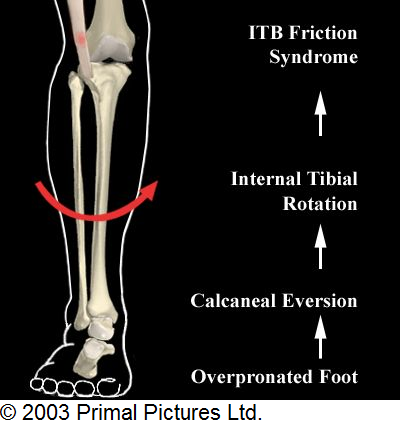
Now, in this photo of the right knee it points out ITB friction syndrome (runner’s knee). You can see how force is transmitted up the kinetic chain based on bio mechanical alignment. With increased internal tibial rotation, ITB irritation is a distinct possibility. In addition, it is important to note that this pronation also leads to increased valgus moments (knee caves inward) leading to added stress to the knee. It may also create increase shear force along the lateral patella and compressive force along the lateral knee joint.
This abnormal force transmission is one of the primary reasons runners with overpronation experience ITB and lateral knee pain. Aside from utilizing arch supports, getting proper footwear and gradually increasing mileage, there are some essential strengthening and stretching exercises to include if you have overpronation issues including:
- ITB stretching
- Hamstring and calf stretching
- Quadriceps strengthening
- Gluteus medius strengthening
- Single leg (knee bent) balance and reaching
- Single leg calf raises to increase arch support by strengthening the posterior tibialis
In the next post, I will review Chondromalacia (softening of the cartilage behind the kneecap) and patello-femoral arthritis, a condition that affects many women over the age of 30. I also wanted to let you know I will be releasing a DVD on knee arthritis in the next few weeks. If you read my blog, you will be entitled to a special pre-release offer as well. Stay tuned for more details.


 0
0


 Back to top