

Brian Schiff’s Blog
Injury Prevention, Sports Rehab & Performance Training Expert
 11
11
One of the greatest things about medicine is that it continues to evolve and change. Sports medicine is at the forefront and athletes are always looking for faster ways to recover and get back in the game. If you are not familiar with platelet rich plasma (PRP) therapy, click here to read my earlier post on it.
It has been used increasingly to treat muscle strains and chronic tendinitis in the heel, knee and elbow. While some early responses have been favorable, there has not been much follow-up data or research available to assess its efficacy. In the August edition of the American Journal of Sports Medicine reports on one-year follow-up for the use of PRP in chronic Achilles tendinopathy.
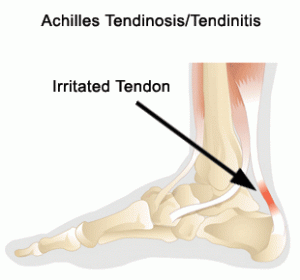
The study was a double blind randomized placebo-controlled study using 54 patients (age 18-70) who had chronic tendinopathy 2-7 cm proximal to the Achilles tendon insertion (minimum of 2 months). They were randomized and given PRP or a saline injection in addition to an eccentric training program. Keep in mind recent research has indicated the efficacy of eccentric training to treat chronic tendon problems.
In this intervention, patients were given the injection with ultrasonagraphic guidance. After the injection, theyw ere told to avoid sports for 4 weeks. In week 2, they preformed a stretching program. Then all participants began a 12 week eccentric exercise program. Follow-up was done at 6, 12 and 24 weeks by one researcher, while another blinded researcher did the one-year follow-up. Clinical and ultrasonagraphic follow-up was done at each interval.
Results
At the 1 year follow-up, there was no clinical or sonagraphic benefit of PRP. This matches the findings at 6 months as well. One other radnomized studly looking at tennis elbow did find a statistical significance when they compared PRP to a corticosteroid injection at 1 year, instead of a placebo injection. Another key factor or difference is one area is load bearing and the other is not.
In reviewing this study, it should be noted that not only was pain reduction not statistically greater, nor was there any added positive tendon structure changes noted using the PRP. With that said, the looming issue with this treatment intervention is that variables like platelet count, injected volume. number of injections, preactivation and the presence of leukocytes are not always the same across studies, and they were not determined within this study either.
The takeaway here is that there appears to be no added benefit from PRP with chronic Achilles tendinits. However, there is no known negative side effect associated with trying it either. I think the hardest part is scaling back activity and being patient enough to overcome these injuries. In my experience, they often require soft tissue massage, rolling, stretching, eccentric loading, relative rest, and a very specific return-to-activity plan based 100% on the tissue and pain response of the patient.
Time and future research will continue to tell us more about PRP. I think we may find that different growth factors and treatment options may evolve that do in fact speed regeneration and healing.
Today I am going to share two pieces I have written for other publications as I think the exercises I discuss have real merit and broad application for competitive athletes and weekend warriors. I am a columnist for PFP Magazine and Endurance Magazine and these articles come from those publications.
Single Leg Theraband Activation Squats
The idea behind this exercise is applying progressive gradients of resistance that encourage the faulty motion (pulling the leg into adduction and internal rotation) to facilitate increased activation of the gluteus medius/minimus and small lateral rotators to create an anti-adduction/internal rotation force. Decreasing such moments at the knee will reduce IT Band issues, patellofemoral pain, ACL injury risk and overuse problems often seen in running.
Click here to see how to perform the exercise
Mobility Training for Endurance Athletes
It is no secret that endurance events require repetitive motion and often carry a higher risk of overuse injuries. In light of this, poor thoracic extension and/or limited ankle dorsiflexion negatively impact proper running and riding mechanics and lead to faulty movement patterns. Beyond physical stress, this reduces performance capacity as well. There are two simple mobility exercises to help correct imbalances that may be hindering you.
Click here (go to page 16) to see how to sustain your body with these exercises
Unearthing the cause of anterior knee pain and ridding our patients and clients of it is one of the never ending searches for the “Holy Grail” we participate in throughout training and rehab circles. I honestly believe we will never find one right answer or simple solution. However, I do think we continue to gain a better understanding of just how linked and complex the body really is when it comes to the manifestation of knee pain and movement compensations.
We used to say rehab and train the knee if the knee hurts. It was simply strengthen the VMO and stretch the hamstrings, calves and IT Band. Slowly, we began looking to the hip as well as the foot and ankle as culprits in the onset of anterior knee pain. The idea of the ankle and hip joint needing more mobility to give the knee its desired level of stability has risen up and seems to have good traction these days.
Likewise, therapists and trainers have known for some time that weak hip abductors play into increased femoral internal rotation and adduction thereby exposing the knee to harmful valgus loading. So, clam shells, band exercises and leg raises have been implemented to programs across the board.

Single Leg Resisted Hip External Rotation
As a former athlete who has tried his hand at running over the past 5 years, I have increasingly studied, practiced and analyzed the use and importance of single leg training and its impact on my performance and injuries. As I dive deeper into this paradigm, I continue to believe and see the benefits of this training methodology for all of my athletes (not just runners).
As a therapist and strength coach, it is my job to assess movement, define asymmetries and correct faulty neuromuscular movement patterns. To that end, I have developed my own assessments, taken the FMS course, and increasingly observed single leg strength, mobility, stability and power in the clients I serve. Invariably, I always find imbalances – some small and some large ones.
What are some of the most common issues I see?
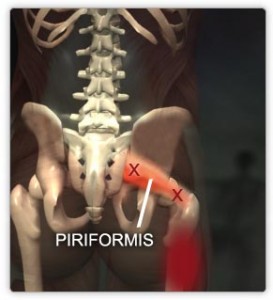
So, have you ever experienced pain in the buttock that radiates down into the thigh? Maybe even felt some numbness and tingling? Recently, I was contacted by an experienced marathoner who has been plagued by pain in the buttock and posterior thigh. He self diagnosed himself as having piriformis syndrome after doing some research on the Internet. So. what is piriformis syndrome?
Some experts debate whether it truly exists, but essentially, it involves the piriformis, a small pear shaped muscle in that helps externally rotate (turn out) the hip and the sciatic nerve which runs down the entire back of the leg and is responsible for sensation and motor movement patterns of many of the muscles in the lower leg.
It is suggested that in this syndrome the sciatic nerve essentially becomes compressed or irritated by a tight piriformis muscle. The sciatic nerve travels above, below or even through the piriformis muscle itself based on anatomical studies.
Some have even suggested that prolonged sitting with the hips turned out or sitting on a wallet can contribute to this problem. I even remember being told in PT school that it is more common in truck drivers. With that said, I think I can count on one, if not both hands the number of patients I have seen in 15 years that I truly believe had piriformis syndrome.
Now back to my runner. He began having pain in his left buttock and hamstring in late December after seeing a trigger point specialist who suggested he had a tight piriformis and did some deep tissue work on it. A short time afterward, he began having symptoms. He saw a physical therapist for 2-3 sessions and was given some stretches to do. Meanwhile, he began getting deep tissue massage focused on the area in January and February.
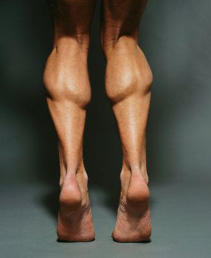
Some people love their calves, while others hate them. Ever see people piling on the weight at the gym (barbells, seated calf press machine, etc.) attempting to build shapely calves? Or maybe you see people performing calf raises on a box with their feet in, straight ahead and out. The question has long been this: is there any real benefit to doing them beyond the neutral or straightforward position to get maximal activation and strength gains?
Why is this important? Well, beyond muscle tone, this question has physiological ramifications with respect to performance and rehabilitation. Consider, for example that as knee flexion angles increase, the medial gastroc becomes increasingly disadvantaged regardless of the ankle position. This suggests inherent functional differences in the muscle architecture and activation patterns of the medial and lateral heads of the gastroc.
In a study just published in the March 2011 Journal of Strength & Conditioning Research, Riemann et al. investigated the impact of all three positions on gastroc activation. They used 20 healthy subjects (10 male and 10 female) with no history of a calf injury and all had prior resistance training experience.
 Back to top