

Brian Schiff’s Blog
Injury Prevention, Sports Rehab & Performance Training Expert
 7
7
Femoroacetabular impingement (FAI) is often a hidden and misunderstood cause of hip pain. I currently work with a physician who has studied under some of the best hip arthroscopists in the US, and he is performing arthroscopic procedures to resolve hip impingement. For many years, this has likely been a source of misdiagnosed, under treated and debilitating hip pain for people.
As things advance in medicine, hip arthroscopy is expanding and allowing for easier surgical correction of these issues. However, it is not an easy surgery technically speaking. As such, finding the right surgeon (if needed) is critical to attaining a positive outcome. Who normally gets it? Unfortunately, many people are predisposed to it, much like we see the natural genetic architecture (shape) of the acromion affecting impingement in the shoulder.
If you have an overhang of the hip acetabulum (socket) or non-spherical shape of the femoral head (or both) this can compromise the joint space and injure the joint cartilage and/or labrum. Destruction can occur at a very young age. I am currently rehabbing a 19 y/o male who recently underwent hip arthroscopy to debride his labrum and smooth out the hip socket and re-shape the femoral head. He had extensive damage at an early age due to his joint architecture and shows some signs of impingement on the other side as well.
How do you know if you have hip impingement? Generally, you may have hip joint pain along the front, side or back of the hip along with stiffness or a marked loss of motion (namely internal rotation). It is common in high level athletes and active individuals. However, other things may cause hip pain as well such as iliopsoas tendonitis, low back pain, SI joint pain, groin strain, hip dysplasia, etc. so a careful history, exam and plain films are necessary to confirm the diagnosis. If suspected, an MR athrogram is usually ordered to confirm if there are labral tears present. Physicians also use an injection with anesthetic to see if the pain is truly coming from the hip joint. This may be done under fluoroscopy to ensure it is in the joint space.
Signs and symptoms of FAI may include:
- Pain with sitting
- Pain or limited squatting
- Stiffness and decreased internal rotation
- Pain with impingement testing (see picture below of hip flexion, adduction and internal rotation – examiner will move the hip into this position and marked stiffness/loss of internal rotation and pain indicates a positive test)

Conservative treatment typically involves limiting or avoiding squats, strengthening the core and hip stabilizers as well as attempting to maximize mobility of the joint. Due to the fact that by the time pain brings patients in to see the doctor there has already been marked labral and joint damage, a cautious and proactive approach to managing hip pain is warranted especially in younger active patients and athletes.
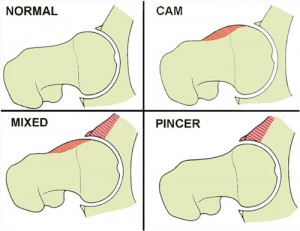
The types of lesions seen are either Cam or Pincer lesions.
Cam lesion – involves an aspherical shape of the femoral that causes abnormal contact between the ball and socket leading to impingement
Pincer lesion – involves excessive overgrowth of the acetabulum resulting in too much coverage of the femoral head and causing impingement where the labrum gets pinched
You can also see a mixed lesion where Cam and Pincer lesions are involved. FAI may lead or contribute to cartilage damage, labral tears, hyperlaxity, sports hernias, low back pain and early arthritis.
The good news is that these patients typically do well post-operatively. Dr. Philipon et al reported in 2007 in the Knee Surg Sports Traumatol Arthrosc. (click here to read the abstract) on 45 professional athletes who underwent arthroscopic management of FAI with an average follow-up of 1.6 years. In this time period 78% of them were able to return to their sport.
Following surgery, weight bearing may be restricted for the first 4 weeks or so to protect the labrum if it is repaired. With a simple debridement and re-contouring of the acetabulum, weight bearing may be initiated earlier. Avoiding twisting motions and excessive external rotation is a must in the first month or so as well. Typically, impact and twisting restrictions are lifted around 3 months post-op.
In the end, proper diagnosis and treatment is necessary to preserve the hip joint and maximize function and return to sport. If you or someone you know suffers from chronic and persistent hip pain that has failed conservative treatment, then consider getting a second look to rule out FAI.
Unearthing the cause of anterior knee pain and ridding our patients and clients of it is one of the never ending searches for the “Holy Grail” we participate in throughout training and rehab circles. I honestly believe we will never find one right answer or simple solution. However, I do think we continue to gain a better understanding of just how linked and complex the body really is when it comes to the manifestation of knee pain and movement compensations.
We used to say rehab and train the knee if the knee hurts. It was simply strengthen the VMO and stretch the hamstrings, calves and IT Band. Slowly, we began looking to the hip as well as the foot and ankle as culprits in the onset of anterior knee pain. The idea of the ankle and hip joint needing more mobility to give the knee its desired level of stability has risen up and seems to have good traction these days.
Likewise, therapists and trainers have known for some time that weak hip abductors play into increased femoral internal rotation and adduction thereby exposing the knee to harmful valgus loading. So, clam shells, band exercises and leg raises have been implemented to programs across the board.

Single Leg Resisted Hip External Rotation
As a former athlete who has tried his hand at running over the past 5 years, I have increasingly studied, practiced and analyzed the use and importance of single leg training and its impact on my performance and injuries. As I dive deeper into this paradigm, I continue to believe and see the benefits of this training methodology for all of my athletes (not just runners).
As a therapist and strength coach, it is my job to assess movement, define asymmetries and correct faulty neuromuscular movement patterns. To that end, I have developed my own assessments, taken the FMS course, and increasingly observed single leg strength, mobility, stability and power in the clients I serve. Invariably, I always find imbalances – some small and some large ones.
What are some of the most common issues I see?
Many people like to do lunges in the gym. Many people do them wrong. Some simply do not know proper form, while others have mechanical issues preventing them from executing proper form.
Unfortunately, many clients struggle to keep the knee in line with the foot, and the knee often caves inward. Even with verbal, visual and tactile cues, they may still struggle to master the proper form due to flexibility and strength imbalances. This may have to do with limited ankle mobility, but for the purposes of this post, I want to address the hip. More specifically, people often lack mobility, stability and strength in the hips.
I recently wrote two columns for PFP Magazine featuring two exercises I use to clean up lunge form:
- Torso Rotational Lunges
- Diagonal Hip Flexor Lunge Step
The torso rotational lunge is great for integrated muscle activation of the gluteus medius, while I utilize the diagonal hip flexor lunge step to address hip flexor tightness and limited thoracic spine mobility.

Torso Rotational Lunge

Diagonal Hip Flexor Lunge Step
In these columns, I specifically review regressions and progressions. So, whether you train clients or simply want to take your lunges to the next level, check out the full columns online at PFP below:
Click here for the Torso Rotational Lunges
Click here for the Diagonal Hip Flexor Lunge Step
Looking for more cutting edge training tips and rehab/injury prevention strategies? Subscribe to my members’ only Training & Sports Medicine Update available at www.BrianSchiff.com.
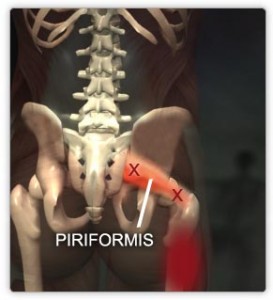
So, have you ever experienced pain in the buttock that radiates down into the thigh? Maybe even felt some numbness and tingling? Recently, I was contacted by an experienced marathoner who has been plagued by pain in the buttock and posterior thigh. He self diagnosed himself as having piriformis syndrome after doing some research on the Internet. So. what is piriformis syndrome?
Some experts debate whether it truly exists, but essentially, it involves the piriformis, a small pear shaped muscle in that helps externally rotate (turn out) the hip and the sciatic nerve which runs down the entire back of the leg and is responsible for sensation and motor movement patterns of many of the muscles in the lower leg.
It is suggested that in this syndrome the sciatic nerve essentially becomes compressed or irritated by a tight piriformis muscle. The sciatic nerve travels above, below or even through the piriformis muscle itself based on anatomical studies.
Some have even suggested that prolonged sitting with the hips turned out or sitting on a wallet can contribute to this problem. I even remember being told in PT school that it is more common in truck drivers. With that said, I think I can count on one, if not both hands the number of patients I have seen in 15 years that I truly believe had piriformis syndrome.
Now back to my runner. He began having pain in his left buttock and hamstring in late December after seeing a trigger point specialist who suggested he had a tight piriformis and did some deep tissue work on it. A short time afterward, he began having symptoms. He saw a physical therapist for 2-3 sessions and was given some stretches to do. Meanwhile, he began getting deep tissue massage focused on the area in January and February.
I think most people involved in health and fitness are up to speed on the move to address mobility and stability at the hip as an integral part of our assessments and exercise prescription. I know in my practice I see lots of issues with both a lack of hip stability and mobility.
As I learn, practice and evolve as a professional, I find myself looking for more bang for my buck with exercises. A few themes and trends in my own training include:
- Increasing emphasis on body weight exercises
- More and more single leg training
- Integrated movement patterns versus isolation
So, if you are familiar with Gray Cook and Mike Boyle (I am specifically referring to their writing and discussion on the joint by joint approach) you know that they advocate for increasing mobility at some joints and gaining stability at others. Ironically, the hip has a need for more of both depending on the movement and individual imbalances.
So, I really enjoy exercises that provide some of each and meet the trends I referenced above. I just released one such hip exercise in my “Functionally Fit” Column in PFP Magazine. I call it the RDL Hip Driver.


Click here to read the entire post with a full description of how to perform the exercise and its functional application.
 Back to top